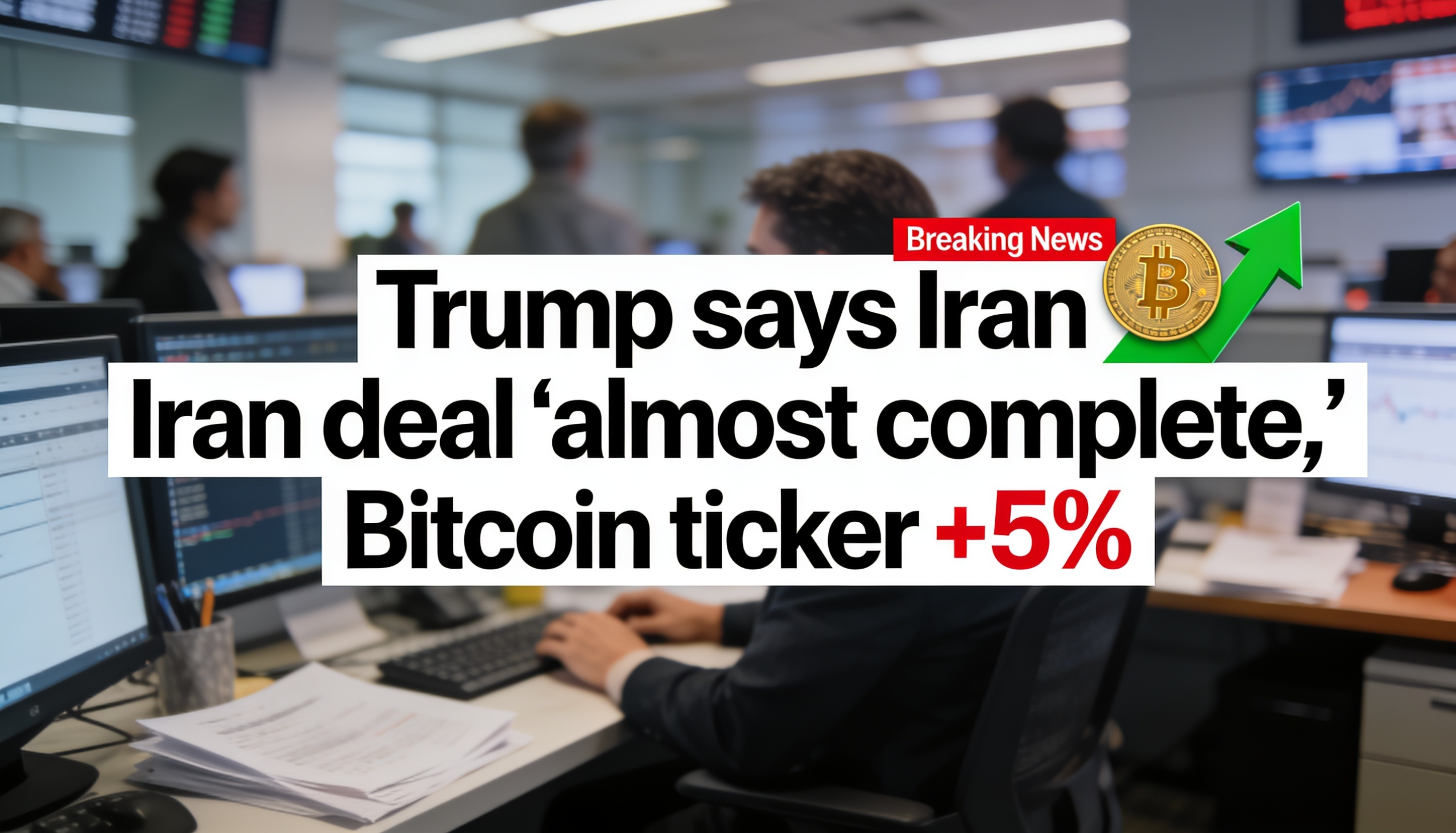
Trump Signals Breakthrough in Iran Talks, Bitcoin Responds With a 5% Spike
Here’s a full paraphrased version of your passage, rewritten for clarity, flow, and originality while keeping the meaning intact:
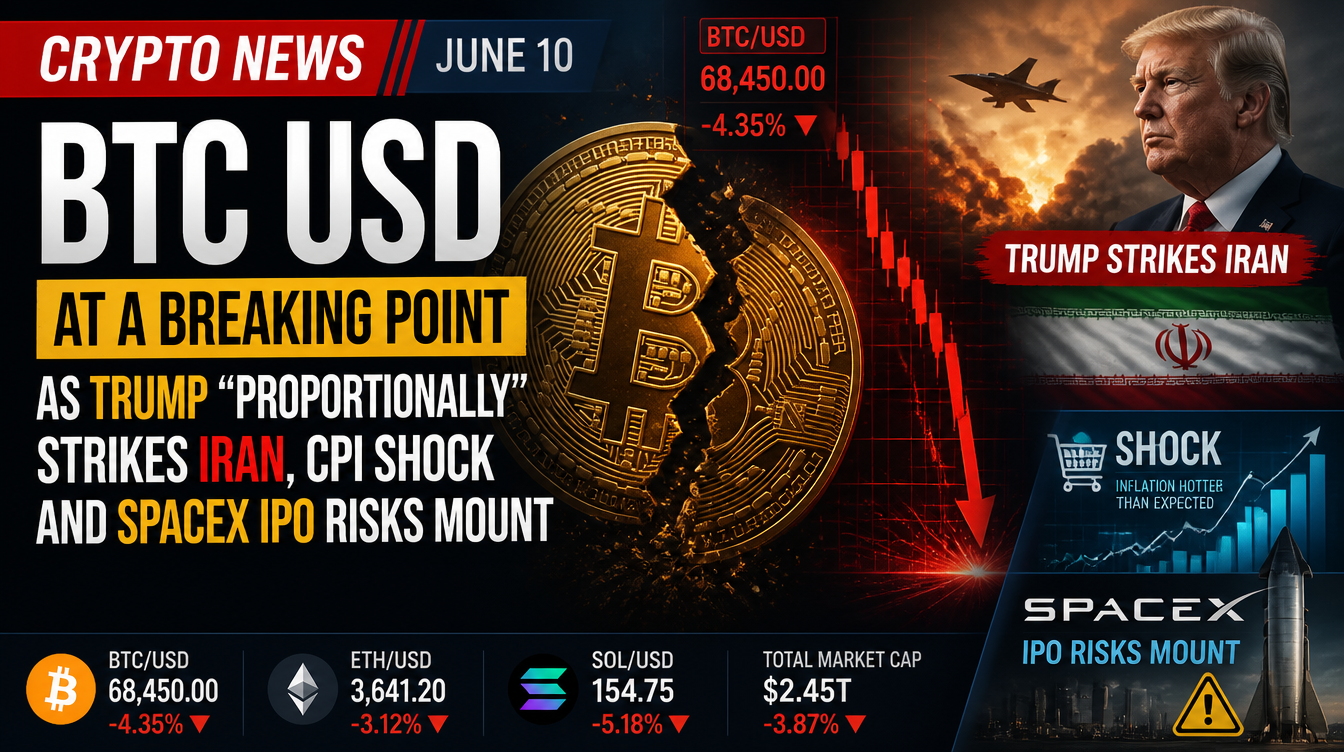
Trump’s statement that Israeli Prime Minister Benjamin Netanyahu would be left with “no choice” but to accept a U.S.-mediated agreement with Iran triggered a 5% surge in Bitcoin, briefly lifting the price to $64,000 on Sunday, June 8. It marked the strongest single-session rebound in weeks.
However, the rally quickly faded, with Bitcoin slipping back to around $63,000 within hours. This rapid retracement highlighted the limited conviction behind a move driven primarily by headline momentum rather than sustained demand.
The price jump originated from the June 5 intraday low of $59,100, which marked Bitcoin’s weakest point since February. That level has since become a key reference zone defining the lower boundary of the current trading range.
Why Iran Deal News Moved Bitcoin 5% in a Single Session
The reaction can be explained through a clear macro transmission channel. Signals of reduced tensions between the U.S. and Iran lower the perceived risk of broader regional conflict, compress the geopolitical risk premium in oil markets, and encourage a shift toward risk-taking across high-volatility assets.
Among those assets, Bitcoin tends to respond first and most aggressively due to its high liquidity and sensitivity to global risk sentiment.
This dynamic reinforces Bitcoin’s behavior not as a traditional safe-haven asset, but as a leveraged gauge of macro risk appetite. During periods of heightened fear, it typically underperforms equities, while in moments of de-escalation, it tends to outperform on the upside. The recent move followed this pattern closely.
Trump described the Iran agreement as “almost complete” and suggested an announcement could come at the start of the new week. Traders interpreted this language as more concrete than previous rounds of speculation that had persisted for months.
Earlier in 2026, Bitcoin reached highs near $77,000 amid rising expectations around U.S.–Iran negotiations. At the same time, prediction markets saw heavy activity on the probability of a deal, with each new development repeatedly triggering 3–5% price swings in Bitcoin, often within short time frames.
At the same time, geopolitical tensions had been acting as a headwind. Rising oil prices linked to the standoff added inflationary pressure and complicated the Federal Reserve’s policy outlook, with officials signaling caution about rate cuts and in some cases not ruling out further hikes.
This macro backdrop—where inflation and Fed expectations are tightly linked to geopolitical developments—had contributed to Bitcoin’s recent weakness before the rebound.
Bitcoin’s Post-Spike Price Structure
After briefly touching $64,000, Bitcoin failed to sustain the move and settled near $63,000, which now acts as near-term resistance.
The $62,500 to $63,000 range has become an important consolidation zone as the market awaits fresh macro or geopolitical catalysts.
On the downside, $59,100 remains the key support level. At that June 5 low, more than half of Bitcoin’s supply was in unrealized loss territory—a condition often associated with major market bottoms and typically followed by strong recovery moves once sentiment shifts.
The sell-off also triggered large-scale liquidations of leveraged positions, and the subsequent rebound was intensified by forced short covering.
For bullish momentum to continue, Bitcoin needs to hold above $63,000 on a daily closing basis, which would keep the recovery structure intact and open a potential retest of $64,000 resistance.
If price falls below $61,500, however, it would signal renewed weakness and increase the likelihood of another move down toward the $59,100 support zone.
Share this content: