Bitcoin Sell-Off Deepens: $2.4B Losses Push BTC into ‘Fire-Sale’ Range
Here’s a new rewrite with a more punchy, editorial/newsroom style:
Bitcoin Slides Into Fire-Sale Range as Long-Term Holders Offload at $2.4B Loss
Bitcoin has entered a sharp discount phase after long-term holders (LTHs) realized roughly $2.4 billion in losses over a 48-hour stretch ending June 5, 2026. The drop pushed price below the Short-Term Holder Realized Price (STH-RP), a critical on-chain threshold often seen as the final support line in a bullish market structure.
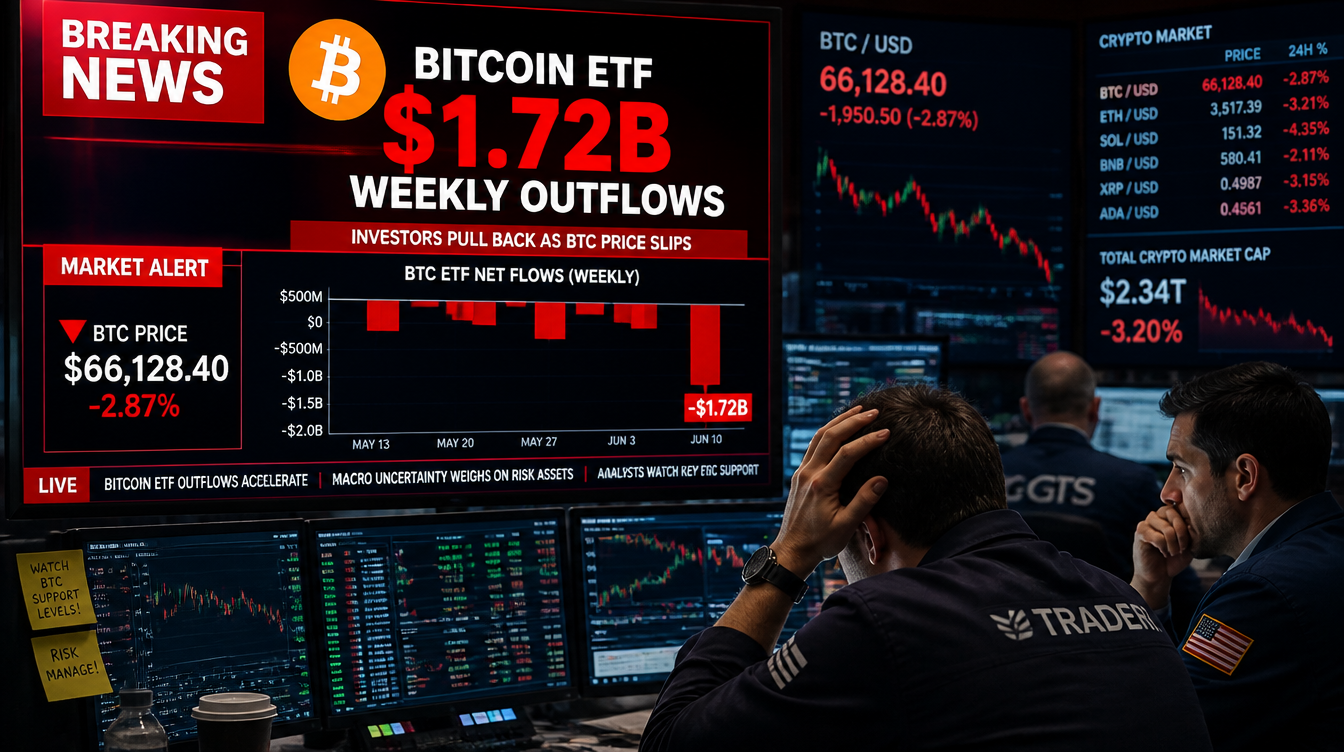
The move comes amid a wider risk-off backdrop across global markets, with more than $2 billion in long liquidations recorded in derivatives. At the same time, the Fear and Greed Index plunged to 12/100—deep in extreme fear territory, levels last seen during the COVID crash and the 2022 FTX fallout.
The conversation has now shifted. Rather than questioning the severity of the move, market participants are focused on whether this reflects a deeper loss of conviction among long-term holders or a temporary flush that could set the stage for recovery.
Capitulation Signals Emerge in On-Chain Data
On-chain indicators confirm heavy selling activity, with the Long-Term Holder SOPR (LTH-SOPR) dropping below 1.0—signaling that older coins are being sold at a loss.
This type of behavior is unusual during bull markets and has historically aligned with major market bottoms, including those seen in 2015, 2018, and 2022. Data shows that approximately 26% of recently sold Bitcoin was acquired above $90,000, highlighting a shift from accumulation to distribution among long-term investors.
CryptoQuant classifies the current phase as an on-chain capitulation event. Metrics such as the STH-RP suggest Bitcoin is trading at deep discounts within a “fire-sale” zone. While this may attract opportunistic buyers, similar conditions in previous cycles have often persisted for weeks or even months before a clear bottom emerged.
Bitcoin is now down around 30–35% from its peak—a decline that has historically shaken out late buyers without necessarily breaking the broader uptrend. However, it remains unclear whether this is simply a correction or the start of a larger reversal.
Broader Metrics Show Stress, Not Resolution
Additional indicators reinforce the idea of market stress but stop short of confirming a bottom. The MVRV Z-Score is hovering near -1.5, aligning with the $62,000–$65,000 range—a zone that has previously served as a key accumulation area.
A large share of Bitcoin supply is currently underwater, similar to conditions seen during the late-2022 capitulation. Still, this does not confirm that selling pressure has fully run its course.
Meanwhile, the Realized Cap HODL Wave shows rising activity among coins aged 1–3 months, while older holdings remain relatively stable—suggesting the market has yet to enter deeper bear market territory.
A confirmed bottom would likely require a drop in long-term holder selling, a sustained move back above the STH-RP, and stabilization in loss-held supply—none of which are evident yet.
What’s Next: Three Possible Outcomes
Bullish Scenario:
Bitcoin reclaims the STH-RP within the next 5–10 days, supported by renewed ETF inflows and easing sell pressure. Holding above $62,000–$65,000 could indicate accumulation, with upside targets between $85,000 and $92,000 in the coming months.
Neutral Scenario:
Price moves sideways between $60,000 and $68,000 for several weeks as long-term holders finish distributing. Signals would include declining realized losses and steady inflows without sharp volatility.
Bearish Scenario:
A sustained break below $60,000 could trigger another wave of selling, potentially driving price down to the $52,000–$55,000 range—marking a total drawdown of up to 50%. Warning signs would include continued ETF outflows, worsening sentiment, and further weakness in LTH-SOPR.
The key metric to watch is whether realized losses among long-term holders begin to shrink. A slowdown would suggest selling pressure is easing, while persistent losses would point to continued capitulation.
Share this content: