Institutional Investors Exit Bitcoin ETFs With $1.72B Outflow — Bottom or More Pain Ahead?
Here’s a refined rewrite with a more concise, high-impact financial news tone:
Bitcoin ETFs Bleed $1.72B in a Week as Macro Headwinds Intensify
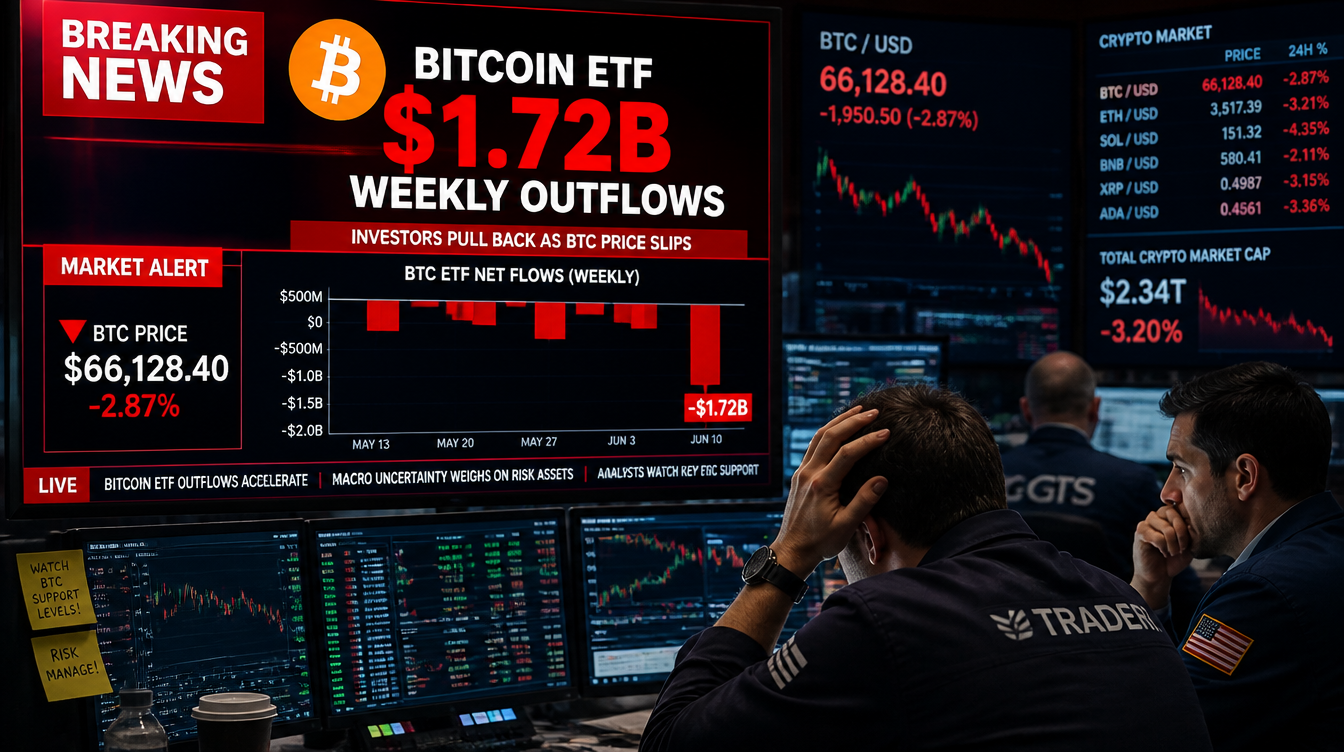
U.S. spot Bitcoin ETFs posted $1.72 billion in net outflows for the week ending June 6, 2026, marking the largest weekly redemption since April 2025. The heavy selling coincided with Bitcoin plunging nearly 18%—its worst weekly performance this year—before stabilizing with a modest 1.5% rebound to around $63,100.
The outflows reflect a convergence of macroeconomic and geopolitical pressures. Rising tensions between Iran and Israel drove oil prices up more than 5%, while a stronger-than-expected U.S. jobs report reinforced expectations of prolonged Federal Reserve tightening. At the same time, institutional capital has continued to rotate into AI-driven equities, reducing crypto exposure across diversified portfolios.
The focus has now shifted from the size of the outflows to their implications—whether the current selling wave is nearing exhaustion or signaling a deeper reassessment of Bitcoin’s role in institutional portfolios.
ETF Flows and Macro Drivers: Reading Between the Lines
Data from SoSoValue shows the $1.72 billion outflow extends a four-week streak, with cumulative withdrawals now reaching $5.4 billion. This has pushed total spot Bitcoin ETF assets under management down from approximately $104 billion to $94 billion.
BlackRock’s IBIT accounted for a significant share of the selling, recording $440.3 million of the $483.8 million in outflows on June 1 alone. As the leading institutional gateway into Bitcoin since early 2024, IBIT’s flows are widely viewed as a key barometer of large-scale investor sentiment.
Macro conditions remain the dominant catalyst. Elevated Treasury yields, persistent inflation concerns, and diminishing expectations for near-term rate cuts have reduced the appeal of non-yielding assets like Bitcoin. As the opportunity cost rises, institutions have increasingly used ETFs to scale back exposure.
Friday’s strong nonfarm payrolls data further strengthened the “higher-for-longer” rate outlook, adding pressure on crypto markets.
Analysts at Galaxy Research suggest the outflow trend reflects a broader portfolio reallocation rather than temporary positioning, indicating a more structural shift in institutional behavior.
Meanwhile, continued inflows into AI-focused equities—such as Nvidia, Marvell, and Micron—have provided alternative high-growth opportunities, reinforcing the rotation away from crypto. This dynamic, coupled with elevated yields, has remained a persistent headwind for Bitcoin throughout the current outflow cycle.
Share this content: