Ethereum Eyes Major Privacy Shift as pERC-20 Targets Default Private Transfers
Ethereum News: pERC-20 Proposal Pushes Privacy by Default for Token Transfers
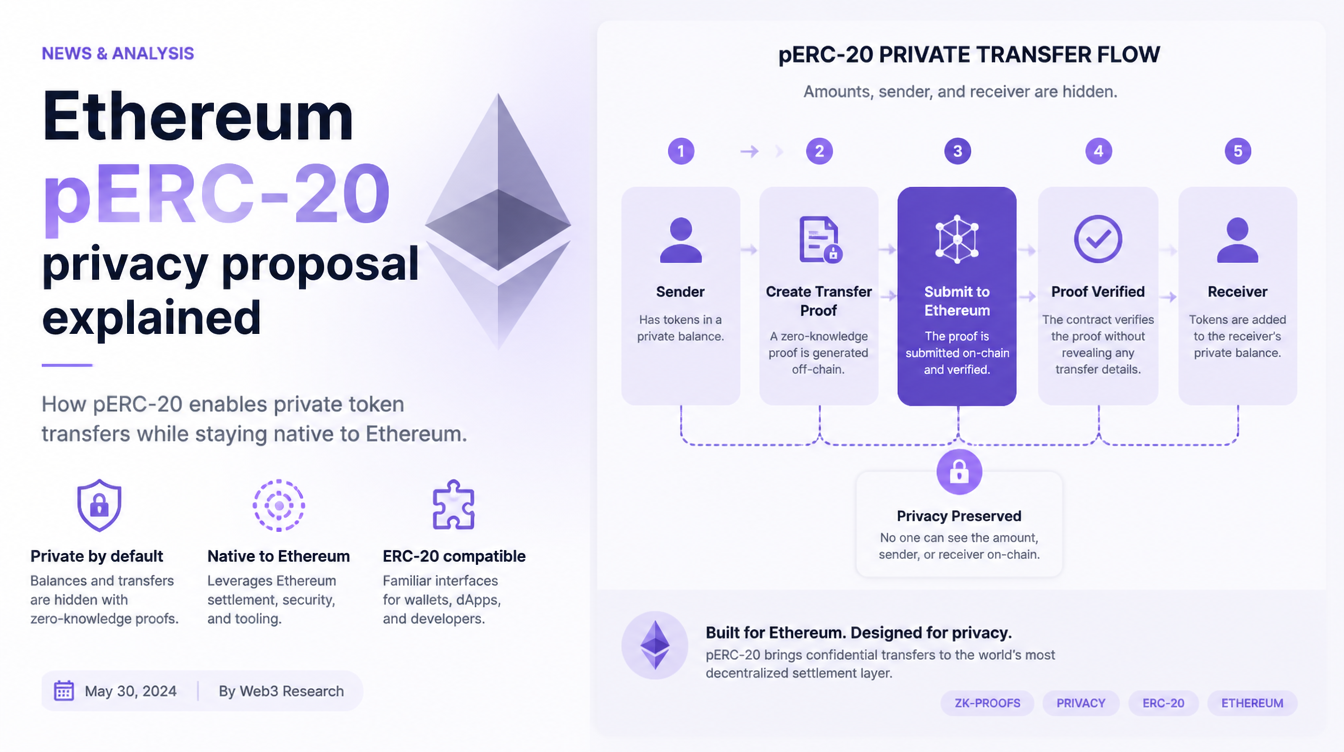
A draft Ethereum token standard known as pERC-20 (ERC-7605) proposes a major overhaul of token design by enabling private-by-default transfers. The system integrates zero-knowledge proofs directly into the token contract to obscure balances, transaction amounts, and counterparties.
Rather than serving as an add-on privacy layer for ERC-20, pERC-20 is designed as a full replacement interface. It is built to be privacy-native throughout the entire token lifecycle, ensuring that balances are never exposed in public blockchain state.
The architecture draws heavily from Zcash-style ZK-UTXO systems, including Groth16 proofing and Orchard-inspired note commitments, and adapts them for Ethereum’s EVM environment. It is designed to remain compatible with existing wallets like MetaMask and does not require new precompiled contracts or specialized infrastructure.
Under this model, tokens exist as encrypted cryptographic notes instead of public account balances.
The proposal also introduces a compliance-aware blacklist mechanism, signaling an attempt to balance privacy with regulatory requirements rather than pursuing full anonymity.
Ethereum News: How pERC-20 Replaces ERC-20’s Account Model
Under ERC-20, token balances are fully transparent and can be queried at any time using functions like balanceOf, revealing holdings and transaction history for any address.
pERC-20 eliminates these account-based primitives entirely.
Instead of relying on balanceOf, approve, or transferFrom, the new standard proposes a simplified interface built around mint, burn, and transfer operations. Each transaction must be validated through zero-knowledge proofs.
The system follows a UTXO-like, note-based structure similar to Zcash’s Orchard model. Rather than residing in wallet balances, tokens exist as encrypted notes tied to cryptographic keys, each representing a specific amount and usable only once.
Ownership is verified through standard ECDSA signatures, allowing seamless compatibility with EVM wallets without requiring additional tooling or hardware.
Transaction validity is enforced using Groth16 zero-knowledge proofs, enabling verification of correctness—such as matching inputs and outputs and valid ownership—without revealing sensitive details.
Poseidon hash commitments are used for efficient note construction, while spent-note tracking is optimized to avoid long-term state bloat that impacted earlier privacy designs.
A key limitation remains: while transaction amounts are hidden, the network graph is still partially visible. Wallet interactions can still be observed, meaning full transactional privacy is not achieved.
Status and Next Steps
pERC-20 remains a draft proposal and must pass Ethereum’s formal review process before adoption. It can also be implemented at the application layer, meaning it does not require changes to Ethereum’s base protocol.
The critical next step is whether it evolves from discussion into a stable specification with a reference implementation. If successful, Ethereum could face a foundational design shift: whether token transfers should remain fully transparent by default or move toward privacy-preserving standards as a new norm.
Share this content: