Crypto’s World Cup Play: How Kraken, Chainlink, and Chiliz Are Tapping FIFA 2026
The FIFA World Cup 2026 begins today, featuring 48 national teams, 104 matches, and 16 host cities across Canada, Mexico, and the United States. Beyond its expanded format, this edition is also being described as the most crypto-integrated World Cup to date.
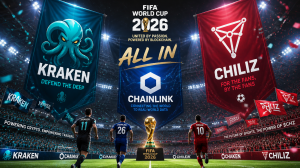
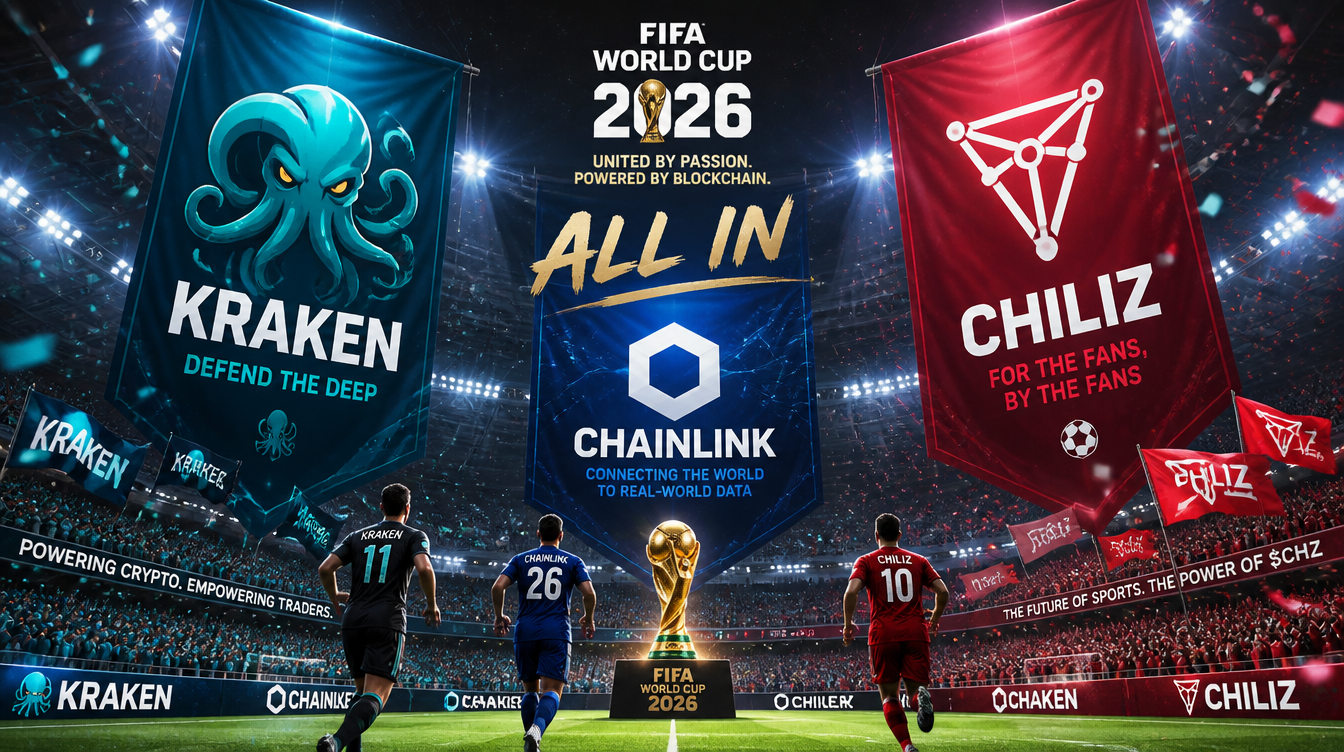
Kraken joins the tournament as the Official Crypto Exchange Supporter. Meanwhile, ADI PredictStreet is powering FIFA’s first official prediction market using Chainlink’s oracle infrastructure, and Chiliz fan tokens—now deployed on Solana and Base—are already experiencing heightened on-chain activity.
Together, these three initiatives represent an unprecedented convergence of crypto use cases within a single global sporting event.
Kraken’s FIFA Partnership and Global Reach
Kraken has secured the role of Official Crypto Exchange Supporter for FIFA World Cup 2026™, making it the only crypto exchange included in FIFA’s sponsorship lineup for this cycle.
The agreement spans fan engagement initiatives and digital experiences across North America and Europe throughout the tournament’s seven-week schedule, running from June 11 to July 19. With FIFA projecting a global audience exceeding six billion viewers, the partnership provides Kraken with one of the largest exposure opportunities in the crypto industry to date.
Operating in more than 190 countries and backed by over a decade of exchange infrastructure development, Kraken views the collaboration as a large-scale distribution opportunity that few crypto firms have ever accessed.
Co-CEO Arjun Sethi highlighted football’s unmatched global reach, noting that billions of people across every region watch the same matches simultaneously, and suggesting that financial systems should function with similar borderless efficiency.
FIFA Chief Business Officer Romy Gai pointed to shared innovation goals and technological alignment as key reasons behind the partnership.
The deal adds to Kraken’s growing sports portfolio, which includes partnerships with clubs such as Tottenham Hotspur FC, Atlético de Madrid, RB Leipzig, and the Williams Racing Formula 1 team. However, none of these engagements match the global visibility of the World Cup.
At the same time, Kraken remains positioned within FIFA’s Supporter tier, below top-level Global Partners like Adidas, Coca-Cola, Visa, and Hyundai-Kia. No crypto exchange has yet reached FIFA’s highest sponsorship category, a structural limitation that still separates crypto from traditional global brands.
Chainlink Powers FIFA’s First Prediction Market
A major innovation in this tournament comes from ADI PredictStreet, which is running FIFA’s first official World Cup prediction market, built on Chainlink’s oracle infrastructure.
The system works by using Chainlink oracles to retrieve verified match outcomes from trusted data providers. These results are then delivered on-chain through the Chainlink Runtime Environment, enabling automatic settlement of prediction markets without the need for manual intervention or centralized control.
This design marks a key difference from conventional prediction platforms, where outcomes are typically resolved by the platform operator rather than through decentralized infrastructure.
ADI PredictStreet CEO Dimitrios Psarrakis said Chainlink was selected for its ability to deliver transparent, scalable, and reliable settlement mechanisms. Chainlink Labs Chief Business Officer Johann Eid described the integration as a step toward transforming prediction markets into a mainstream fan engagement layer rather than a niche crypto product.
A Multi-Layer Crypto Presence at FIFA 2026
Taken together, FIFA World Cup 2026 showcases five distinct crypto sectors operating simultaneously within one global event: Kraken representing exchanges, Chainlink providing oracle infrastructure, ADI PredictStreet enabling prediction markets, Chiliz driving fan token engagement, and Avalanche supporting blockchain-based ticketing.
This level of multi-chain, multi-use-case integration has never been seen at a previous World Cup.
By comparison, FIFA World Cup 2022 in Qatar featured a more limited blockchain presence, primarily through Algorand, which handled NFT and digital wallet initiatives before much of the program was scaled back during the broader crypto market downturn.
The 2026 edition reflects a more diversified model, with multiple independent companies and blockchain networks contributing separate layers of functionality rather than relying on a single partner to represent the entire sector.
However, a structural ceiling remains in place. While crypto projects now span several operational categories within FIFA’s ecosystem, none have yet reached the organization’s elite Global Partner tier alongside brands such as Visa, Coca-Cola, and Adidas.
Whether that changes ahead of the 2030 World Cup may depend on how successfully these integrations perform during this tournament’s seven-week run. The coming weeks effectively serve as a live test case for whether crypto can justify a larger role at football’s highest commercial level.
Share this content: