Tokenized Finance Expands as Citi Debuts Platform for Private Shares
Citi News: Citigroup Launches Tokenized Private Equity Trading Platform
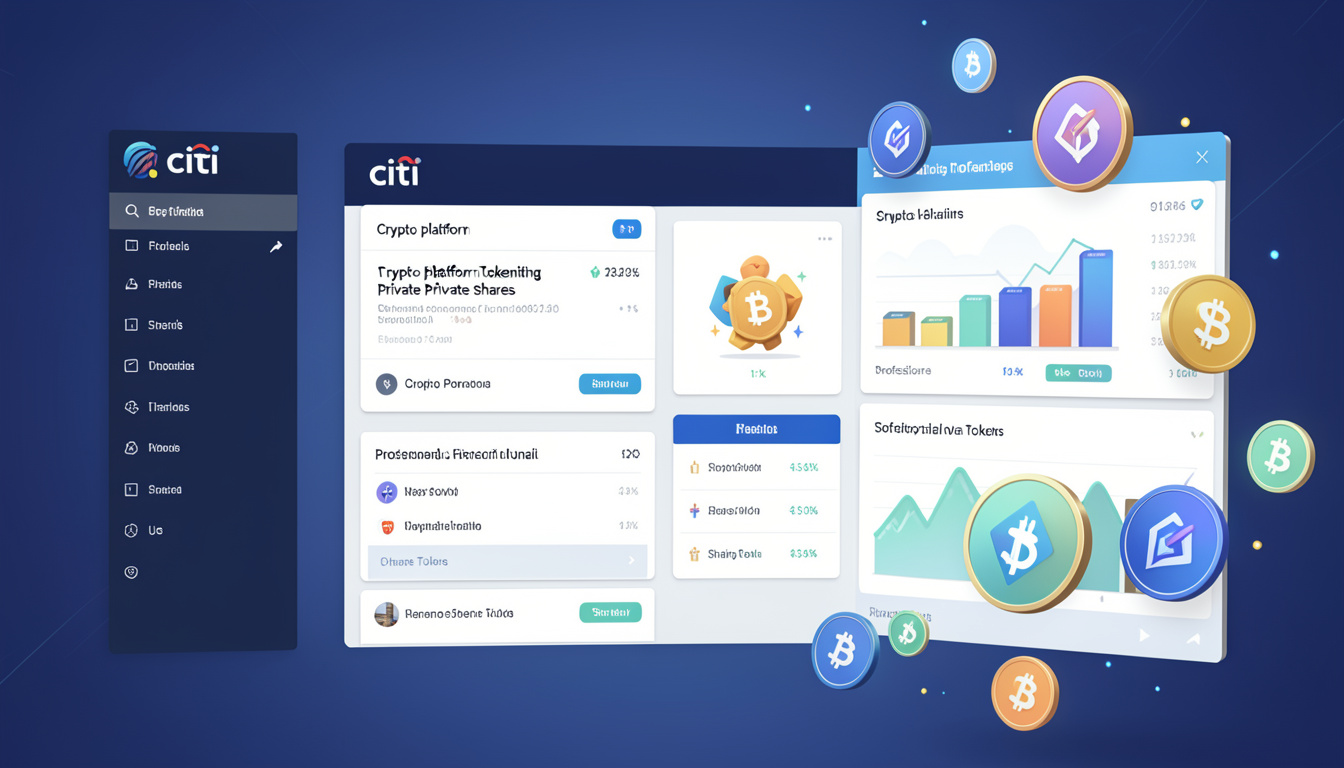
Citigroup has unveiled a new crypto infrastructure platform that will tokenize and enable trading of late-stage private company shares for institutional and qualified investors. The initiative is being developed alongside SDX, the digital asset division of the SIX Swiss Exchange, and is built on a permissioned distributed ledger framework.
In this model, Citi acts as both custodian and tokenization agent, issuing regulated tokenized depositary receipts backed by underlying private company shares held within traditional financial institutions. The bank is already in discussions with several major private firms that could participate in the platform.
The rollout will begin with access restricted to non-U.S. investors, with expansion into the United States planned later depending on regulatory approval. The focus is the estimated $75 billion late-stage pre-IPO market, which has expanded as companies like SpaceX and Anthropic delay public listings, limiting institutional access to secondary liquidity.
Citi Infrastructure: SDX and R3 Corda Enable Permissioned Tokenization
The platform is powered by R3’s Corda distributed ledger technology, operating through SDX’s central securities depository within the SIX Group ecosystem. Rather than relying on public blockchain networks, the system is designed as a permissioned, regulated infrastructure tailored for institutional-grade custody, compliance, and settlement.
Citi issues tokenized depositary receipts while holding the underlying securities as custodian. Initial distribution will be carried out via Sygnum Bank in Switzerland and SBI Digital Markets in Singapore, targeting institutional and eligible investors across Europe and Asia.
Citi executives describe the experience as enabling private company equity to exist alongside traditional listed assets such as Apple, effectively unifying access to public and private markets within a single investment environment.
The system also aims to modernize private market trading, which is typically slow, manual, and reliant on fragmented cap table management. With SDX-based tokenization, Citi claims settlement can be executed much faster, approaching near real-time processing.
Tokenization Market Outlook: Citi Targets Multi-Trillion-Dollar Shift
Citi’s Tokenization 2030 report estimates that tokenized real-world assets could reach $5.5 trillion by 2030, up from roughly $17 billion today. Growth is expected to be led by private equity, real estate, and money market funds, with forecasts ranging between $2.7 trillion and $8.2 trillion depending on regulatory progress.
Although institutional sentiment has varied in the short term, major financial institutions continue building infrastructure, signaling long-term confidence in tokenization as a structural shift rather than a passing trend.
Competition is also intensifying across traditional finance. JPMorgan, Bank of America, and Citi are collaborating on a tokenized deposit network through The Clearing House, expected to launch around 2027 to compete with stablecoin-based settlement systems. The New York Stock Exchange is developing its own tokenized securities platform for late 2026, while the DTCC has already begun limited live production testing.
Taken together, these developments show that tokenization is moving from experimentation into production-scale financial infrastructure. Citi’s SDX-powered platform positions the bank directly within this emerging ecosystem, particularly as demand grows for private market exposure amid delayed IPO pipelines and shifting institutional capital allocation.
Share this content: