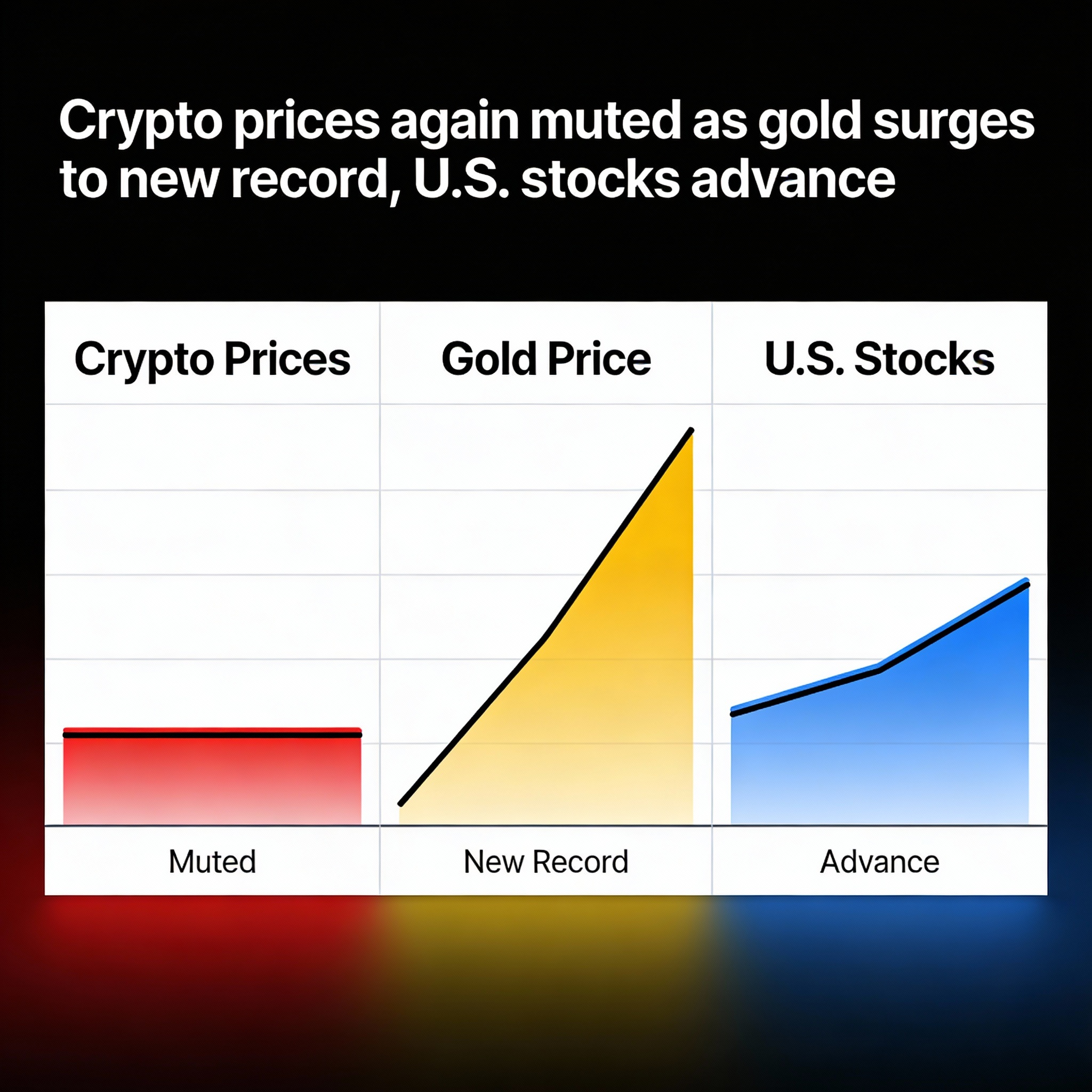
Crypto markets remain restrained as gold reaches a new peak and Wall Street gains.
Bitcoin briefly reclaimed the $90,000 handle ahead of the U.S. market open but failed to sustain the move, drifting lower as broader risk assets extended gains during the American session.
Crypto markets stayed subdued, with bullish momentum limited as investors continued to favor the debasement trade in traditional assets. Gold led the charge on Monday, jumping 2% to a new record high of $4,475 an ounce. Silver added 1.6% and earlier notched its own all-time high just below $70 an ounce.
By early afternoon in New York, the Nasdaq and S&P 500 were each higher by roughly 0.6%, while the U.S. dollar index slipped 0.3%.
After pushing above $90,000 during Asian and European hours, bitcoin (BTC) retreated toward the $89,000 area. Although still higher on a 24-hour basis, it continued to underperform most major asset classes. Ether (ETH), Solana (SOL) and XRP also traded in the green but pulled back from highs set before U.S. markets opened.
AI-linked crypto stocks outperform
Crypto-related equities with exposure to AI infrastructure and high-performance computing led gains. Sentiment was boosted by Alphabet’s agreement to acquire AI infrastructure startup Intersect for $4.75 billion, a move the company said would speed the rollout of data center capacity while accelerating energy development and innovation.
Hut 8 (HUT) jumped 17.5% to lead the group, while IREN (IREN), Cipher Mining (CIFR) and Bitfarms (BITF) rose between 5% and 10%.
Elsewhere in the sector, Circle (CRCL), Coinbase (COIN), Bullish (BLSH) and Galaxy Digital (GLXY) advanced 2%–4%, while bitcoin treasury proxy Strategy (MSTR) was little changed, up about 0.3%.
Precious metals still dominate
Analysts at ByteTree said bitcoin and the broader crypto market are unlikely to take the spotlight until the powerful rally in precious metals cools.
While bitcoin has outperformed metals over the longer term, the firm noted that silver’s parabolic advance has now nearly matched BTC’s cumulative return over the past eight years.
Share this content:


