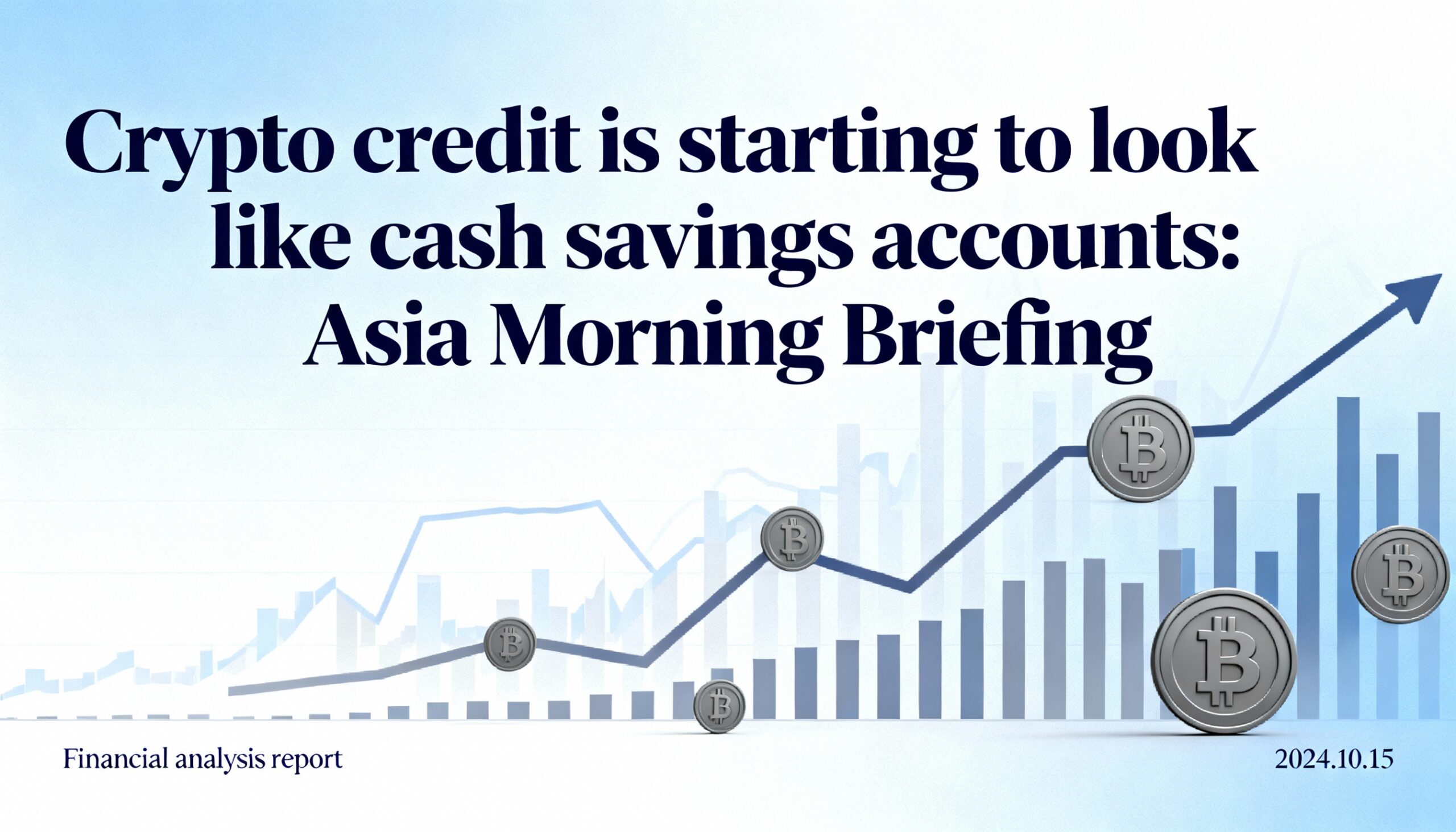
Crypto credit is increasingly mirroring cash savings products: Asia Morning Briefing
Crypto credit markets are increasingly behaving like traditional cash-management systems, with deeper liquidity keeping volatility subdued even as demand reaches record levels, according to market maker Flowdesk.
In its 2025 crypto credit outlook, Flowdesk says the era of easy yield has ended for structural reasons rather than cyclical ones. Yields across staking, stablecoin lending, and bitcoin-backed credit have compressed not because activity has slowed, but because liquidity has deepened and arbitrage has tightened.
Flowdesk notes that participation has expanded across onchain money markets, derivatives funding, and futures basis trades. The broader capital base has reduced volatility and flattened returns, even as usage climbed to new highs.
Onchain data reflects the shift. Ether staking yields have settled around 2.5%, well below the double-digit levels seen in earlier cycles, despite total value locked nearing $30 billion. Stablecoin lending followed a similar path. Borrow demand for USDC hit record highs in 2025, but an even larger increase in supply kept rates anchored at lower levels. According to Flowdesk, the balance between heavy demand and abundant liquidity has muted volatility rather than amplifying it.
Derivatives markets reinforce the picture. Perpetual funding rates rarely moved into euphoric territory even as prices reached new highs, while futures basis spreads remained tight as traders increasingly favored delta-neutral strategies over directional bets. The result has been a flatter yield curve across crypto markets, with fewer pricing dislocations available to exploit.
Bitcoin-backed lending shows the downstream effects. BTC’s liquidity and collateral profile have drawn in a wider range of lenders, including traditional financial institutions, turning what was once a bespoke trade into a more standardized balance-sheet business. As more desks competed for the same borrowers, margins narrowed, loan-to-value ratios tightened, and excess returns diminished.
Flowdesk concludes that crypto credit is now functioning more like a mature financial system. Returns from ETH staking and USDC lending increasingly cluster in the mid-single-digit range, comparable to money market funds, savings accounts, and short-dated U.S. Treasuries. Deeper liquidity, tighter arbitrage, and broader participation have transformed core yield products into infrastructure rather than sources of alpha.
With baseline yield now crowded and efficient, Flowdesk argues that the next opportunities will come from more complex structures, including bespoke credit arrangements, altcoin-backed lending, and hybrid on- and offchain products, often grouped under the label CeDeFi.
Market movement
- Bitcoin (BTC): Bitcoin was little changed at the start of Asian trading, edging down about 0.3% to roughly $91,000, while remaining nearly 4% higher over the past week.
- Ether (ETH): Ether slipped around 0.4% to about $3,150, paring gains after rising more than 6% over the past week.
- Gold: Gold remained under technical selling pressure despite a weaker-than-expected U.S. private payrolls report showing 41,000 jobs added in December. Spot prices fell 1.26% to roughly $4,436 an ounce, as steady wage growth muted the data’s market impact.
Share this content: