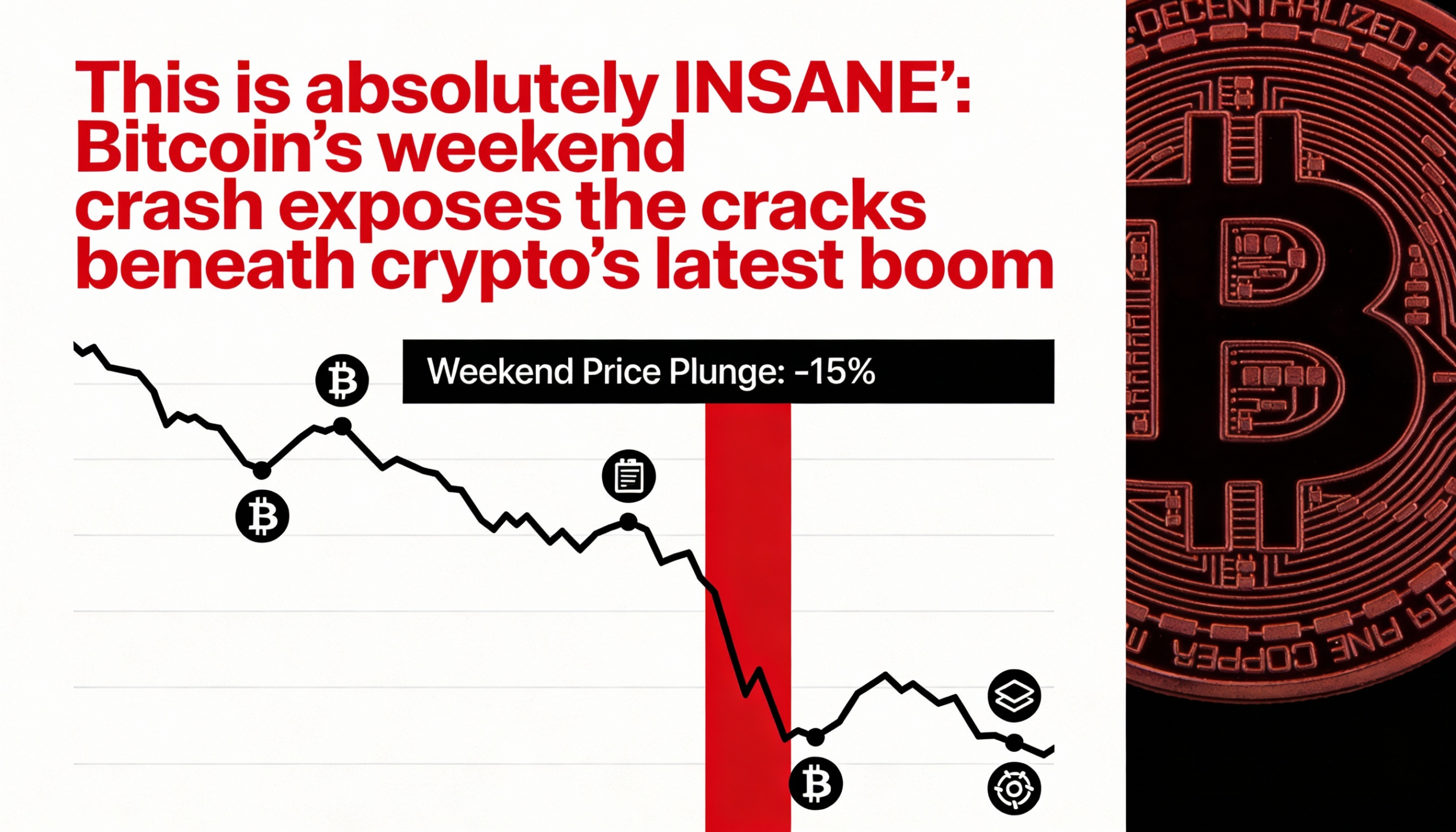
“Completely unbelievable”: The weekend crash in Bitcoin lays bare the vulnerabilities behind crypto’s rally
Bitcoin Dives to $77K as Crypto Markets Enter “Extreme Fear” Mode
Bitcoin’s dramatic weekend drop has shaken the crypto market. The flagship digital asset tumbled past $80,000, briefly touching $77,000, levels not seen since April 2025. In total, bitcoin has lost $800 billion in market value since its October peak of $126,000, with $2.5 billion in leveraged long positions liquidated in 24 hours.
The plunge has pushed bitcoin out of the global top 10 assets, now trailing institutional giants like Tesla and Saudi Aramco. Panic is spreading across social media, and the selloff isn’t limited to crypto—tech stocks and precious metals have also taken a hit.
Here’s what’s driving the sudden shift to Extreme Fear.
1. Geopolitical Tensions Trigger Liquidity Sell-Off
Reports of a potential U.S.–Iran military escalation on Saturday rattled risk appetite. Traders didn’t see bitcoin as a safe haven—they used it as a liquidity source.
In times of crisis, capital typically flows to the U.S. dollar. Bitcoin, trading around the clock, often acts as the market’s “first responder.” With liquidity still fragile since the October 10 crash, the weekend selloff accelerated rapidly.
2. Gold and Silver Also Suffer
Crypto wasn’t alone. Gold fell 9% to $4,900, and silver dropped a historic 26% to $85.30. Analysts link this to a surging U.S. dollar, driven by Kevin Warsh’s nomination to lead the Federal Reserve, pricing dollar-denominated metals out of reach for international buyers.
By Sunday, gold and silver staged minor recoveries—trading at $4,730 and $81, respectively.
3. Liquidation Cascade
The geopolitical shock hit a market already strained by political uncertainty. As prices fell, automatic liquidations triggered a domino effect, wiping out nearly $2.5 billion in long positions. Roughly 200,000 traders saw their accounts blown out Saturday alone.
Michael Saylor’s Market Impact
Bitcoin briefly fell below Michael Saylor’s MSTR average entry of ~$76,037, stoking fears of forced sales. While none of his coins are pledged as collateral, the market reacted to reduced buying power, intensifying the selloff.
Wall Street Feels the Ripple
The selloff is spilling into traditional markets. Sunday evening U.S. futures showed declines across the board: Nasdaq down 1%, S&P 500 off 0.6%.
Retail Capitulation vs. Whale Accumulation
Wallet data shows small investors (less than 10 BTC) selling aggressively after a 35% drop from the $126,000 high. Meanwhile, mega-whales (1,000+ BTC) quietly added to their holdings, absorbing retail panic but insufficient to lift prices.
Bigger Picture: Cycles of Boom and Bust
Despite the turmoil, crypto markets have matured. Institutional adoption is growing through ETFs, stablecoins, and public crypto companies. Regulatory frameworks are expanding, making the market more accessible than ever.
Yet human behavior hasn’t changed. Speculative bubbles, panic selling, and boom-bust cycles continue. If history repeats, bitcoin could fall 80% from the October peak, reaching $25,000, potentially clearing the market for the next sustained bull run.
As Warren Buffett famously said: “It’s only when the tide goes out that you discover who’s been swimming naked.” The tide may not be fully out yet—but warning signs are everywhere.
Share this content: