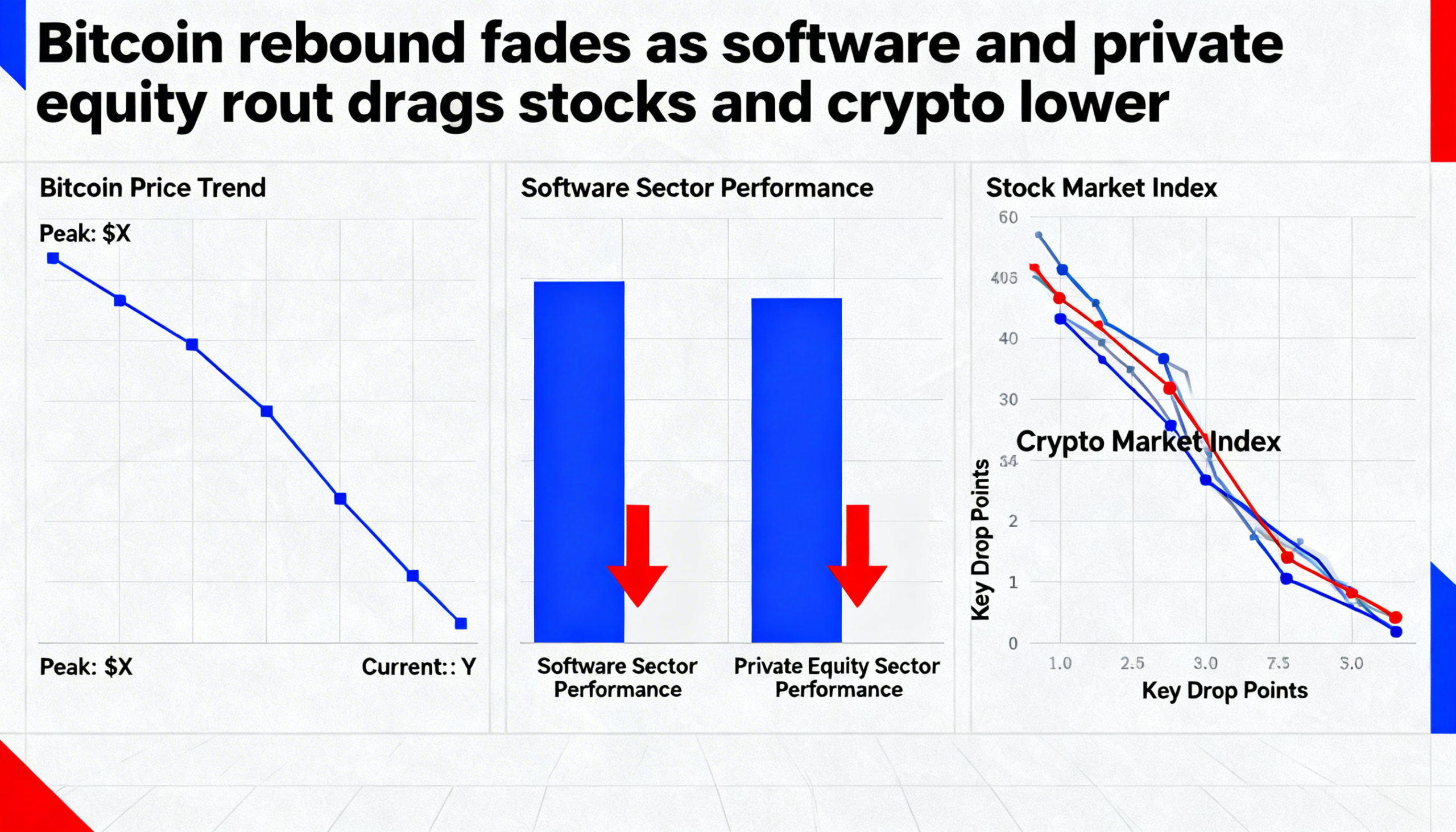
Bitcoin’s rebound loses steam as a selloff in software and private equity pulls stocks and crypto markets lower.
Crypto markets extended their slide Monday as digital assets continued to track weakness in the software sector, with a closely watched tech ETF dropping to a fresh 52-week low.
Bitcoin staged only a brief recovery after an overnight plunge, but that rebound quickly lost momentum during U.S. morning hours as broader risk assets turned lower. By around midday on the East Coast, bitcoin was trading near $65,400, still sharply lower over the prior 24 hours following a steep selloff.
The downturn coincided with renewed pressure in U.S. equities. The S&P 500 and the Nasdaq-100 each fell more than 1%, dragged down by fresh weakness in software and private equity stocks.
The iShares Expanded Tech-Software ETF slid another 5% to a new 52-week low and is now down roughly 35% since October. Investors have grown increasingly concerned that generative AI applications could disrupt traditional software business models. Rightly or wrongly, market participants have lately treated crypto as an extension of the software trade, and bitcoin’s price action has shown an almost lockstep correlation with IGV in recent weeks.
Bearish sentiment has also been fueled by concerns that the AI boom could be inflating financial imbalances, raising the risk of a broader credit event reminiscent of the 2008 financial crisis. Those fears have been reflected in battered private equity shares, many of which have significant exposure to the software sector.
Blue Owl Capital — which recently sold assets to meet liquidity demands from investors — dropped another 3.5% on Monday and is now down roughly 32% year to date. Peers including Blackstone, Ares Management, and Apollo Global Management extended recent losses, falling between 6% and 8%.
Crypto frequently trades as a high-beta proxy for technology stocks and broader liquidity conditions, and Monday’s price action reinforced that dynamic. Although bitcoin has managed to hold above its early February lows, it remains confined to a broad $60,000 to $70,000 range as investor risk appetite stays fragile.
Adding to the cautious tone is uncertainty surrounding global trade policy after the Supreme Court of the United States limited President Donald Trump’s prior use of sweeping tariffs, according to Joel Kruger, market strategist at LMAX Group.
The ruling contributed to a classic risk-off environment, Kruger said, with investors rotating out of speculative assets. In that setting, bitcoin has behaved less like “digital gold” and more like a leveraged play on overall market risk.
Share this content: