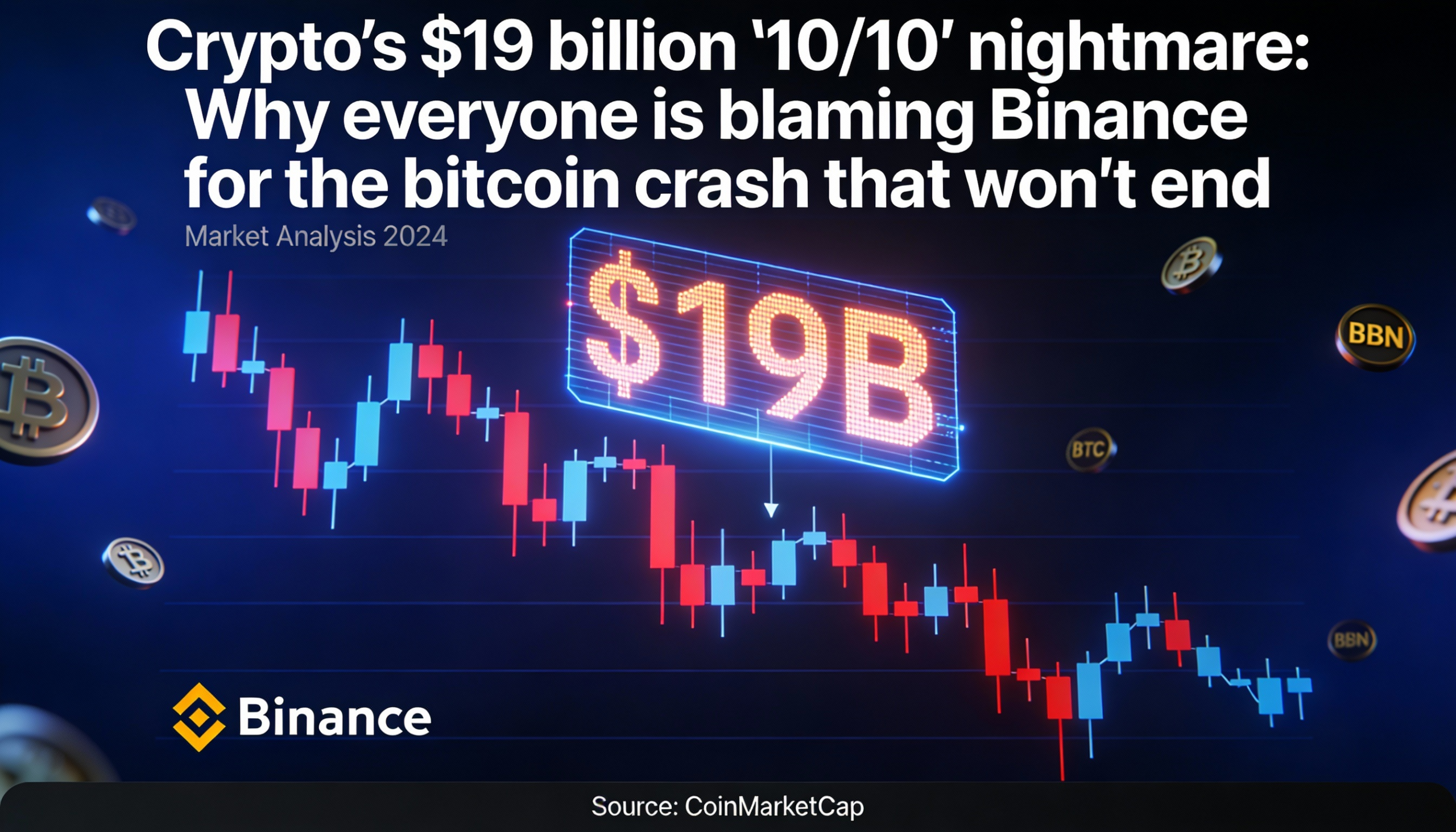
Bitcoin’s $19 billion wipeout: Why all eyes are on Binance amid the market turmoil
Months After $19 Billion Bitcoin Crash, Binance Remains in the Spotlight
Months after the Oct. 10 liquidation cascade, crypto markets are still reeling, and traders remain split over Binance’s role as Bitcoin continues its slide.
Initially, the $19 billion wipeout looked like a routine chain of forced liquidations across major exchanges as BTC dropped to roughly $79,254.20. But the scale of the sell-off—the largest single-day liquidation in crypto history—and the lack of transparency have shaken traders and reshaped market behavior.
Binance, the world’s largest crypto exchange, has become the focal point. Bitcoin fell as much as 12.5% that day, the steepest decline in 14 months, forcing leveraged positions to close. Social media has repeatedly singled out Binance, citing its size, dominance in derivatives, and opaque operations.
Binance denies any fault, attributing the crash to market conditions: macroeconomic pressure, high leverage, illiquidity, and Ethereum network congestion. Co-founder Changpeng “CZ” Zhao called claims the exchange caused the crash “far-fetched” and noted that $283 million was paid to affected users.
Critics remain unconvinced. The $19 billion figure has symbolic weight, and payouts are seen as insufficient. Ark Invest CEO Cathie Wood attributed $28 billion in deleveraging to a “Binance software glitch,” while Binance co-founder He Yi clarified the exchange does not serve U.S. users. Competitors like OXK and Hyperliquid have used the moment to highlight weaknesses and position themselves as alternatives.
Some argue Binance is a convenient scapegoat. Wintermute CEO Evgeny Gaevoy described Oct. 10 as a flash crash driven by high leverage in thin markets, not an exchange-specific failure. The deeper issue is structural: crypto remains heavily leveraged, liquidity is conditional, and market makers retreat under stress, amplifying volatility.
The transparency gap fuels speculation. Former CFTC regulator Salman Banaei urged an investigation, noting that the absence of post-mortems leaves room for rumors. Traders like Flood have suggested ongoing sell pressure from major exchanges, further eroding trust.
Ultimately, many see Oct. 10 as a warning about market structure rather than blame on a single exchange. Eric Crown, former options trader, summarized: “High leverage, low liquidity, and risky altcoins created a perfect storm—and that’s exactly what happened.”
Share this content: