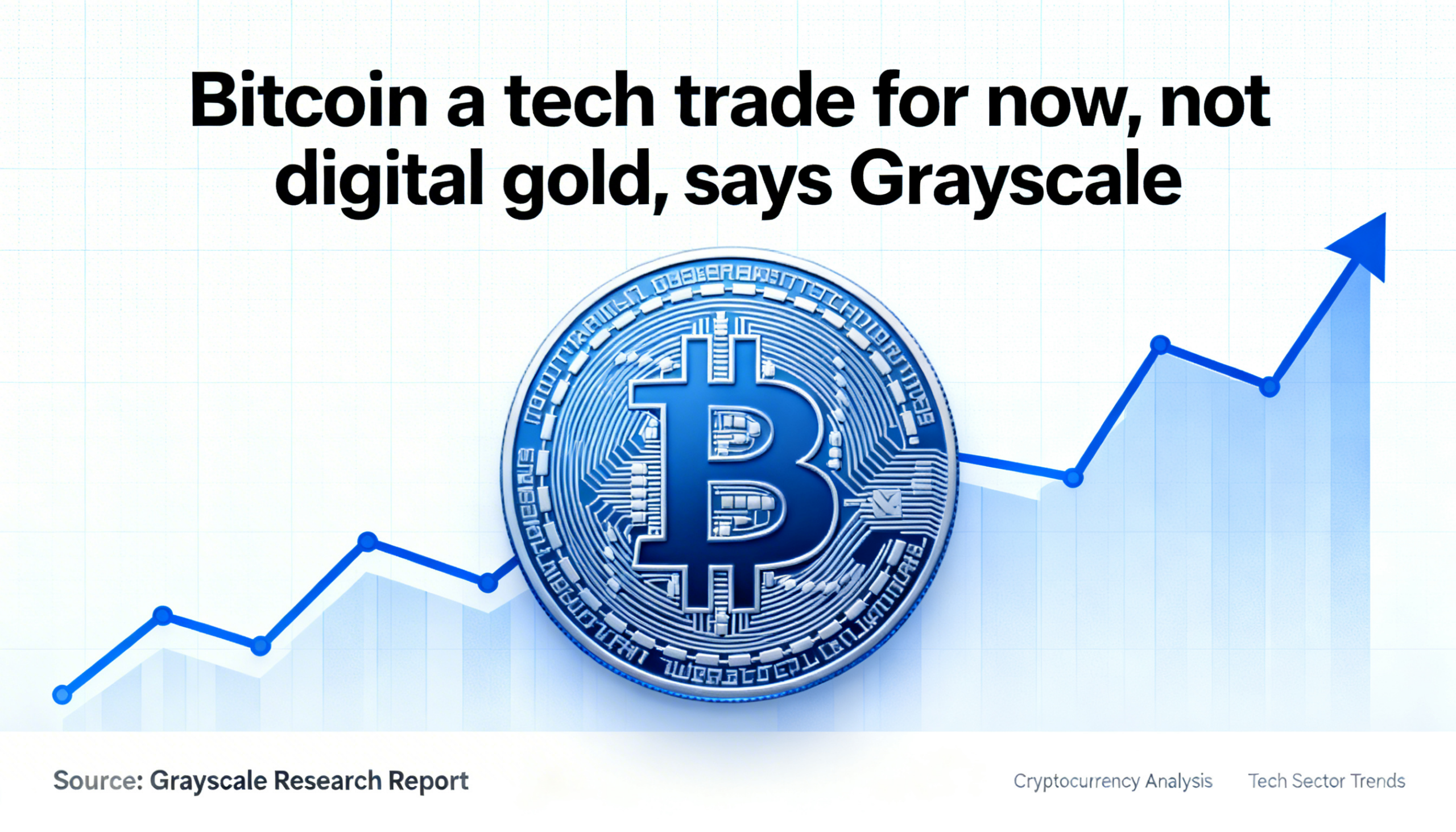
Bitcoin remains a tech-driven trade for now, not a safe-haven asset, according to Grayscale.
Bitcoin’s recent retreat toward $60,000 looked less like a failure of “digital gold” and more like a classic growth-stock pullback, according to a new report from Grayscale.
The crypto asset manager said bitcoin’s decline closely tracked weakness in high-growth technology equities, particularly software names, reinforcing the view that the cryptocurrency currently trades as a risk-sensitive tech asset rather than a defensive store of value.
Grayscale acknowledged that bitcoin’s core attributes — fixed supply, decentralization and independence from government control — underpin its long-term store-of-value thesis. But the firm emphasized that bitcoin remains early in its lifecycle. At just 17 years old, it lacks the historical track record that underpins gold’s reputation as a reliable hedge.
“Bitcoin can be considered a long-term store of value,” wrote Zach Pandl, Grayscale’s head of research, arguing that the network is likely to endure and may preserve purchasing power over time. However, he noted that near-term price behavior reflects adoption dynamics more than safe-haven demand.
In recent months, bitcoin has moved in step with broader risk assets, falling sharply as investors reduced exposure to growth trades. Meanwhile, gold has rallied to record highs, attracting capital at the same time bitcoin funds experienced outflows. That divergence has cast doubt on bitcoin’s ability — at least for now — to act as a dependable hedge during periods of market stress.
Pandl said investing in bitcoin today is fundamentally tied to belief in its long-term adoption as a global monetary asset. Until that adoption becomes more entrenched, the cryptocurrency is likely to remain sensitive to swings in market sentiment, rising alongside growth assets during risk-on phases and retreating when conditions tighten.
Market structure data supports that interpretation. Grayscale pointed to U.S.-driven selling pressure, continued outflows from spot bitcoin exchange-traded funds (ETFs), and significant deleveraging in crypto derivatives markets. These signals suggest a broader unwind of risk exposure rather than a breakdown in confidence in bitcoin’s underlying technology.
U.S.-listed spot bitcoin ETFs have seen sustained withdrawals in recent weeks, with hundreds of millions of dollars exiting amid volatility. The redemptions have weighed on total assets under management and highlight softer institutional demand during the correction.
Looking further ahead, Grayscale sees potential drivers for renewed growth. Regulatory clarity around stablecoins and tokenized assets, along with ongoing innovation in blockchain infrastructure, could accelerate broader adoption. Networks such as Ethereum and Solana, as well as infrastructure providers like Chainlink, may benefit from that next phase.
For bitcoin, long-term credibility will depend on continued technical resilience. Issues such as scalability, transaction costs and emerging technological threats — including quantum computing — remain areas to monitor. If those challenges are successfully addressed and adoption broadens, Grayscale expects volatility to decline, correlations with equities to weaken and bitcoin’s behavior to increasingly resemble that of gold, albeit in digital form.
Separately, JPMorgan has suggested that bitcoin’s relatively lower volatility compared with gold could enhance its long-term appeal, potentially making it an attractive asset allocation over time.
Share this content: