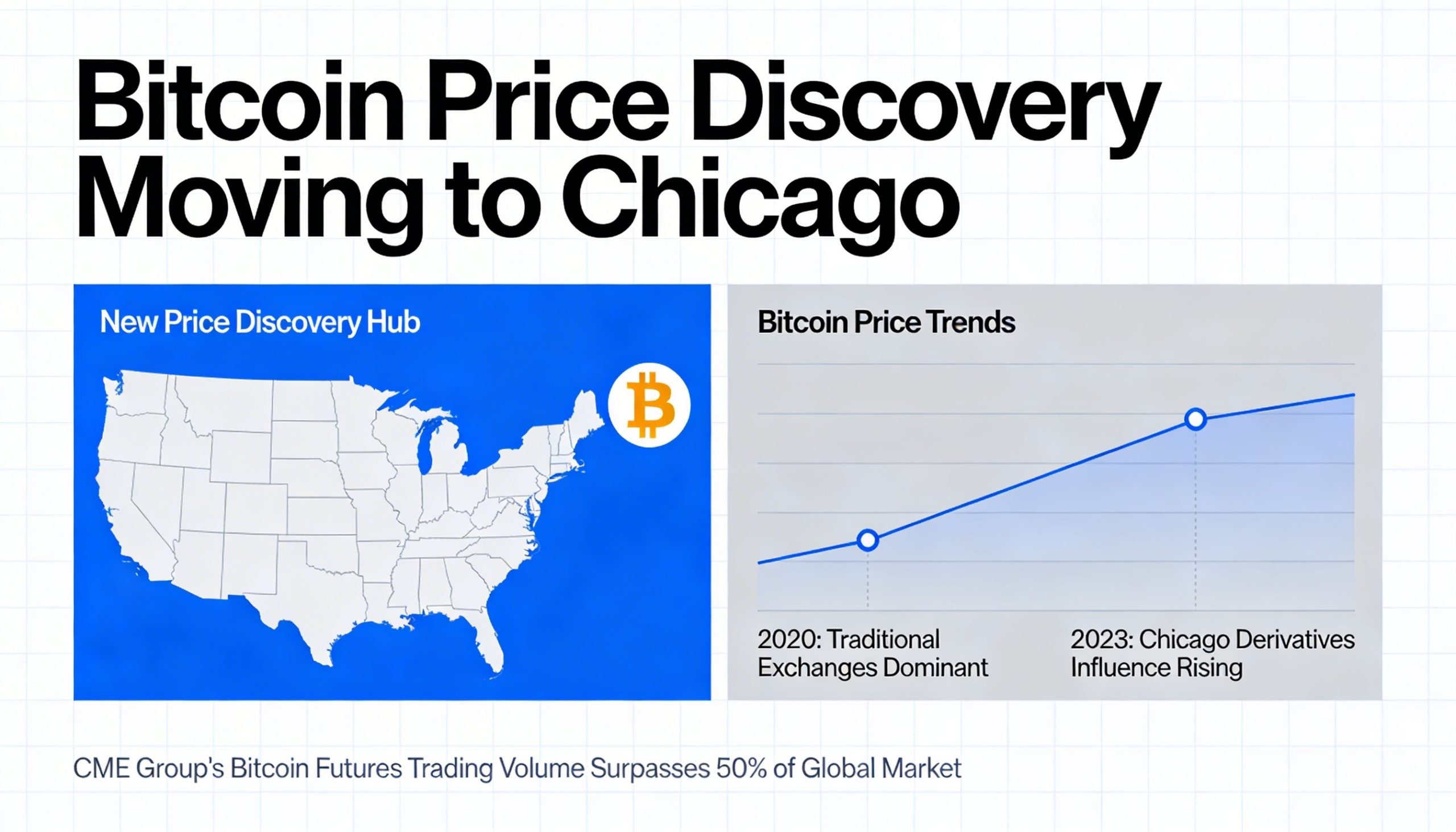
Bitcoin Price Discovery Is Shifting to Chicago
Bitcoin, long marketed as a rebellion against Wall Street, is increasingly being shaped by it.
Trading activity in bitcoin derivatives has been steadily migrating toward CME Group, and the exchange’s plan to introduce 24/7 derivatives trading later this year could further entrench its dominance in institutional crypto markets. The move effectively eliminates one of the final structural advantages held by offshore crypto exchanges: uninterrupted market access.
Karl Naim, Chief Commercial Officer at XBTO, said the change lowers the barrier for traditional hedge funds and macro managers to deepen their exposure.
“You’ll see more traditional hedge fund managers entering the space because they can trade instruments they’re already familiar with, without overhauling their infrastructure or shifting signals,” Naim told CoinDesk. “Why assume counterparty risk with an entity you don’t know?”
CME already leads regulated bitcoin futures markets by open interest, and its contracts underpin much of the hedging activity tied to U.S.-listed spot ETFs. Until now, however, CME’s weekend closure created the so-called “CME gaps,” leaving institutional investors unable to adjust positions while offshore exchanges continued trading around the clock.
With continuous trading, that limitation disappears. Institutions will be able to hedge exposure at all hours, narrowing arbitrage spreads between regulated futures and offshore perpetual swaps. As pricing discrepancies shrink, the incentive to maintain balances on crypto-native exchanges purely for weekend access diminishes.
For large allocators prioritizing regulatory oversight and established clearinghouses, CME increasingly resembles the default venue rather than an alternative.
Even executives at crypto exchanges recognize the structural shift. In January, OKX President Hong Fang argued in a CoinDesk op-ed that crypto derivatives volumes could eventually rival or exceed spot activity on major global platforms, positioning U.S.-regulated volatility markets as a central anchor for bitcoin price discovery.
Institutions Take the Lead
According to Naim, the transition reflects a broader transformation in bitcoin’s investor base. What began as retail-driven enthusiasm rooted in anti-establishment sentiment has evolved into a market increasingly steered by sovereign wealth funds, asset managers, and institutional allocators.
“Today we speak to a lot of sovereigns and institutions. They go with what they know,” Naim said, noting that many first accessed bitcoin through spot ETFs before exploring more advanced derivatives strategies.
As institutional capital accounts for a larger share of liquidity, bitcoin’s short-term price action is becoming more tightly linked to macroeconomic forces and global risk sentiment.
“If geopolitical tensions escalate — for example, if the U.S. were to attack Iran — we’d likely see broad risk-off positioning,” Naim said. “Gold rallies, equities fall, and bitcoin would likely decline as well.”
In that context, bitcoin trades less like an isolated crypto experiment and more like a macro-sensitive asset class, influenced by the same flows that move equities and commodities.
Naim acknowledged the irony. Bitcoin was conceived as a decentralized alternative to traditional finance. Yet as liquidity consolidates within regulated clearinghouses and institutional frameworks, the infrastructure supporting the asset is becoming more centralized.
Institutional capital, he noted, seeks exposure to risk assets — not operational risk.
Share this content: