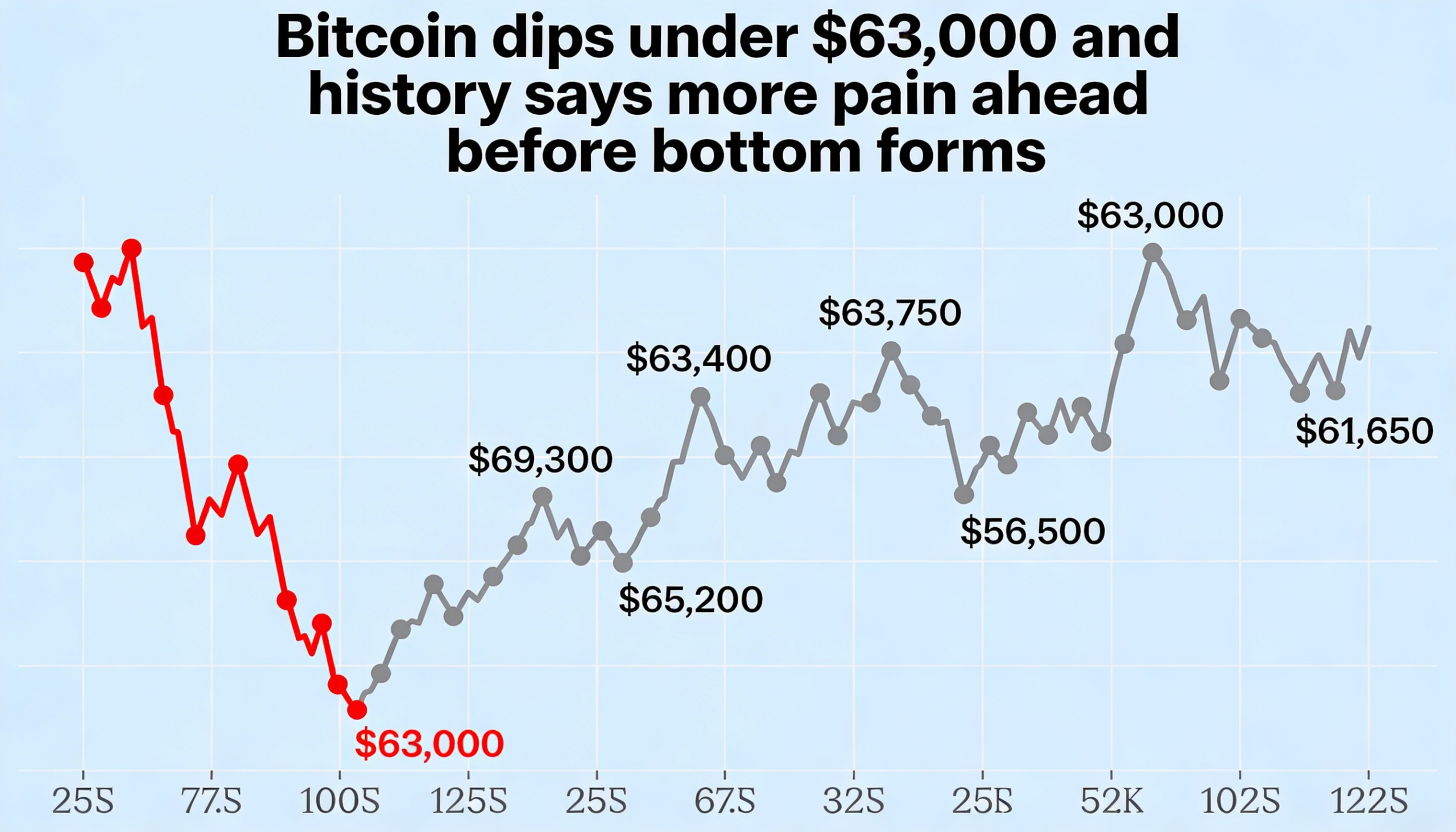
Bitcoin Falls Below $63,000, With History Suggesting Further Downside Before a Bottom
Bitcoin extended its overnight slide during Asian trading hours, briefly falling below $63,000 as renewed concerns over President Donald Trump’s tariff policy and ongoing AI-related volatility weighed on risk appetite.
The largest cryptocurrency by market value is now down nearly 7% on the week, trading at levels last seen on Feb. 6, when prices approached the $60,000 mark, according to CoinDesk data.
“Similar to equities, bitcoin has experienced a sharp pullback driven primarily by renewed tariff uncertainty, echoing the dynamics we saw in April 2025,” said Matt Howells-Barby, vice president at Kraken and host of Trading Spaces, in comments to CoinDesk. He added that escalating geopolitical tensions could add further short-term pressure on BTC.
Howells-Barby identified $60,000 as a critical support level. “If that level fails to hold, we could see an extension into the mid-to-low $50,000 range,” he said.
U.S. equities declined Monday after Trump announced plans to impose temporary 15% tariffs on imports, up from the 10% rate unveiled Friday following a decision by the Supreme Court of the United States that struck down his previous tariff strategy. At the same time, investors continued rotating out of companies perceived as vulnerable to disruption from artificial intelligence.
History Points to Potential for Deeper Losses
Longer-term technical indicators suggest the sell-off may not yet have run its course. Historically, bitcoin has tended to form major cycle bottoms only after its 50-week moving average falls below the 100-week moving average — a so-called “bear cross.” That signal marked the end of the 2018 and 2022 bear markets.
At present, however, the 50-week average remains comfortably above the 100-week average, indicating that the crossover has not yet occurred.
If historical patterns hold, bitcoin could face additional downside — potentially toward $50,000 or lower — before longer-term capitulation sets in. Several market participants speaking at Consensus Hong Kong echoed the view that further weakness cannot be ruled out.
While it may seem counterintuitive that a bearish crossover could coincide with a market bottom, moving averages are lagging indicators. They confirm trends that have already unfolded rather than predict future moves. In prior cycles, the longer-term crossover has aligned with the final stages of bear markets in bitcoin.
Still, as with any technical signal, past performance offers no guarantee of future outcomes.
Share this content: