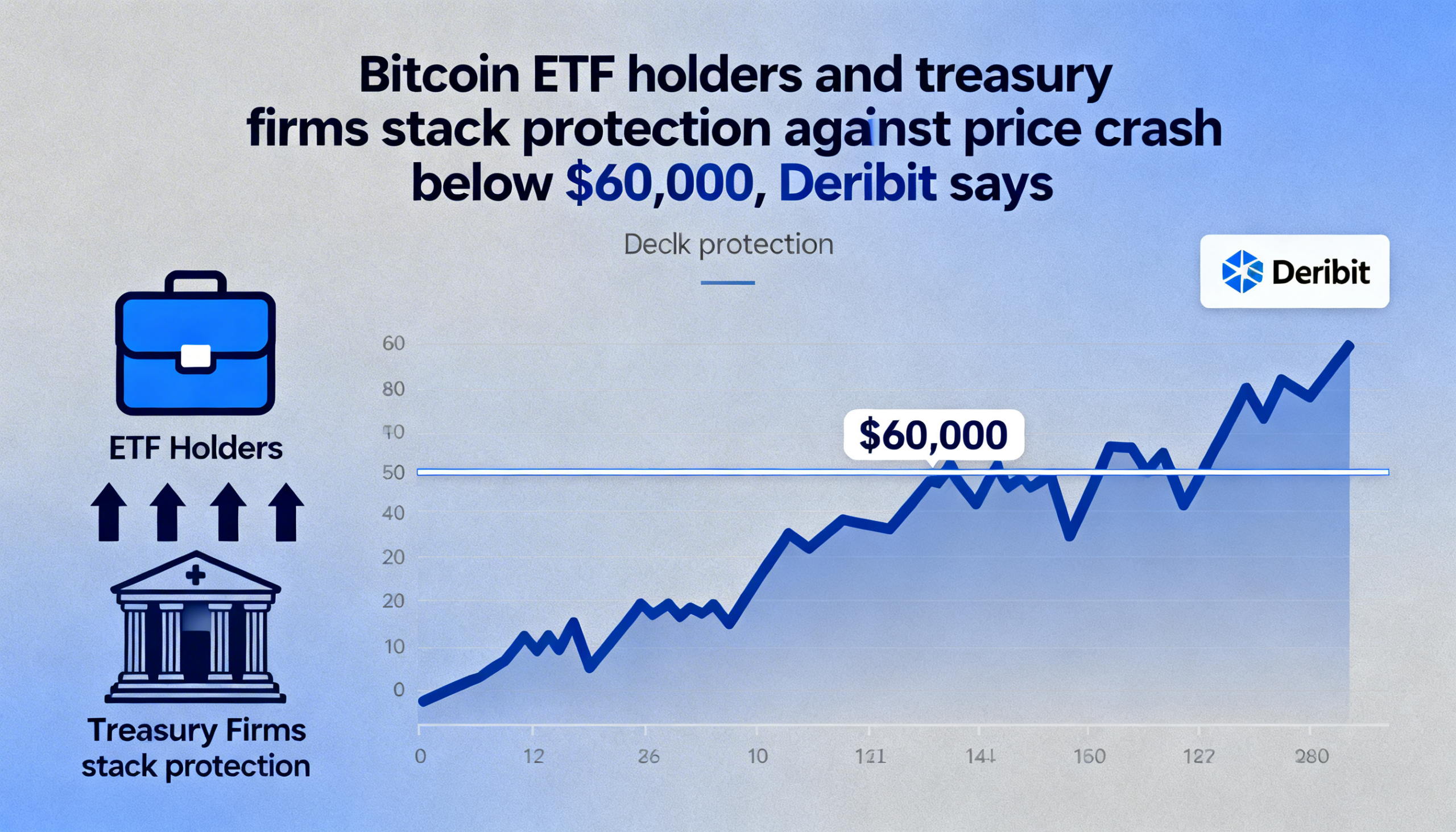
According to Deribit, Bitcoin ETF investors and treasury firms are building safeguards against a potential drop below $60,000.
Bitcoin ETF holders and corporate treasuries are increasingly buying protection against a potential price drop below $60,000, reflecting a cautious stance despite holding large positions, cryptocurrency derivatives exchange Deribit told CoinDesk.
At the time of writing, Bitcoin BTC was trading around $64,874, and investors with long-term outlooks are stacking $60,000 put options — derivative contracts that allow holders to sell Bitcoin at that strike price even if the market falls further. “ETF holders and corporate treasuries are buying six-month and one-year $60,000 puts as portfolio insurance,” said Jean-David Péquignot, Chief Commercial Officer at Deribit.
Put options act like insurance, providing a safety net for investors who continue to hold Bitcoin while hedging against steep losses. Interest in these contracts has surged: open interest in the $60,000 strike now stands at $1.5 billion, the largest across all strikes and expiries on Deribit. One contract represents one Bitcoin, and the platform accounts for nearly 80% of global crypto options activity.
The demand for longer-dated $60,000 puts signals that investors are wary of short-term rallies fizzling and are preparing for the possibility of a sharper decline. This hedging is particularly notable because ETF holders and corporate treasuries control a significant portion of Bitcoin’s circulating supply: U.S.-listed spot Bitcoin ETFs alone have accumulated roughly 1.26 million BTC, about 6% of supply, while publicly listed firms hold around 1.14 million BTC, or 5.7%.
Bitcoin has traded unevenly below $70,000, dipping near $60,000 earlier this month. Despite a roughly 5% gain since Wednesday, the options market suggests caution, with puts trading at a notable premium compared with calls. “While the spot price has climbed, the 25-delta risk reversal remains stubborn,” Péquignot noted. “Thirty-day puts are still trading at a ~7% volatility premium over calls, signaling that smart money is prioritizing downside protection rather than chasing gains.”
He added that volatility could increase if Bitcoin drops below $63,000. Market makers and dealers providing liquidity are “short gamma” at $60,000 and lower, meaning they may sell more as prices approach that level to rebalance exposure, which could amplify downside swings.
This pattern highlights the cautious approach of long-term holders, who are insuring their positions while remaining committed to Bitcoin over the medium and long term.
Share this content: