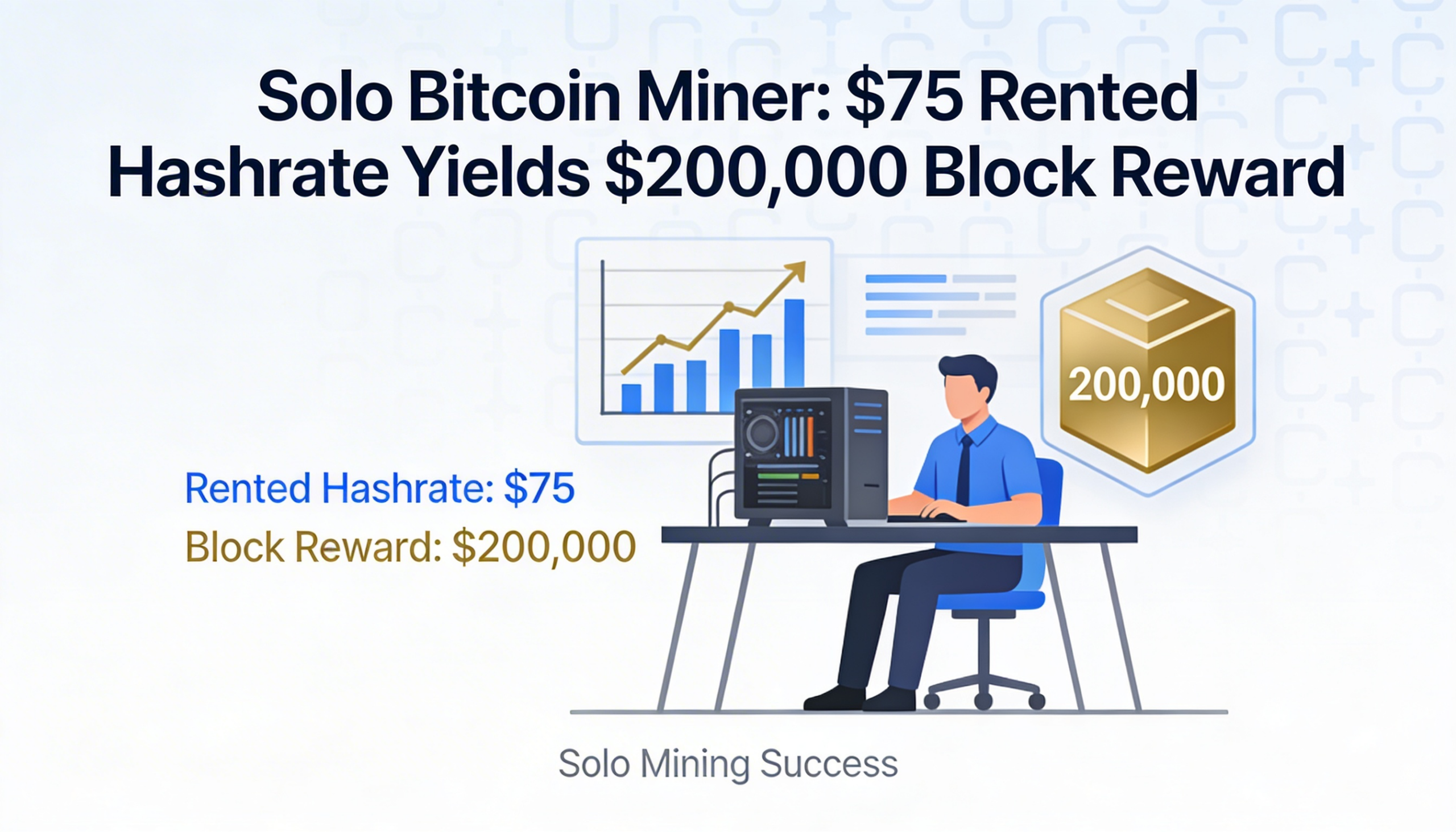
A solo Bitcoin miner converts $75 in rented hashpower into a $200,000 block payout.
A solo Bitcoin miner turned a modest wager into a six-figure payout after successfully validating block 938,092 — one of just 21 blocks mined independently over the past year.
According to data from Mempool.space, the miner confirmed the block at approximately 8:04 a.m. UTC on Tuesday, claiming the full 3.125 BTC reward worth more than $200,000 at current prices. The remarkable win came after renting just 1 petahash per second (PH/s) of computing power through an on-demand cloud mining service at a cost of roughly 119,000 satoshis — about $75.
The miner used CKPool, a platform that enables individuals to mine independently while relying on a shared server to submit valid blocks to the network. Unlike traditional mining pools that split rewards among participants, solo miners keep the entire payout if they solve a block.
The return is extraordinary — roughly 2,600 times the initial outlay — making it comparable to a lottery-style payoff, albeit with transparent and calculable odds.
Bitcoin’s network bundles transactions into blocks roughly every 10 minutes. Miners compete to solve a cryptographic puzzle, and the first to do so earns the block reward plus transaction fees. The likelihood of success depends on hashrate — the computing power dedicated to generating guesses per second. The higher the hashrate, the greater the probability of finding a valid block.
With just 1 PH/s, the miner’s chances were slim. Against the vast industrial-scale mining farms that dominate the network, such a setup represents a tiny fraction of total computational power — akin to competing with a slingshot in a battlefield dominated by heavy artillery. Statistically, the odds of a single petahash solving a block ahead of the global network are exceedingly low.
Still, improbable does not mean impossible.
Data from solo mining tracker Bennet indicates that 21 individual miners have independently validated blocks over the past year, collectively earning 66 BTC — approximately $4.1 million at current prices. That marks a 17% increase in solo-mined blocks compared with the previous year, averaging roughly one successful solo block every 17 days.
The growth reflects the increasing accessibility of hashpower rentals. Cloud-based mining platforms now allow users to lease computing capacity for relatively small sums, removing the need to own and operate expensive hardware. What was once an infrastructure-intensive industry has, in some respects, evolved into a high-risk, high-reward probability play.
The timing of the win is also notable given recent shifts in mining economics. Bitcoin’s network difficulty — a measure of how hard it is to find a block — recently climbed 15% to 144.4 trillion, reversing an 11% decline earlier in the month triggered by severe winter storms in the United States that temporarily knocked mining operations offline. The rebound restored competitive conditions after the weather-driven dip briefly made blocks easier to find.
At current difficulty levels, miners collectively require an average of 144.4 trillion hash attempts to discover a valid block — a stark contrast to Bitcoin’s earliest days in 2009, when competition was minimal.
For one solo miner armed with $75 worth of rented hashpower and precise timing, that narrow window proved enough to beat the odds.
Share this content: