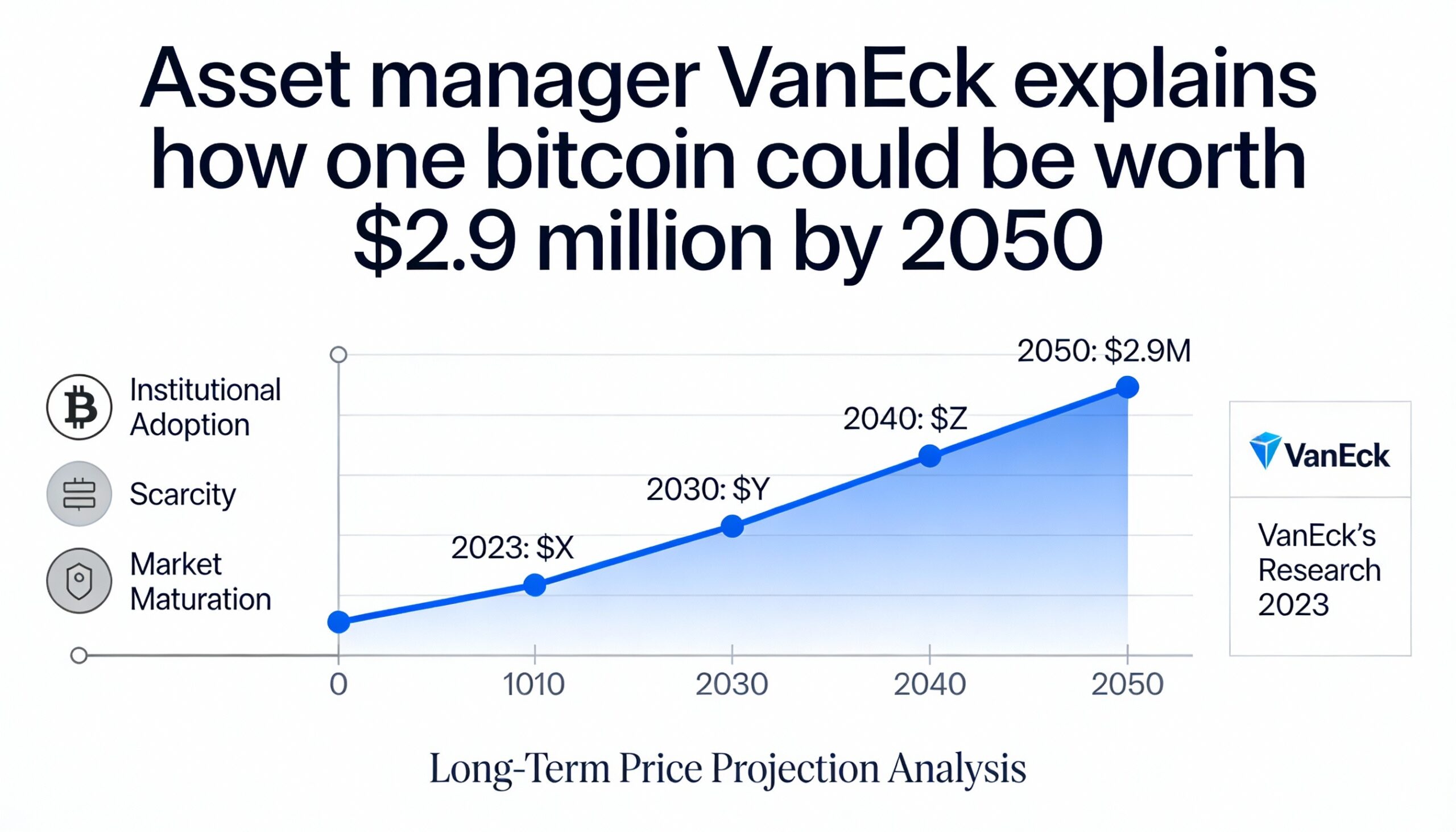
VanEck explains why bitcoin could climb to $2.9 million per coin by 2050.
VanEck has outlined a long-term framework suggesting bitcoin could be worth around $2.9 million by 2050. The research, published Thursday in a blog post titled “Bitcoin Long-Term Capital Market Assumptions,” was authored by Matthew Sigel, head of digital assets research, and Patrick Bush, senior digital assets analyst at the firm.
The study presents a base-case valuation model projecting an annualized return of roughly 15% over the next 25 years. Rather than a price target, VanEck frames it as a valuation exercise, focusing on bitcoin’s potential adoption beyond its current role as a trading asset. The model evaluates bitcoin’s value through adoption scenarios rather than traditional equity metrics.
Key assumptions include bitcoin’s use as a settlement asset in global trade, potentially processing 5%–10% of international transaction volume, and gradual central bank allocations as part of long-term reserve diversification. These scenarios differ sharply from today’s reality, where bitcoin plays a minimal role in trade settlement and is not held as a reserve by major central banks. VanEck notes that regulatory clarity, infrastructure development, and political acceptance would be required to reach this base-case scenario.
The report also highlights the volatility that could accompany widespread adoption, with long-term annualized volatility projected between 40% and 70%, comparable to frontier markets. Even in its bear-case scenario, VanEck expects positive long-term returns, reflecting bitcoin’s growing structural relevance.
Macroeconomic factors are central to the framework. VanEck notes that bitcoin historically tracks global liquidity trends more closely than equities or commodities, and its correlation with the U.S. dollar has weakened over time, indicating increasingly global drivers.
From a portfolio perspective, VanEck suggests modest allocations of 1%–3% can improve risk-adjusted returns in diversified portfolios. The firm stresses that this does not make bitcoin low-risk, but that its volatility can be managed when position sizes are limited.
Share this content: