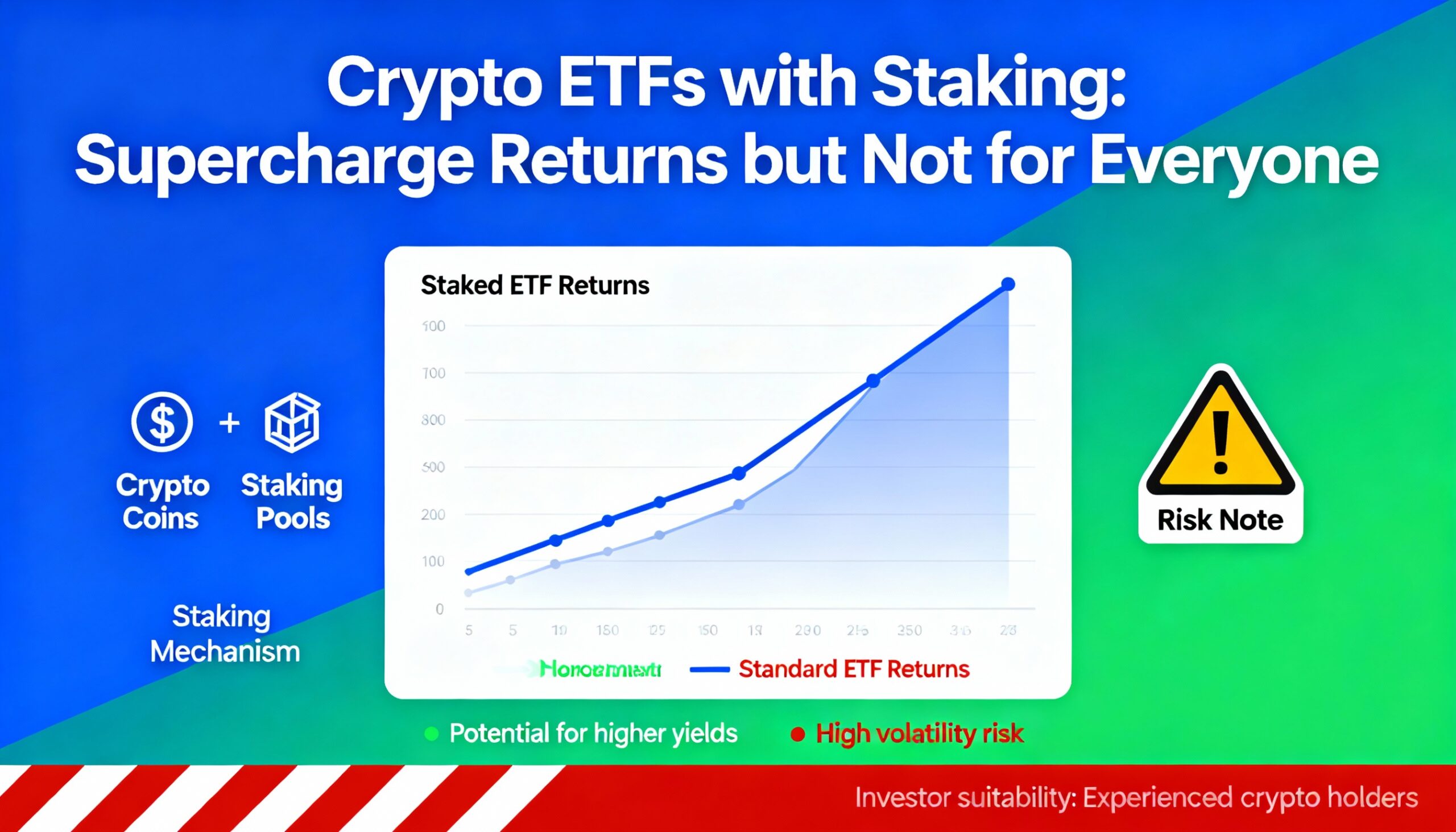
Staking-enabled crypto ETFs offer the potential for higher yields, but they’re not a one-size-fits-all product.
From yield opportunities to custody considerations, here’s how direct ETH ownership compares with staking ETFs across investor profiles.
Investing in ether, the native token of the Ethereum blockchain, was once a relatively straightforward proposition. Investors either purchased ETH through platforms such as Coinbase or Robinhood or transferred it to self-custody wallets like MetaMask, holding the asset directly and riding its price movements.
That approach evolved with the introduction of staking, which allows ETH holders to lock up tokens to help secure the network in exchange for rewards. Staking quickly became a popular way to earn passive income while maintaining long-term exposure to Ethereum’s growth.
As crypto has moved closer to the financial mainstream, the investment landscape has expanded. Spot exchange-traded funds (ETFs) tracking ether prices now coexist with direct ownership, offering traditional investors a familiar on-ramp—but also introducing new trade-offs.
More recently, some ether ETFs have added staking to the mix. These products combine price exposure with yield, allowing investors to earn staking rewards without ever interacting with a crypto exchange or wallet.
Earlier this month, Grayscale became the first issuer to distribute staking rewards through its Ethereum Staking ETF (ETHE). The fund paid $0.083178 per share. With ETHE trading around $25.87 at the time, a $1,000 investment would have generated approximately $82.78 in staking income.
The emergence of staking ETFs sharpens a fundamental question: Is it better to hold ETH directly, or to gain exposure through a fund that stakes on investors’ behalf?
Ownership versus yield
At its core, the decision hinges on two factors: who controls the asset and how yield is generated.
Buying ETH directly through an exchange such as Coinbase or Robinhood means owning the underlying cryptocurrency. Investors’ returns depend on price movements, while the platform acts as custodian. Those who choose to stake through Coinbase can earn annual rewards typically ranging from 3% to 5%, after commissions. The exchange manages the technical side of staking, but investors remain embedded in the crypto ecosystem and retain the ability to unstake, transfer, or use their ETH elsewhere.
Ether ETFs, by contrast, abstract away those mechanics. Investors buy shares through a brokerage account, and the fund acquires and holds ETH on their behalf. When staking is involved, the ETF stakes the tokens and distributes rewards to shareholders, offering exposure to both price appreciation and yield without direct interaction with blockchain infrastructure.
Fees are a critical differentiator.
Grayscale’s Ethereum Trust (ETHE), for example, charges a 2.5% annual management fee regardless of market performance. If staking is layered on top, a portion of the rewards is also allocated to the fund’s staking provider before distributions reach investors.
Coinbase, meanwhile, does not charge a management fee for holding ETH but takes a commission of up to 35% on staking rewards. According to the company’s disclosures, this rate applies to several proof-of-stake assets, including ETH, though lower fees are available through its paid subscription tiers.
“There is no fee to stake your assets,” Coinbase notes on its website. “Coinbase takes a commission based on the rewards you receive from the network.”
In practice, this structure often results in higher effective yields for investors staking directly through exchanges, even after commissions. Still, ETFs may appeal to those who value simplicity, regulatory familiarity, and access via traditional brokerage accounts.
For such investors, staking ETFs offer ETH price exposure and income generation in a format that resembles dividend-paying funds—except the yield is generated by blockchain activity rather than corporate earnings.
Risks, access, and flexibility
Despite their convenience, staking ETFs are not without drawbacks. Staking income is inherently variable.
Ethereum staking rewards fluctuate based on network activity and the total amount of ETH staked. Current yields are around 2.8% annually, according to CoinDesk data, but they can change over time.
Operational risks also exist. If a validator underperforms or is penalized, a fund may lose a portion of its staked ETH. Similar risks apply when staking through exchanges such as Coinbase, though direct holders maintain greater flexibility to respond.
Control and access remain key points of divergence. Investors holding ETH directly—even on centralized platforms—can generally transfer it to wallets, unstake it, or deploy it in decentralized finance applications. ETF investors cannot. Their exposure is confined to buying and selling shares during market hours, with no ability to move or independently stake the underlying asset.
Ultimately, staking ETFs trade control for convenience, while direct ETH ownership offers greater flexibility and potentially higher net yields. The better option depends on whether an investor prioritizes ease of access—or direct ownership within the crypto ecosystem.
Share this content: