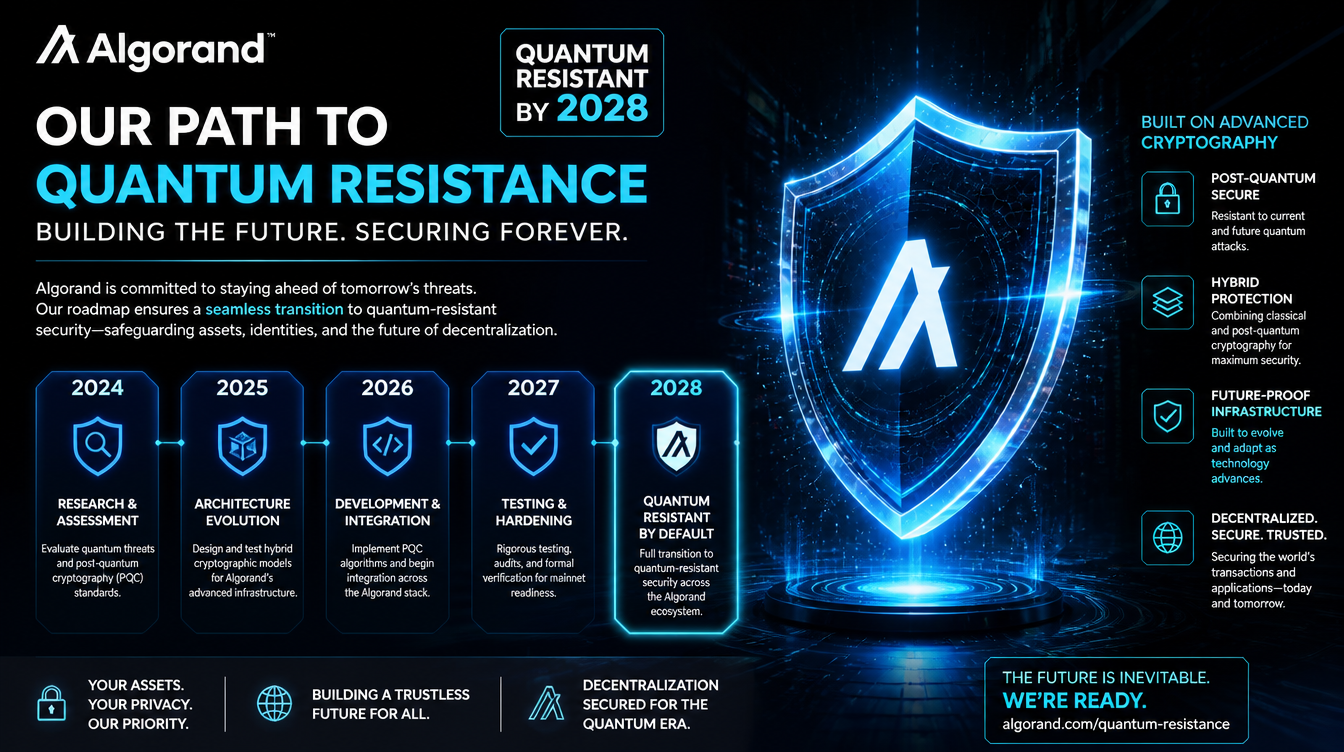
Algorand Charts Path to Quantum-Resistant Network by 2028
The announcement highlights a growing realization in the crypto sector that transitioning to quantum-resistant cryptography will be a lengthy, multi-year effort, requiring major upgrades not only to wallets but also to core blockchain infrastructure.
The Algorand Foundation has rolled out a roadmap targeting full quantum resistance by the end of 2027, joining a broader wave of blockchain projects preparing for a future in which quantum computing could compromise today’s cryptographic systems.
The plan outlines phased upgrades starting in 2026, including post-quantum accounts, multisignature wallets, and staking features, with later phases focused on deeper protocol-level changes.
This reflects a wider industry shift: quantum readiness is increasingly viewed as a long-term transformation rather than a near-term patch, demanding coordinated changes across both application layers and foundational protocol design.
Most blockchains today rely on elliptic curve cryptography to secure transactions and wallets, a standard widely considered vulnerable to sufficiently advanced quantum computers. While such systems do not yet exist at scale, governments, technology firms, and crypto projects are actively preparing for eventual migration.
For instance, Google has urged organizations to begin adopting post-quantum cryptography and aims to fully integrate quantum-safe standards by 2029. At the same time, the U.S. National Institute of Standards and Technology (NIST) continues to lead efforts to standardize post-quantum algorithms and phase out legacy cryptographic systems over time.
Within crypto, quantum resistance has become an increasing focus. The Ethereum Foundation recently launched an initiative exploring post-quantum migration strategies across wallets, applications, and validators, while Solana developers have also proposed frameworks for transitioning if quantum threats become imminent.
Algorand emphasized that blockchain networks must prepare well ahead of “Q-Day,” the theoretical point at which quantum computers could break current encryption.
The roadmap builds on work begun in 2022 and extends it across the full protocol stack, aiming for broad quantum resilience by 2027. The foundation noted this timeline would place Algorand ahead of NIST’s planned retirement of legacy cryptographic standards and several years before timelines set by U.S. national security agencies.
As chief scientific officer Chris Peikert noted, migrating a live blockchain is a long process, and the risk of quantum attacks on existing cryptography increases significantly as the decade advances.
Share this content: