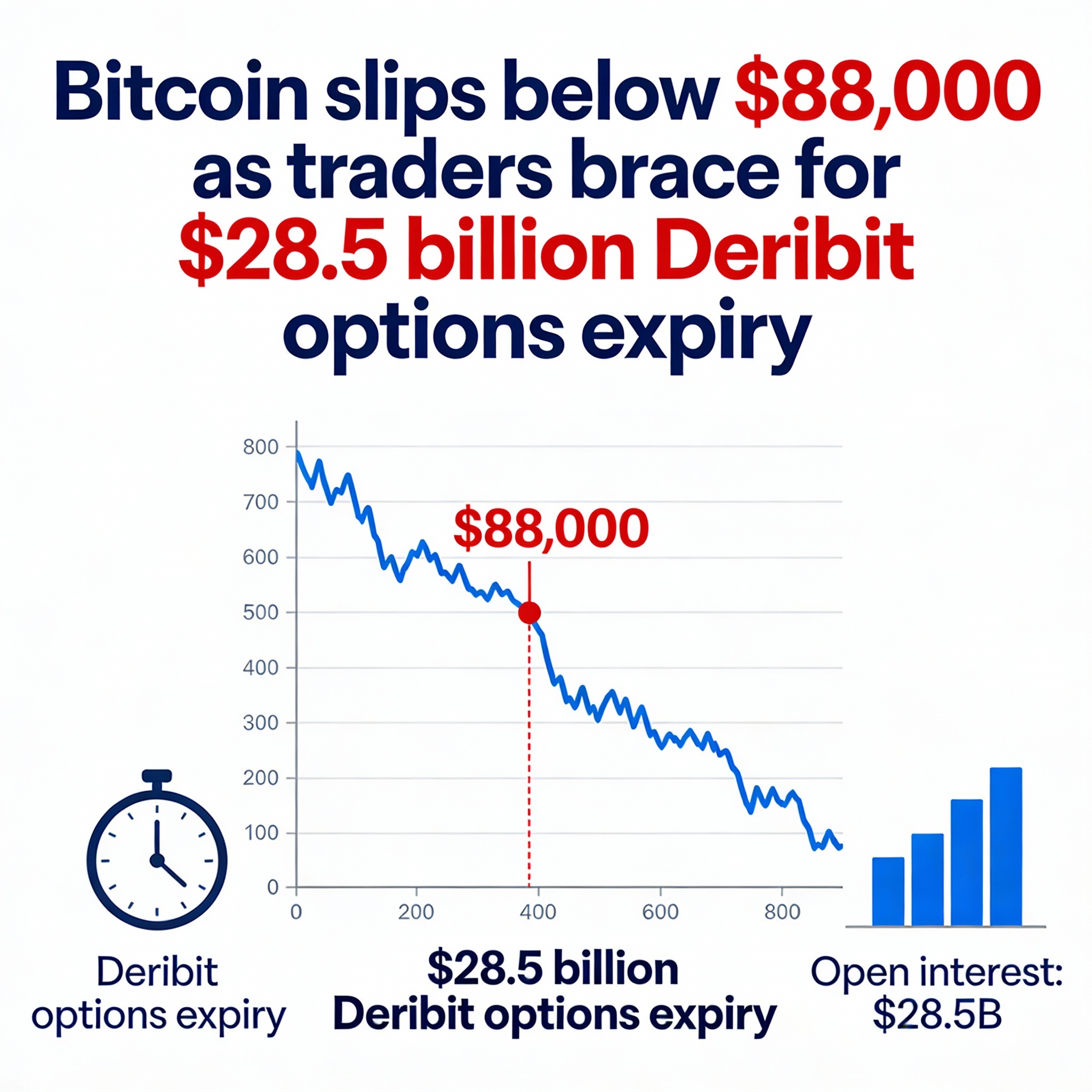
BTC trades below $88,000 as markets prepare for $28.5 billion Deribit expiry
Crypto markets extended their decline ahead of this week’s record options expiration, with defensive positioning and thinning liquidity underscoring a cautious setup into 2026.
Bitcoin (BTC) and other major digital assets drifted lower through Monday’s U.S. session. BTC fell below $88,000 after earlier trading above $90,000, while ether (ETH) slipped back under the $3,000 level.
Some crypto-linked equities continued to show relative strength. Hut 8 (HUT) led gains, climbing 16% as it built on last week’s rally following its 15-year AI data center lease with Fluidstack. The move was further supported by a price target increase from Benchmark analyst Mark Palmer. Coinbase (COIN) and Robinhood (HOOD) were also higher on the day, though both pulled back from intraday highs as crypto prices weakened. Strategy (MSTR) reversed from an earlier 3% advance to a modest loss late in the session.
Options expiry takes center stage
The choppy price action between $85,000 and $90,000 comes ahead of Friday’s record $28.5 billion expiration of bitcoin and ether options on Deribit. The expiring contracts account for more than half of the exchange’s $52.2 billion in total open interest, according to Jean-David Pequignot, Deribit’s chief commercial officer.
“This year-end expiry reflects a market that has matured institutionally and shifted away from purely speculative cycles toward a policy-driven supercycle,” Pequignot said.
Bitcoin’s $96,000 “max pain” level sits at the center of the expiry, where option sellers stand to benefit most. About $1.2 billion in open interest is concentrated at the $85,000 put strike, a level that could exert downward pressure on spot prices if selling intensifies. While mid-term call spreads targeting $100,000 to $125,000 remain in play, short-dated protective puts have grown more expensive, he added.
Although the skew between call and put pricing has retreated from recent highs, it continues to signal caution. Traders appear to be rolling hedges forward rather than closing them outright, shifting from December $85,000–$70,000 puts into January $80,000–$75,000 put spreads—suggesting unease beyond year-end.
Share this content:


