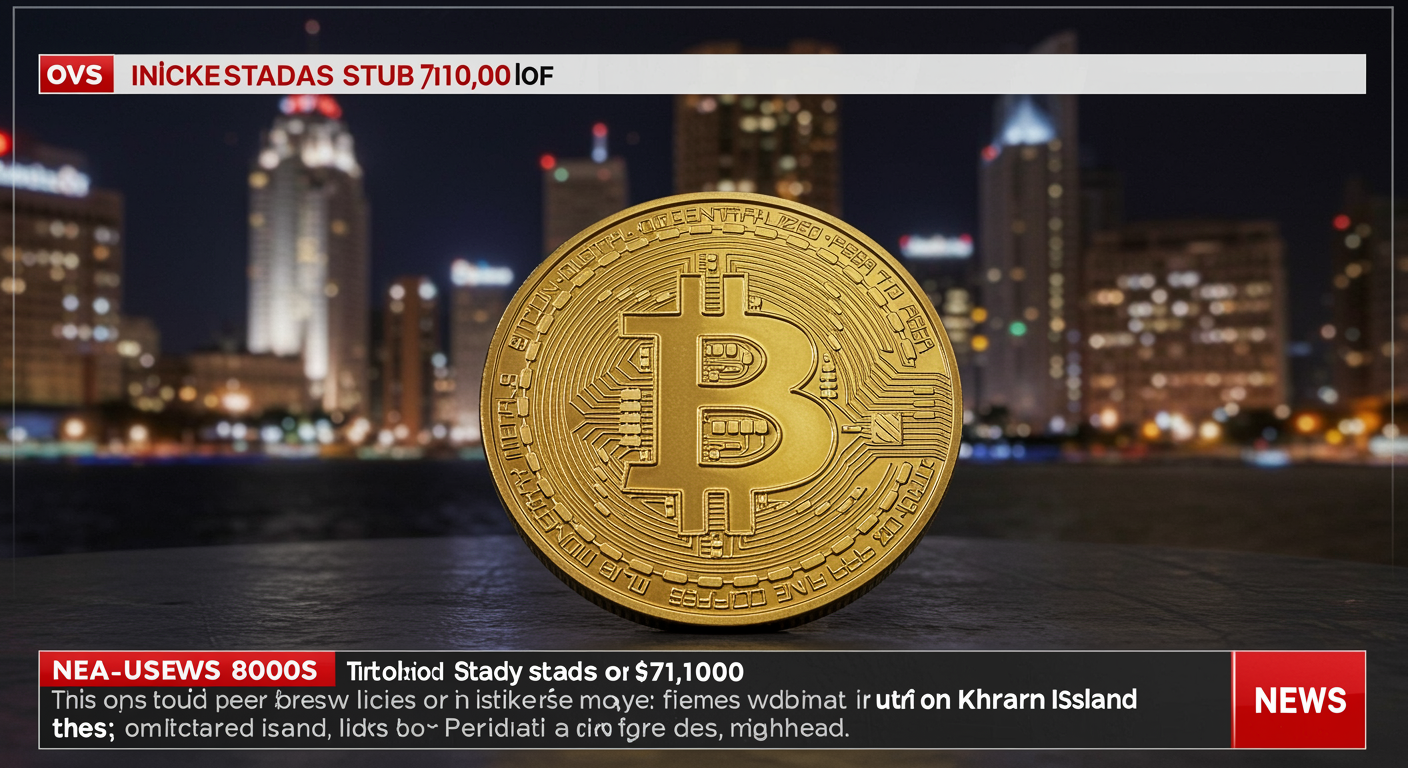
Bitcoin Holds Near $71K Despite Donald Trump Warning of Potential Strikes on Kharg Island
Bitcoin is holding near $71,000 despite rising geopolitical tensions, with the asset still up more than 4% on the week as investors look ahead to the upcoming Federal Reserve policy meeting on March 17–18.
The world’s largest cryptocurrency was trading around $71,000 early Saturday, down about 0.7% over the previous 24 hours after the U.S. struck military targets on Kharg Island, Iran’s primary oil export facility.
The pullback followed a sharp but limited reversal from Friday’s high of $73,838. Bitcoin dropped roughly 3.5% following the Kharg developments before stabilizing — a relatively mild reaction compared with previous geopolitical shocks that might have triggered deeper losses.
Weekly performance paints a stronger picture. Bitcoin has gained roughly 4.2% over the past seven days. Ether rose about 5.5% to $2,090, while Dogecoin advanced around 5%. Solana climbed 4.2% to $88 and BNB increased roughly 4.5% to $655.
Despite the escalating conflict in the Middle East, most major cryptocurrencies remain higher on the week.
Markets appear to be gradually adjusting to the conflict. In the early days of the war, each headline sparked outsized price swings as traders struggled to price in geopolitical tail risks. Now, a pattern has begun to emerge: strikes trigger oil price spikes, bitcoin dips briefly, and then the market recovers.
That reaction cycle has occurred enough times that traders are becoming less reactive to headlines. Even so, the $73,000–$74,000 range remains a key resistance level, rejecting bitcoin four separate times over the past two weeks.
Comments from Donald Trump added fresh uncertainty late Friday.
In a post on Truth Social, Trump said oil infrastructure had been spared “for reasons of decency,” but warned that the U.S. could “immediately reconsider” if Iran continued to disrupt shipping through the Strait of Hormuz.
Iran responded by warning that any strike targeting its energy infrastructure would trigger retaliatory attacks on facilities linked to the United States across the region — a conditional escalation threat that had not been present earlier in the conflict.
If energy infrastructure becomes a primary target, the resulting supply shock could intensify significantly. The International Energy Agency has already described the disruption as the largest energy supply shock on record.
Derivatives markets also reflected the volatile trading session. Roughly $371 million in liquidations occurred across crypto markets in the past 24 hours. Short liquidations accounted for about $207 million, exceeding the $163 million in long liquidations, indicating that bears were squeezed during the initial rally to $73,800 before the Kharg-related decline forced newly opened long positions to unwind.
Investor focus now shifts to the Federal Reserve’s policy meeting on March 17–18.
With oil trading above $100, the global energy supply facing severe disruption, and a war entering its third week without resolution, concerns about stagflation are becoming harder for markets to ignore.
According to the CME Group’s FedWatch tool, traders still assign a greater than 95% probability that the central bank will keep interest rates unchanged in the 3.5%–3.75% range.
However, the Fed’s updated rate projections and comments from Chair Jerome Powell may prove more important than the rate decision itself.
Any indication that interest rate hikes could return would likely pressure risk assets, including the cryptocurrency market, which has spent months anticipating rate cuts that have yet to materialize.
Share this content:


