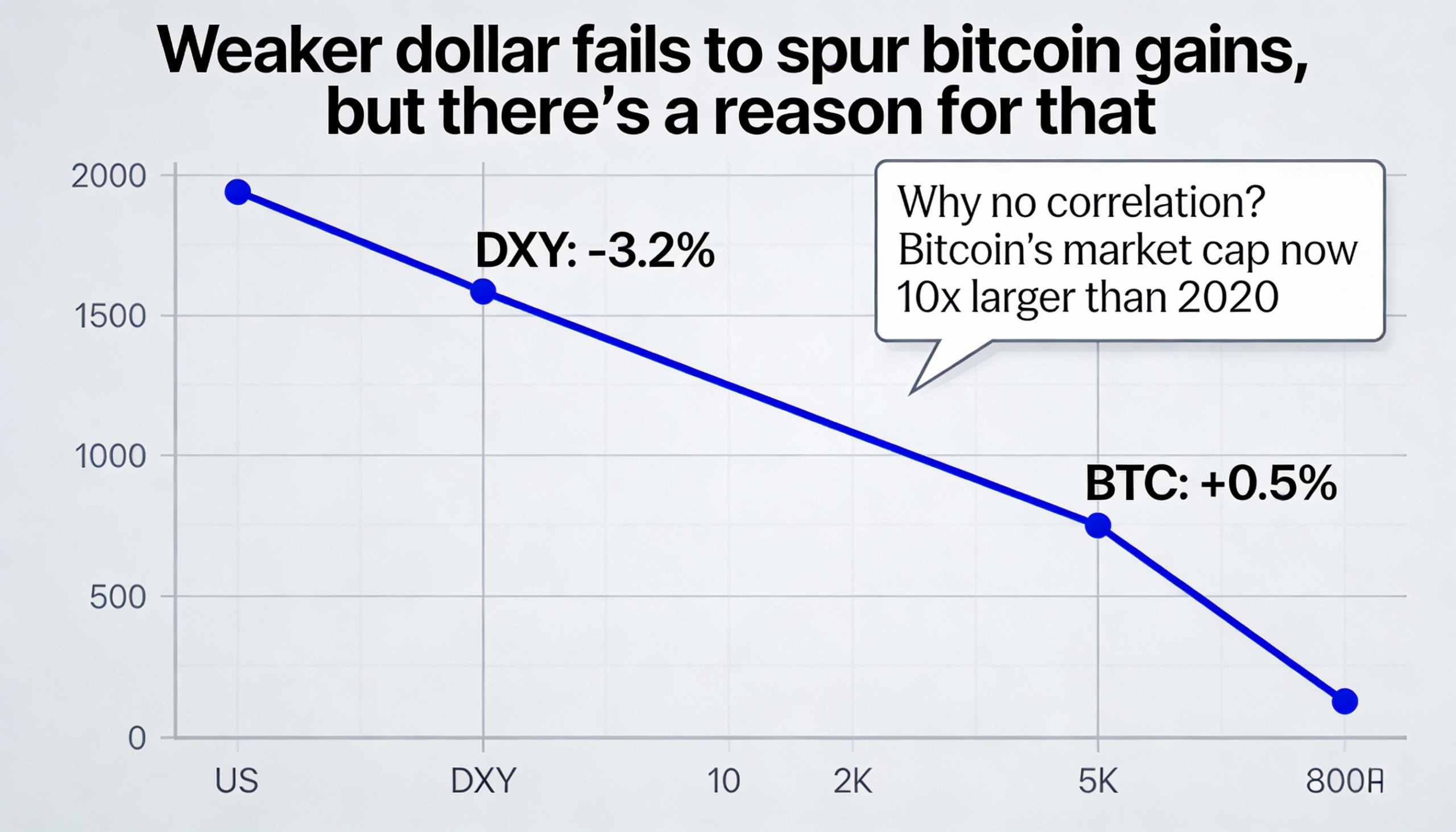
A declining dollar isn’t translating into bitcoin gains, and here’s why
Gold and other hard assets are rallying amid a weaker dollar, but bitcoin remains range-bound, reflecting its continued role as a liquidity-sensitive risk asset rather than a classic dollar hedge.
The Dollar Index (DXY) has dropped roughly 10% over the past year. Historically, BTC tends to rise when the dollar falls, yet bitcoin has lost 13% over the same period, and the broader CoinDesk 20 index (CD20) declined 28%, according to CoinDesk data.
J.P. Morgan Private Bank explains the disconnect by pointing to the nature of the dollar’s slide. “The recent dollar decline isn’t about growth or monetary policy changes,” said Yuxuan Tang, the bank’s head of macro strategy in Asia. “Interest rate differentials have actually moved in the USD’s favor since the start of the year. What we’re seeing now, much like last April, is a USD selloff driven primarily by flows and sentiment.”
The bank expects the dollar’s weakness to prove temporary, stabilizing as the U.S. economy gains momentum. That helps explain why gold and other hard assets have rallied while bitcoin remains range-bound: the crypto market does not see the dollar’s drop as a durable macro shift.
Without a clear shift in growth or monetary policy expectations, dollar weakness alone has not drawn significant capital into crypto. J.P. Morgan suggests that investors looking to diversify from the dollar may find more direct beneficiaries in gold and emerging-market assets, while bitcoin continues to act like a risk-sensitive, high-beta asset.
Share this content: