XRP Climbs 8% as Market Pain Creates Better Risk-Reward for New Buyers
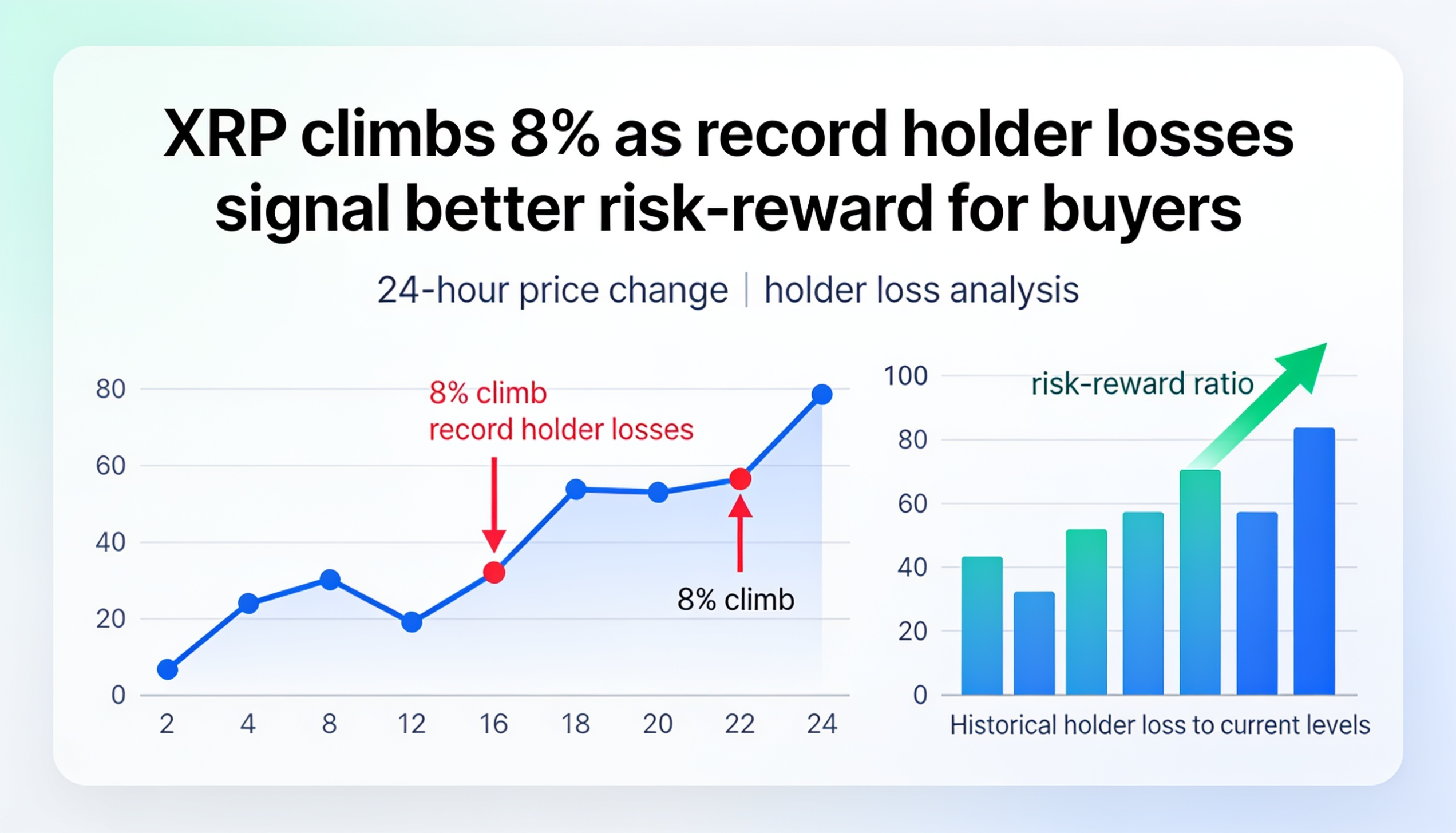
XRP’s 30-day and 365-day MVRV ratios—a measure of how far holders are in loss—have dropped to roughly -45% and -47%, the lowest levels on record, according to Santiment. Some traders interpret such extreme drawdowns as a contrarian signal.
On-chain data indicates that XRP investors are, on average, deeper underwater than at any point in the token’s history, a condition often associated with potential market floors.
The signal is derived from the MVRV (market value to realized value) ratio, which compares the current price of XRP to the average price at which its supply last moved.
When the ratio is below zero, it shows that the typical holder is sitting on a loss. With both short-term and long-term MVRV deeply negative, recent buyers and longer-term holders alike are carrying significant unrealized losses.
Santiment said the combined readings are at historic lows for XRP.
Such conditions typically reflect a capitulation phase, where investors absorb heavy losses and weaker hands exit positions, selling to buyers willing to accumulate at lower prices. Santiment framed this as a risk-reward setup rather than a definitive bottom call.
“The most compelling setups often emerge when sentiment is at its weakest,” the firm said, noting that much of the downside may already be absorbed, while cautioning that prices could still fall if broader market conditions deteriorate.
Despite these depressed metrics, XRP has risen about 8% over the past week to trade near $1.14, according to CoinDesk data, placing it among the stronger-performing major tokens.
The trend aligns with a broader pattern observed by on-chain analysts, where large bitcoin holders continue accumulating even amid record ETF outflows—a dynamic often seen during late-stage sell-offs and absorption phases near cycle lows.
Still, this does not confirm a bottom. MVRV reflects how stretched losses are, not when a reversal will occur, and such conditions can persist while prices move sideways or lower.
What the data suggests is that selling pressure from loss-making holders may be largely exhausted, shifting attention to whether sustained buying demand will drive the next move.
Share this content: