UK’s Crypto Overhaul Targets Global Growth, Yet Strict Compliance Demands Threaten Rollout
The U.K. Financial Conduct Authority’s (FCA) new crypto framework has drawn praise for emphasizing global liquidity and encouraging institutional participation, though the approval process is widely expected to be complex and challenging.
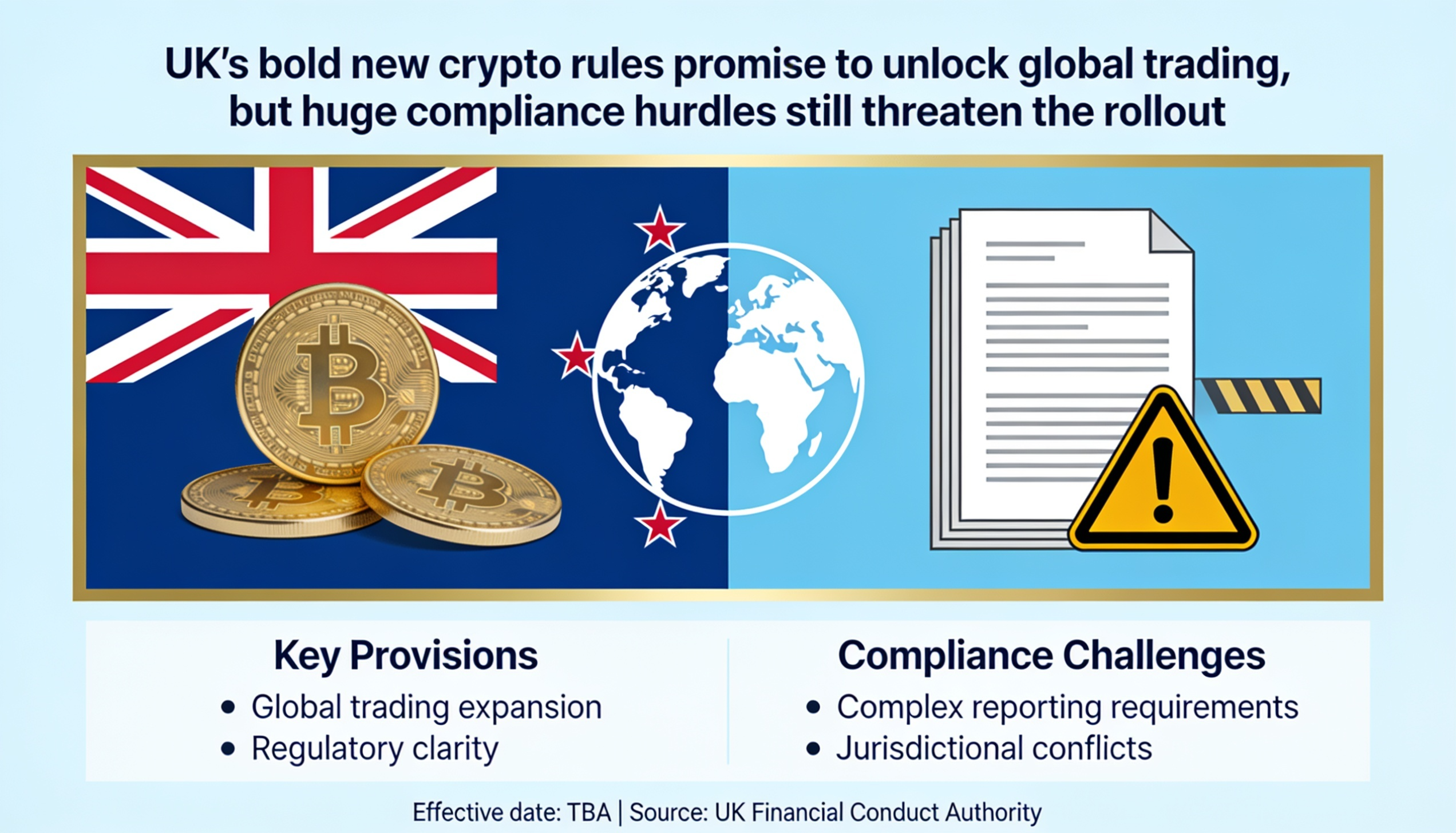
This week, the FCA introduced its long-awaited cryptocurrency regulatory framework, earning early recognition for its globally integrated approach. However, industry voices caution that several uncertainties remain before the U.K. can firmly position itself as a leading global crypto hub.
The proposed rules are designed to maintain access to international liquidity by permitting trading through overseas venues, while also enabling the circulation of stablecoins issued outside the U.K., according to industry stakeholders.
Katie Harries, Coinbase’s head of policy for Europe, described the finalized rules as a significant step forward. She noted that they provide much-needed regulatory clarity and strengthen the U.K.’s competitive position in digital asset innovation.
The FCA’s stance on global liquidity and foreign-issued stablecoins stands in contrast to the European Union’s Markets in Crypto-Assets (MiCA) regulation, which many in the industry view as more protectionist. MiCA has effectively pushed firms toward isolating European operations and liquidity pools.
A key feature of the FCA’s framework is the proposed Qualifying Cryptoasset Trading Platform (QCATP) model. According to Christopher Collins, a partner specializing in financial markets regulation at Katten Muchin Rosenman, this model would allow overseas exchanges to serve U.K. clients through locally authorized branches that remain connected to global trading systems.
Collins explained that this structure would give U.K. customers access to deeper global liquidity rather than limiting them to a segregated domestic pool, potentially resulting in better pricing and improved outcomes.
Despite these advantages, Collins highlighted a major unresolved issue. While the FCA has stated that overseas branches will only be approved if their home jurisdictions offer “comparable regulatory protection,” it has not clarified which jurisdictions meet that standard.
This lack of specificity, Collins argued, makes it difficult for firms to develop viable business strategies, as greater certainty is needed before committing investment to U.K. operations.
Harries also pointed to decentralized finance (DeFi) as an area lacking clarity. She warned that earlier proposals could effectively block centralized platforms from providing access to DeFi services.
She emphasized that the U.K.’s approach to DeFi will be crucial, noting that overly restrictive rules could leave the country trailing jurisdictions like the U.S., where policymakers are actively considering DeFi within broader tokenization initiatives.
Beyond policy considerations, companies must also navigate a demanding authorization process.
Thomas Cattee, a partner at Gherson Solicitors, cautioned that firms face a high likelihood of rejection under the new Financial Services and Markets Act regime. He noted that even the FCA’s existing anti-money laundering (AML) registration process—far narrower in scope—has already proven highly rigorous, with more than 85% of applications either rejected or withdrawn.
The new framework significantly expands requirements, incorporating obligations related to Consumer Duty, prudential regulation, operational resilience, and senior management accountability.
Cattee also warned against delaying applications, referencing the rollout of MiCA in Europe, where many firms waited until deadlines approached. This resulted in licensing bottlenecks that left some businesses unable to secure authorization in time.
For institutional investors, the framework represents more than just another regulatory development.
Sandy Jones, director of digital assets at Baillie Gifford, explained that regulation does not inherently reduce risk in crypto markets. Instead, it provides the legal certainty and governance standards necessary for traditional financial institutions to engage with blockchain-based systems.
He stressed that while the underlying technology is powerful, it cannot independently bridge the gap to mainstream financial markets. Legal clarity, operational robustness, and recognized governance frameworks are essential for broader adoption.
Jones also welcomed the FCA’s updated approach to stablecoins, suggesting that it supports strong settlement infrastructure without introducing unnecessary operational burdens.
Overall, industry feedback indicates that the FCA is positioning the U.K. as a commercially pragmatic alternative to the EU’s MiCA framework. However, whether this strategy succeeds in attracting firms will depend less on the ambition of the rules and more on how consistently and predictably they are implemented in practice.
Ultimately, the key challenge lies in ensuring that regulatory complexity and unresolved policy questions do not undermine the U.K.’s potential competitive edge before it can fully materialize.
Share this content: