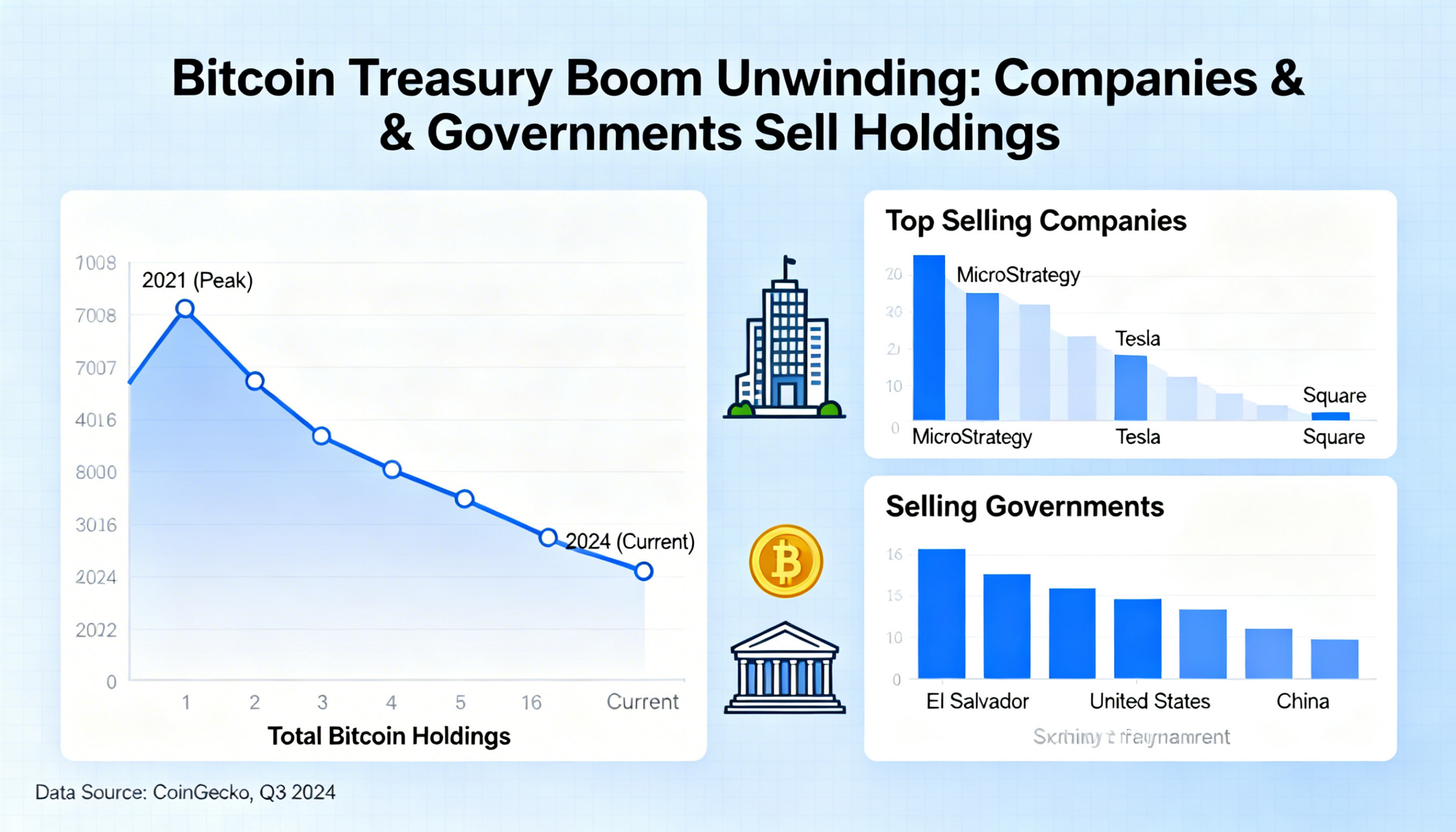
The surge in bitcoin treasury adoption is reversing as firms and governments begin offloading their holdings.
Falling prices and an extended period of consolidation are forcing both public companies and sovereign entities to trim their bitcoin reserves in a bid to stabilize balance sheets. What was once a conviction trade is increasingly turning into a source of liquidity.
Sovereign activity is adding to the pressure. Bhutan, a notable state-backed bitcoin holder, has stepped up its selling, continuing a broader trend of governments reducing exposure after years of accumulation.
Market participants that piled into bitcoin over the past two years are now beginning to unwind positions—an emerging signal that sentiment may be shifting. Public firms, previously viewed as steadfast, long-term holders, are now among those lightening up as price stagnation weighs on financial performance and strategic flexibility.
Empery Digital (EMPD) is a case in point. The company disclosed Wednesday that it sold 370 BTC at an average price of $66,632, raising $24.7 million. The move leaves it with 2,989 BTC. Part of the proceeds was used to fully repay an outstanding term loan, while also freeing up roughly 1,800 BTC that had been locked as collateral. After building its bitcoin treasury starting in July 2025 and peaking near 4,000 BTC, the firm’s stock has since dropped 75% from its all-time high of $15.80.
Elsewhere, Genius Group (GNS), an AI-driven education firm with a bitcoin-focused strategy, has fully exited its holdings. After once holding as much as 440 BTC, the company recently sold its remaining 84 BTC to repay $8.5 million in debt. Management indicated it may revisit its bitcoin treasury strategy when market conditions improve.
The selling is not limited to smaller players. Riot Platforms (RIOT), one of the largest U.S.-listed bitcoin miners, has also been reducing its holdings, according to blockchain data tracked by Lookonchain. The company reportedly moved 500 BTC worth around $34.13 million on Wednesday, continuing to tap its reserves to fund a strategic pivot toward AI and high-performance computing—an increasingly common shift among mining firms.
Riot had already sold roughly $200 million worth of bitcoin in the final two months of 2025. Unlike treasury adopters, its holdings were built steadily through mining operations, reaching a peak of over 19,000 BTC. Its current balance is estimated at around 17,500 BTC.
On the sovereign side, Bhutan has sold a total of 3,103 BTC, including a reported 375 BTC transaction on March 30, according to Glassnode data. The country had accumulated more than 13,000 BTC at its peak in October 2024 through state-backed mining initiatives.
Despite the recent wave of selling, the broader picture suggests institutional exposure remains significant. Public bitcoin treasury companies collectively still hold about 1,164,800 BTC, representing more than 5% of the asset’s fixed 21 million supply, according to BitcoinTreasuries.net.
At the time of writing, bitcoin was trading near $66,500, down more than 2% over the past 24 hours, based on CoinDesk data.
Share this content: