Not all cryptocurrencies are created equal: Schwab reveals where digital asset investments are concentrated
Schwab Report Breaks Crypto Into Layers, Shows Most Value Lies in Networks
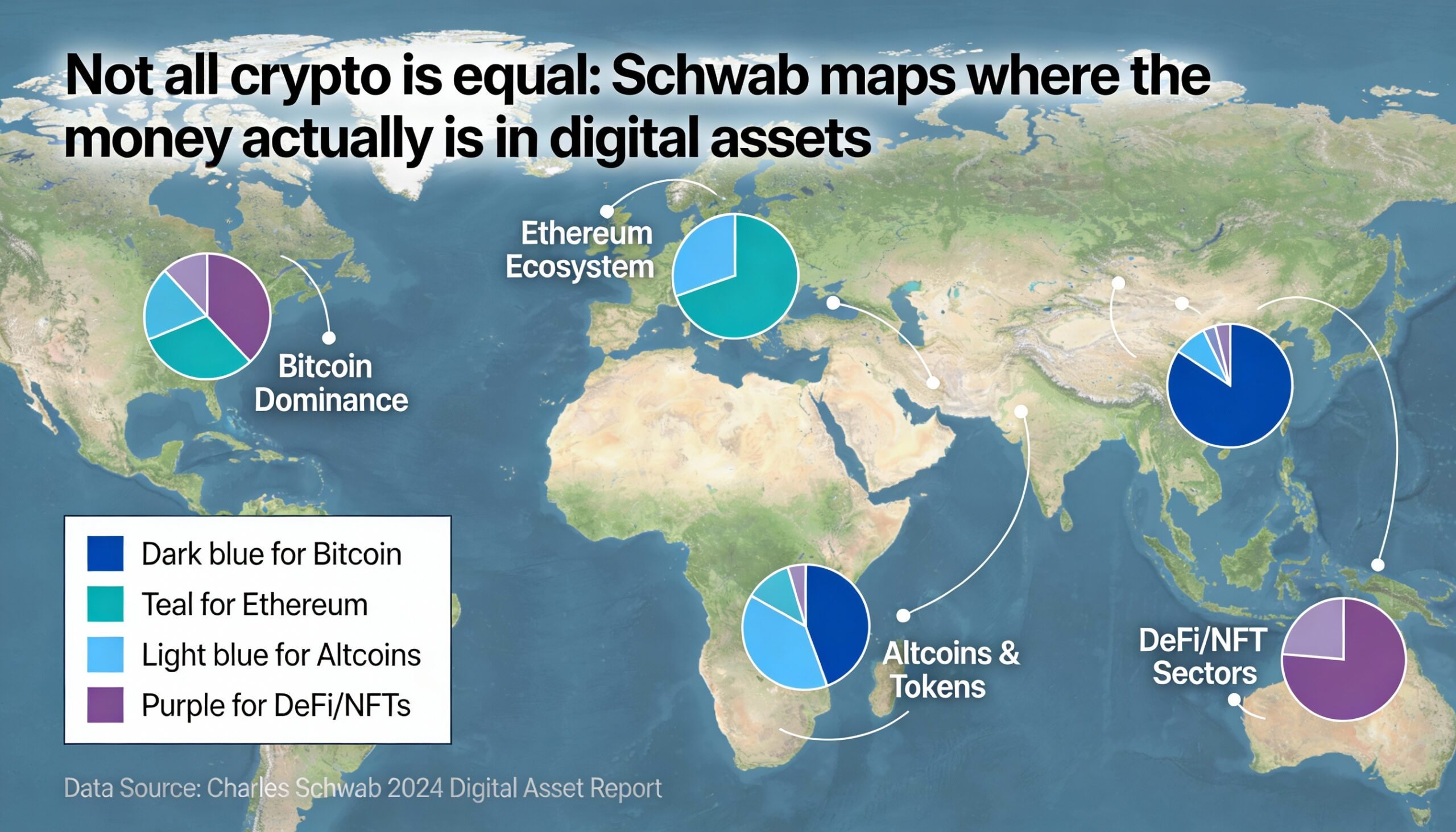
A new report from Schwab’s Center for Financial Research breaks the crypto market into three distinct layers—networks, infrastructure, and products—and finds that the bulk of value remains concentrated in foundational blockchains like Bitcoin and Ethereum.
Schwab emphasizes that crypto is not a single asset class but an ecosystem with deep structural differences, particularly as spot crypto ETFs make the market more accessible to mainstream investors. Understanding where value sits is critical for investors, the report says.
The report categorizes the market into three tiers:
- Networks: Foundational blockchains such as Bitcoin and Ethereum sit at the base. These blockchains record transactions and support nearly all other crypto applications. As of the end of 2025, Schwab notes these networks accounted for nearly 80% of crypto’s $3.2 trillion market capitalization.
- Infrastructure: This layer includes protocols that connect blockchains and applications, such as oracles, cross-chain bridges, and scaling tools. While essential, Schwab notes these projects face a tough business model: users rarely interact with them directly, and switching to competitors is often easy.
- Products: The top layer comprises exchanges, lending platforms, staking services, and other tools that users engage with directly. These protocols tend to enjoy higher switching costs and potential to become industry standards. Examples include crypto lending platform Aave (AAVE) and staking protocol Lido (LDO), though Schwab does not make investment recommendations.
To illustrate, Schwab compares the ecosystem to the traditional software industry: networks are like cloud platforms (AWS, Microsoft Azure) that everything is built on, infrastructure is akin to back-end tools that are essential but often invisible to end users, and products resemble applications like Salesforce or Netflix that interact directly with consumers.
The report also introduces a framework for evaluating crypto protocols, borrowing from growth equity analysis. Schwab suggests examining four criteria: network effects, market share, scalability, and tokenomics—covering token distribution, reward mechanisms, and supply management.
Ethereum serves as a case study. Leading the smart contract sector, it holds over 10 times the market share of its closest competitor by total value locked (TVL). Its early adoption created strong network effects, but slower transaction speeds and concentrated token ownership pose challenges.
A key insight from the report: infrastructure protocols often struggle to retain value, even though they are vital. Among projects with market caps above $100 million, product protocols were nearly twice as common as infrastructure ones, while foundational networks, though fewer, held most of the market’s overall value.
Schwab stresses that crypto remains speculative and high-risk. For new investors, simply “buying crypto” is not enough. Understanding where value actually resides—primarily in foundational networks and widely used products—is crucial to navigating the market.
Share this content: