Ethereum Slips Behind Tether—USDT’s $187B Milestone Raises Market Questions
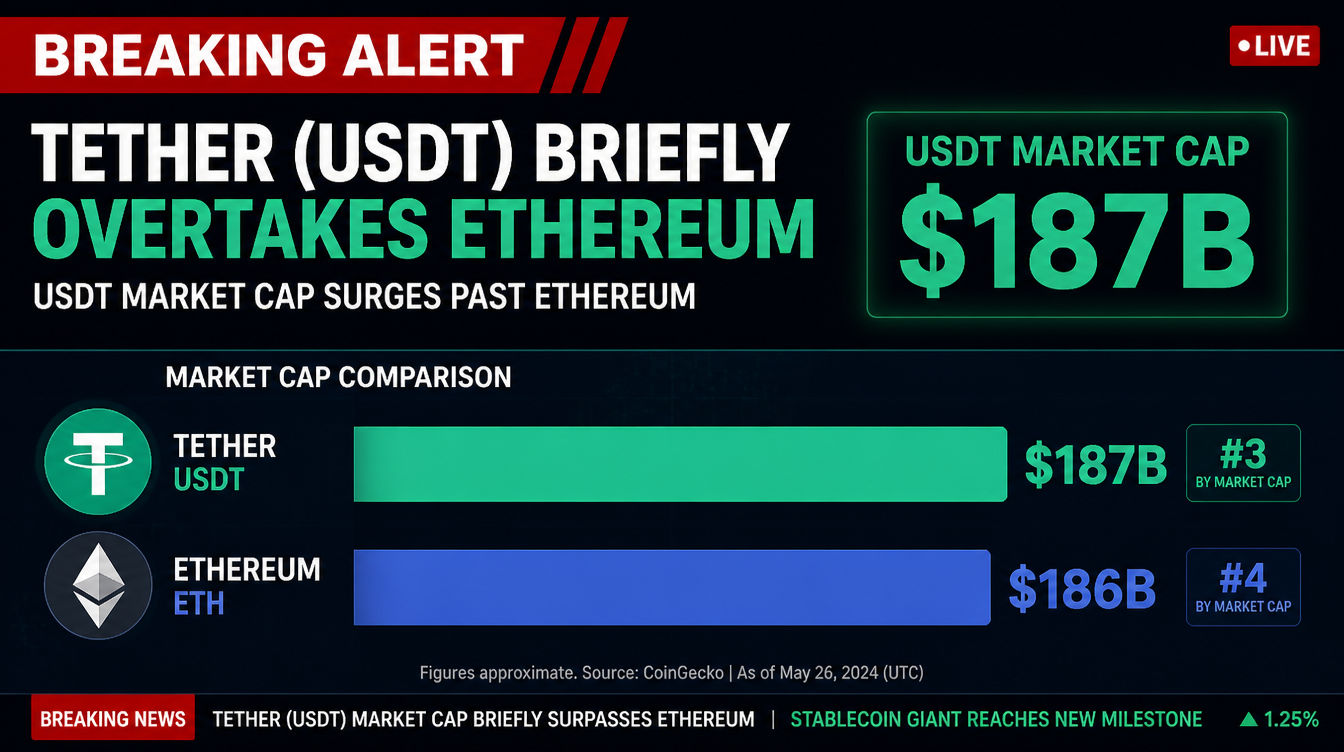
Tether’s USDT briefly surpassed Ethereum in market capitalization earlier this week, marking the first time in eight years the stablecoin has flipped ETH. During the crossover, both assets were tightly grouped in the $183 billion to $188 billion range, with one snapshot showing USDT at $187 billion and Ethereum at $186 billion—a margin of less than $1 billion.
The shift proved temporary, with ETH quickly reclaiming second place as prices stabilized. However, the forces behind the flip—ongoing USDT issuance and sustained ETH price pressure—remain firmly in place.
What Drove the Crossover
The move was not driven by any change in Ethereum’s supply. Instead, ETH’s market cap declined due to price weakness, while USDT expanded through continued issuance. Tether’s Q4 2025 attestation showed supply reaching a record $187.3 billion, including $12.4 billion added in a single quarter despite a broader market downturn.
Over the past 12 months, USDT’s market cap has grown from $144.2 billion to $184 billion, representing a 28% increase, while Ethereum’s valuation has moved lower over the same period.
In the weeks leading up to the crossover, more than $7 billion exited the stablecoin sector, while the total crypto market shed approximately $400 billion in value. Ethereum’s DeFi total value locked (TVL) declined to around $36 billion. Rather than abandoning stablecoins, traders appeared to be reallocating into them as a defensive strategy, preserving liquidity while reducing exposure to volatility.
USDT now accounts for roughly 59% of the stablecoin market, with USDT and USDC combined representing about 82%, underscoring Tether’s dominant role in crypto liquidity flows.
A Structural Shift, Not a One-Off
Bloomberg Intelligence strategist Mike McGlone has long pointed to this trend. In October 2020, when USDT stood at $16 billion compared to Ethereum’s $43 billion, he suggested Tether was on track to close the gap within a year, describing it as part of a broader shift toward stablecoin adoption.
His latest outlook extends that thesis further, suggesting the “flippening” could persist. McGlone has indicated that USDT may overtake Ethereum again in 2026 and, in more extreme scenarios, could eventually challenge Bitcoin. One such scenario involves a sharp Bitcoin decline toward $10,000 alongside significant USDT supply expansion.
While such projections may seem aggressive, dismissing them outright would echo earlier skepticism toward USDT’s rise.
ETH vs USDT: A Narrow Advantage
Ethereum has since regained its position as the second-largest crypto asset, but the lead remains thin. Sustaining that position will require either continued price recovery or a slowdown in USDT issuance—neither of which is guaranteed.
Ethereum’s long-term outlook remains supported by ongoing technological upgrades, including advancements in zero-knowledge scaling. However, these developments operate on a longer timeline than the short-term market pressures that enabled the crossover.
Meanwhile, USDT’s growth trajectory shows no signs of slowing. With its $1 peg, its market cap directly reflects circulating supply, meaning each new token issued translates immediately into higher valuation without exposure to price volatility.
As a result, while the flip itself was brief, the underlying dynamics that drove it remain very much intact.
Share this content: