Markets Cheer U.S.–Iran Breakthrough: Equities Up, Oil Down, Crypto Still Hesitant
Here’s a further rewritten version:
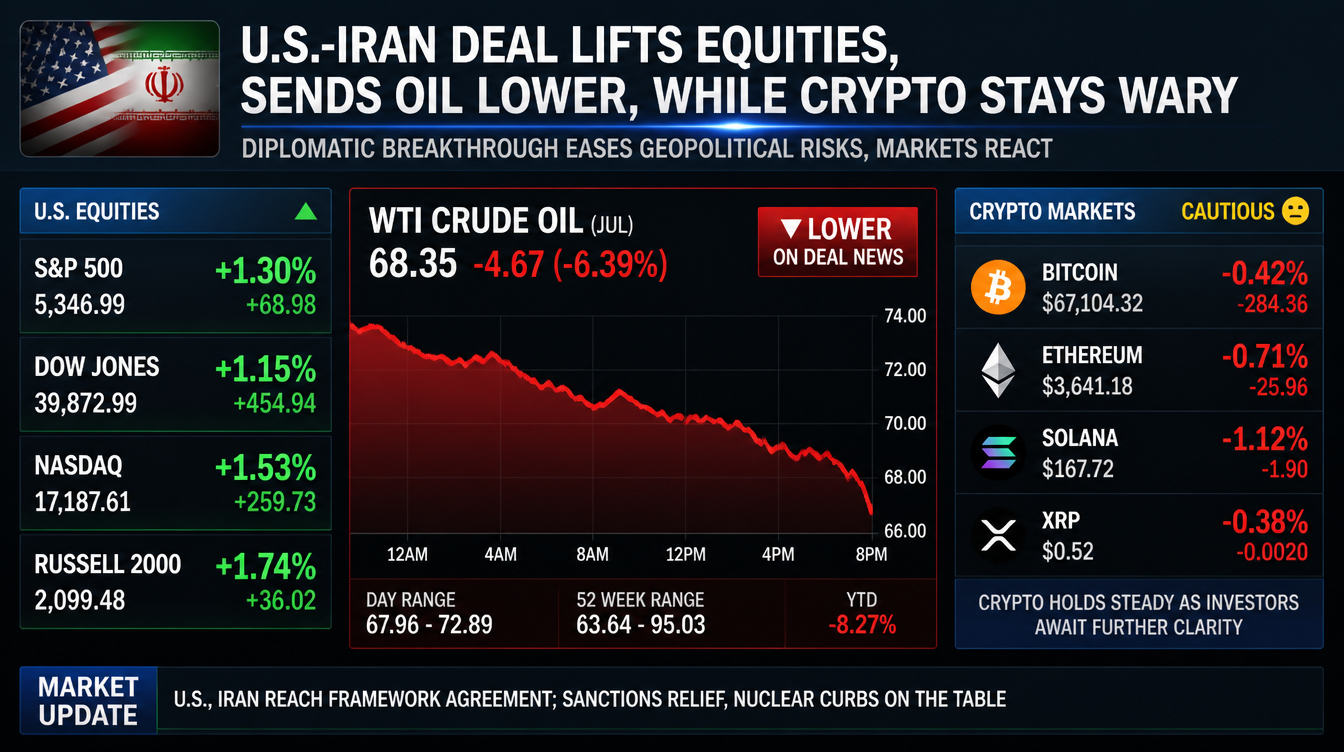
The weekend peace agreement delivered the macro catalyst global markets had been anticipating, although crypto traders remain increasingly cautious about reacting to geopolitical headlines.
The U.S.–Iran deal announced over the weekend broadly lifted risk sentiment across global financial markets.
Oil prices fell more than 4% on expectations that the Strait of Hormuz would reopen, while copper strengthened. Equity markets rallied, with MSCI’s Asia-Pacific index up 3% and Japan’s Nikkei 225 reaching a fresh record high.
Crypto, however, responded in a more restrained manner. The CoinDesk 20 Index (CD20) was little changed since midnight UTC, though it remained up 2.4% over the past 24 hours.
Bitcoin traded just under $66,000 with minimal intraday movement after a 3.4% weekend gain. Ether followed a similar trajectory, while smaller altcoins outperformed modestly, with the CoinDesk 80 Index rising around 1.5%.
The subdued reaction highlights growing skepticism in crypto toward geopolitically driven relief rallies. Previous ceasefire attempts have failed—one in April collapsed and another in early June was broken by U.S. strikes—both of which reversed earlier gains. As a result, traders are reluctant to fully price in the latest agreement ahead of its formal signing later in the week.
While markets have stabilized following the early June selloff, sentiment remains divided. On-chain indicators suggest selling pressure may be fading, while flow data indicates that meaningful new demand has yet to re-enter. Both conditions can exist simultaneously in the current phase.
At the same time, crypto is competing with other high-growth narratives for risk capital. SpaceX’s record IPO surged 19% on debut, with ARK Invest—led by long-time Bitcoin bull Cathie Wood—among the most active institutional buyers.
Upcoming listings from firms such as OpenAI and Anthropic further underscore how speculative capital is increasingly flowing toward AI and equity markets rather than crypto assets.
Derivatives
Bitcoin derivatives positioning improved over the week. Open interest rose to $17.4 billion, up roughly 7% week-on-week, while the three-month annualized basis ticked up to 3.0% from 2.8%.
Funding rates, however, remained weak, ranging from neutral to about -4% annualized across major venues, signaling limited demand for leveraged long exposure.
The combination of rising open interest and a firmer basis suggests incremental institutional participation, but subdued funding indicates a lack of strong directional conviction.
Options data presents a mixed but stable picture. The 24-hour put/call skew leaned toward puts (around 25/75), yet volatility indicators show no signs of stress. Deribit’s DVOL index eased to 39, down 3.4% on the day and near multi-year lows, while the implied volatility curve remains in contango rather than backwardation. This points to targeted hedging rather than broad fear.
Coinglass recorded $343 million in liquidations over 24 hours, with longs accounting for 27% and shorts 73%. Bitcoin and Ethereum led the market with $136 million and $60 million in liquidations respectively.
Binance data highlights $66,100 as a key level to watch on potential upside moves.
Token Talk
Decentralized AI tokens rallied after the U.S. government ordered Anthropic to restrict foreign access to its most advanced models.
Venice (VVV) gained about 14% to $16.37, with trading volume surging nearly 200% to roughly $130 million, according to CoinGecko data. Morpheus (MOR) climbed about 21% to $2.28.
Anthropic said the Commerce Department directed it to restrict access to its Fable 5 and Mythos 5 models under export-control rules. The company temporarily disabled both models globally while keeping other systems active, calling it a narrow compliance issue and saying it is working to resolve the misunderstanding.
Supporters of decentralized AI quickly framed the move as validation of their narrative. Venice founder Erik Voorhees said it reinforced the need for permissionless AI, while Morpheus supporters pointed to it as proof of censorship resistance.
Venice provides access to open-source models through its VVV token, while Morpheus incentivizes contributors of compute and code via MOR.
However, the rally appears more narrative-driven than fundamentally supported. MOR’s 21% gain occurred on less than $300,000 in trading volume, and both projects rely on open-source models that are less capable than Anthropic’s restricted systems.
The move was driven primarily by story momentum rather than technological progress.
Share this content: