Ethereum Ecosystem Race: Robinhood Chain’s Gas Boost Threatens Base’s Layer-2 Lead
Ethereum News: Robinhood Chain is rapidly gaining traction in the Ethereum Layer 2 market, recording 7.6 million transactions in a single day on July 10, only 11 days after its July 1 mainnet debut. The figure placed Robinhood Chain within striking distance of Base, which processed 9.2 million transactions during the same timeframe.
The speed of Robinhood Chain’s adoption has exceeded expectations among Layer 2 observers. Its early growth has largely been driven by a straightforward strategy: eliminating user transaction costs by covering gas fees.
While the transaction figures are impressive, they do not fully capture the strength of each network. Base has spent years developing its ecosystem through the support of Coinbase, extensive DeFi integrations, and established liquidity networks.
Robinhood Chain has managed to approach Base’s activity levels in less than two weeks, but its momentum has been boosted by temporary incentives rather than long-term organic usage. The key question is whether users will remain active after the gas subsidy program ends in late September 2026.
Gas-Free Transactions Fuel Robinhood Chain’s Initial Surge
Robinhood’s 90-day gas subsidy removes transaction fees for users until the end of September 2026. The program has attracted activity from retail traders, DeFi participants, and speculative users seeking low-cost blockchain transactions.
The effect on network activity has been significant. Data from MSBIntel showed Robinhood Chain processed 7.6 million transactions in one day while generating only about $4,000 in protocol fees. The limited fee revenue reflects the impact of subsidized transactions and the early economics of its Arbitrum-based rollup design.
Direct comparisons with Base remain difficult because the two networks currently operate under different fee structures. Base users pay normal transaction costs, while Robinhood users benefit from free execution. A more accurate comparison will come after the subsidy period ends and both networks compete without incentives.
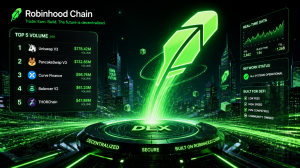
Robinhood Chain’s activity has also expanded beyond basic transfers. The network recorded more than $500 million in daily trading volume through Uniswap deployments, making it one of the largest venues for spot activity outside Ethereum mainnet.
The volume growth suggests that liquidity is forming alongside user activity rather than being driven only by transaction farming. However, analysts have noted that memecoin speculation contributed to some of the early trading volume, creating uncertainty about whether the activity can persist.
Tokenized Equities and Brokerage Users Offer a Unique Advantage
Robinhood Chain’s long-term opportunity may come from its connection to traditional financial markets and its existing user base.
The network launched alongside Robinhood’s tokenized stock platform, using Chainlink infrastructure for price feeds covering 95 tokenized assets, including companies such as Nvidia, Apple, and Alphabet. Trading liquidity is supported by Uniswap, while Morpho provides lending functionality.
The tokenized equities platform is accessible in more than 120 countries, giving Robinhood Chain a distribution advantage that many Ethereum Layer 2 networks lack.
Another major benefit is Robinhood’s existing customer base of around 23 million brokerage users. Unlike crypto-native Layer 2 platforms that must attract users from within the blockchain ecosystem, Robinhood can introduce traditional investors directly to on-chain products.
If a meaningful share of those users continues using decentralized applications after the gas subsidy expires, the network could develop stronger long-term adoption.
Built with Arbitrum Orbit technology, Robinhood Chain also remains connected to Ethereum’s broader scaling ecosystem. Future network fees will contribute a portion of revenue back to the ARB ecosystem, creating cooperation with existing Layer 2 infrastructure.
Investor interest has already reflected optimism surrounding Robinhood’s blockchain expansion. Robinhood Markets shares gained after the Layer 2 announcement, while additional momentum came from the company’s introduction of AI-powered trading tools, according to market data cited in reports.
Share this content: