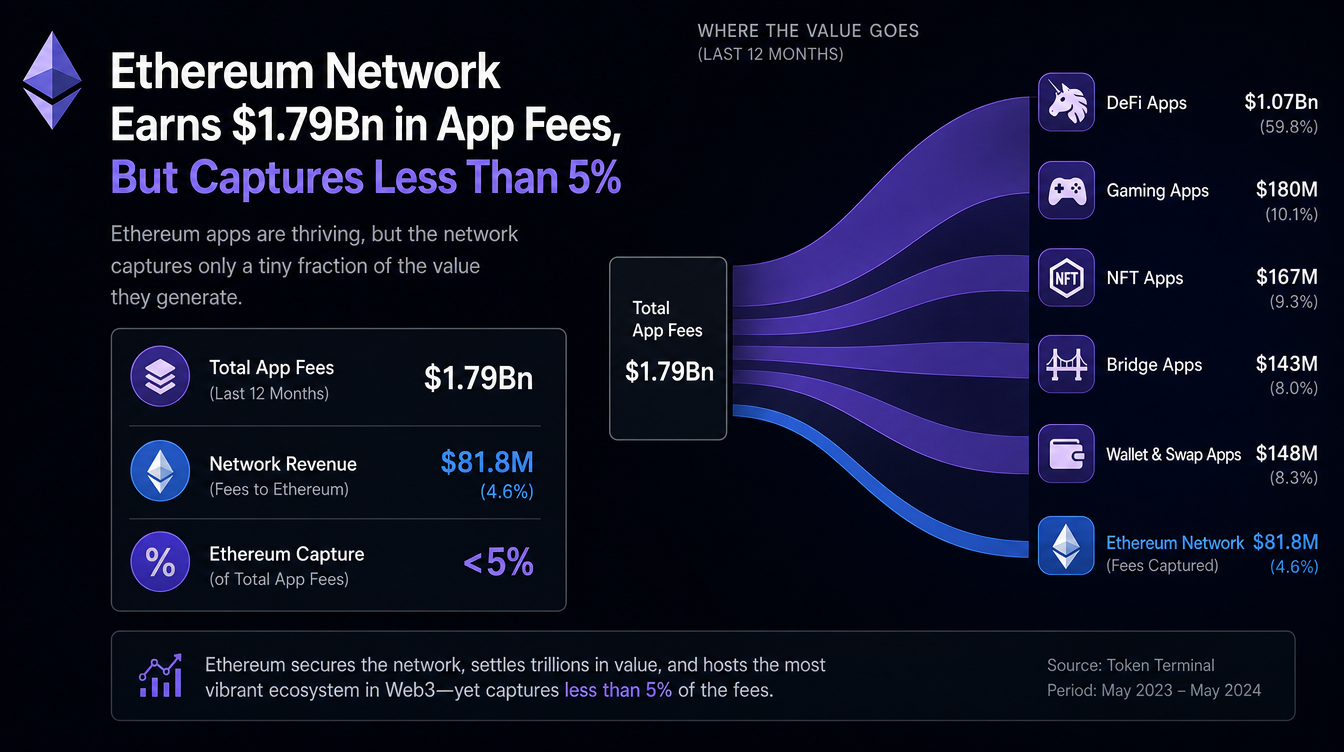
Ethereum Apps Rake In Billions While Network Captures Less Than 5% of the Revenue
Ethereum’s application ecosystem generated $1.79 billion in fees during Q2 2026, while layer-2 networks handled about 1,270 user operations per second and real-world assets worth $17.2 billion were tokenized on the blockchain.
However, ETH’s market performance has failed to match the network’s growth. The token is still trading below $2,000, roughly 60% below its August 2025 record high of nearly $4,950. Although Ethereum activity continues to expand, the value flowing back to ETH holders has not kept pace, creating a major debate around the asset’s long-term economic model.
On-chain analyst @Tanaka_L2 highlighted this disconnect in a July 31 analysis, revealing that Ethereum’s base layer captured just 4.9% of the economic value generated by applications built on top of the network during Q2.
Ethereum’s layer-1 generated $88.4 million in Real Economic Value, compared with the $1.79 billion produced by applications across its ecosystem. This gap helps explain ETH’s underperformance compared with both its historical cycles and Bitcoin, which has fallen around 11% in 2026 while ETH has declined nearly 32%.
The weakness in Ethereum’s value capture appears to be the result of structural changes rather than temporary market conditions. Layer-2 rollups now account for the majority of user activity, with Tanaka’s data showing approximately 1,270 user operations per second on rollups compared with only 20.4 on Ethereum’s mainnet.
Blob Fees Alter Ethereum’s Burn Dynamics
Ethereum’s shift toward rollup-based scaling has improved network efficiency and lowered transaction costs, but it has also reduced the fee pressure that previously contributed to ETH’s supply burn mechanism.
The introduction of cheaper blob fees for L2 data availability has significantly reduced the amount of ETH being burned. Over a seven-day period, blob fee activity resulted in only around 0.22 ETH being destroyed, highlighting the limited impact of current L2 usage on ETH scarcity.
With annual ETH supply growth at approximately 0.85% and staking returns near 2.6%, the foundation of the “ultrasound money” narrative has weakened. The ETH/BTC ratio has also slipped to multi-year lows as Bitcoin continues benefiting from consistent institutional demand.
Ethereum is additionally dealing with ETF outflows and the absence of a strong demand driver that could offset concerns about its value-accrual model. The market is now examining whether tokenization and institutional adoption can provide a new source of ETH demand.
ETH’s Future May Depend on Its Settlement Role
Tanaka argues that Ethereum’s traditional narrative as a fee-generating blockchain no longer fully reflects its potential. Instead, he believes ETH could gain value by becoming a reserve asset and settlement layer for institutional tokenized finance.
Under this framework, expanding on-chain financial markets would create demand for ETH through collateral usage and settlement activity rather than relying mainly on everyday transactions.
Ethereum already supports significant financial activity, with approximately $299.4 billion in stablecoins and $17.2 billion in tokenized real-world assets on the network.
According to Tanaka, Ethereum’s key advantages are its institutional liquidity, established settlement infrastructure, and the large portion of ETH supply locked through staking. These factors could become more important as traditional finance adopts blockchain technology.
However, three major conditions must develop before this thesis can translate into stronger ETH demand:
- Layer-2 growth must create greater demand for Ethereum’s limited throughput capacity.
- Stablecoins and tokenized assets must see increased circulation instead of remaining inactive.
- Institutions must hold ETH as a reserve asset rather than only using Ethereum’s infrastructure.
At present, these factors have yet to reach a meaningful scale.
Can Ethereum Convert Growth Into Token Value?
Ethereum’s next phase depends on whether expanding network usage can eventually produce stronger economic returns for the base layer.
If stablecoin activity and real-world asset settlements increase enough to create demand beyond available blob capacity, Ethereum could see renewed fee pressure and stronger ETH burn activity.
Such a scenario would allow Ethereum’s scaling strategy to translate into improved token economics. But if usage continues rising while L1 fees remain low, concerns over ETH’s value capture could continue and place further pressure on the ETH/BTC ratio.
ETH’s near-term outlook is also shaped by macro factors. The asset has maintained a stronger correlation with Nasdaq compared with Bitcoin and currently lacks a clear catalyst that directly addresses its revenue-generation challenge.
Tanaka describes Ethereum’s current stage as a deliberate period of margin compression: the network has focused on expanding adoption through lower-cost execution while postponing stronger economic returns to the base layer.
The market’s key question is whether this delayed value capture will eventually trigger a major ETH revaluation or become a permanent characteristic of Ethereum’s modular architecture.
Share this content: