Crypto News: $288M Bitcoin and Ethereum Shift Exposes Flaws in Reserve Policies
Here’s a cleaner, more concise rewrite with a slightly sharper tone:
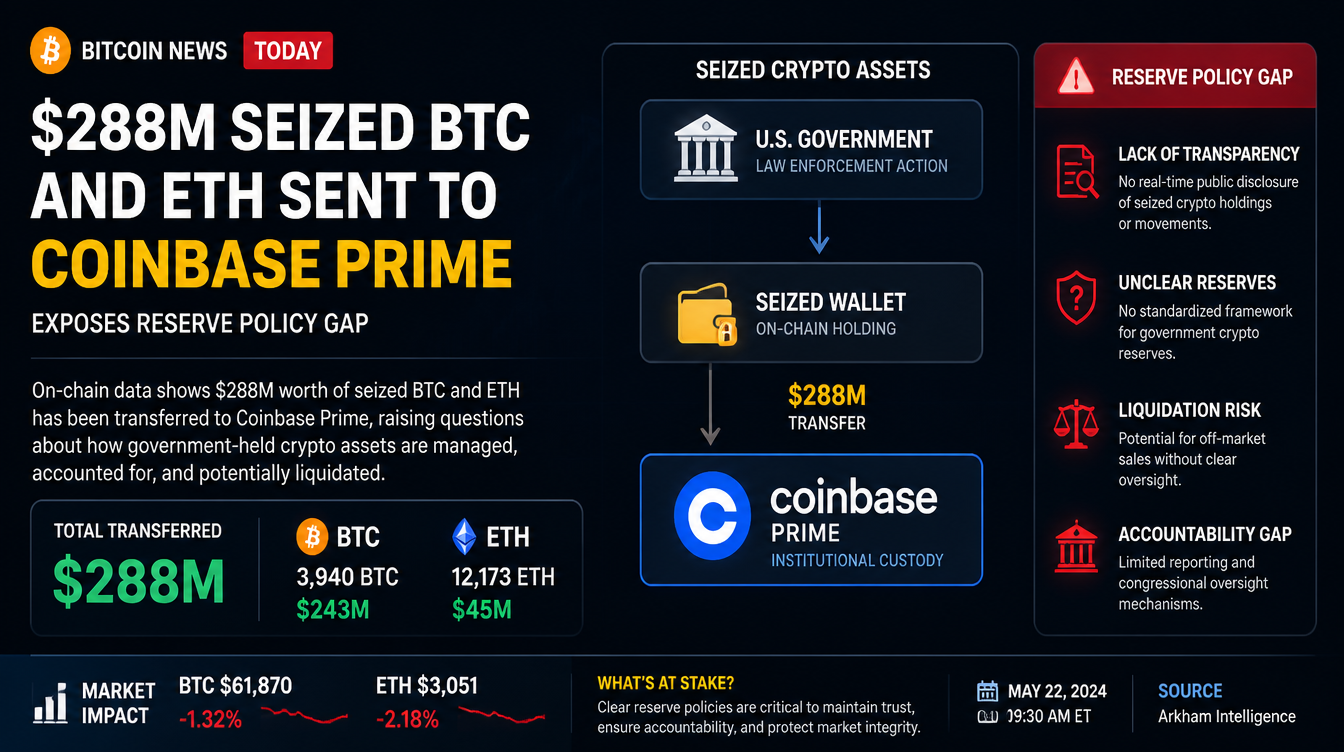
U.S. government wallets moved nearly $288 million in seized Bitcoin and Ethereum to Coinbase Prime, raising fresh questions about how strictly Donald Trump’s Strategic Bitcoin Reserve order is being carried out.
Bitcoin News Today: On July 14, 2026, on-chain data from Arkham Intelligence revealed a series of transfers involving confiscated crypto assets. These included 2,875 BTC linked to the Ryan Farace (“xanaxman”) case, additional bitcoin from the BTC-e exchange seizure, and a large Ethereum tranche tied to Brian Krewson’s laundering scheme.
Altogether, 30,007 ETH associated with Krewson was also routed to Coinbase Prime. The transactions have drawn scrutiny because the March 2025 executive order establishing the Strategic Bitcoin Reserve specifies that seized bitcoin should be held—not sold.
Rather than a routine reshuffling of assets, the transfers highlight a bigger issue: whether the order has been fully implemented across agencies or remains a high-level directive without firm operational backing.
How the Funds Were Moved
The bitcoin transfers followed a two-step routing pattern. Funds from the Farace case—valued at roughly $178 million—were first sent to a newly created intermediary wallet, then quickly forwarded in full to a Coinbase Prime deposit address.
A similar method was used for BTC-e-related funds, where 925.512 BTC (around $57 million) moved through a fresh intermediary wallet before reaching Coinbase Prime.
Ethereum transfers took a simpler path. The 30,007 ETH tied to Brian Krewson were sent directly to Coinbase Prime without any intermediary step.
In a separate move, about 140 BTC were shifted between existing government-controlled Coinbase Prime wallets and cold storage, indicating internal reallocation rather than a new external deposit.
These movements have fueled speculation about closer coordination between government agencies and crypto firms, potentially tied to custody or compliance processes.
The use of newly generated intermediary wallets is particularly notable. While such routing has often been linked to preparing assets for sale, Coinbase Prime also provides institutional custody and staging—meaning the transfers don’t necessarily signal liquidation.
Strategic Bitcoin Reserve: Policy vs. Practice
The Strategic Bitcoin Reserve, created under Trump’s March 2025 executive order, directs that seized BTC be retained as a long-term asset rather than sold. Treasury Secretary Scott Bessent has reinforced this approach publicly.
However, the absence of clearly defined custody frameworks and onboarding procedures leaves room for ambiguity. Transfers to Coinbase Prime sit in a gray zone—they could represent compliance steps or actions that blur the intent of the policy.
More likely, the transactions reflect an operational gap rather than a deliberate breach. Coinbase Prime already serves as a trusted institutional custodian, making it a logical staging point before assets are formally assigned to the reserve.
Still, without official clarification, the intent behind these transfers remains uncertain.
Share this content: