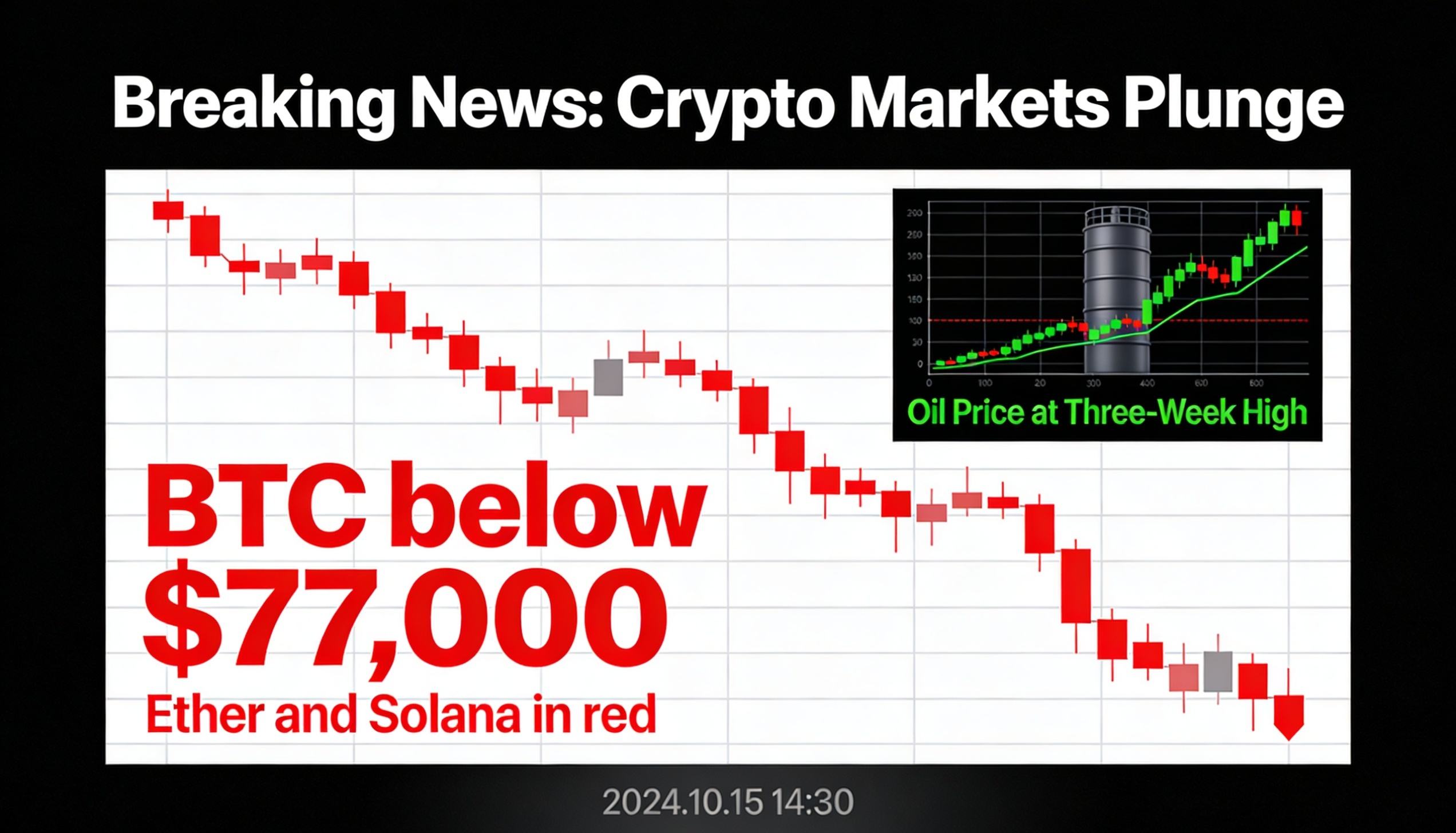
Bitcoin fell to $76,923 on Tuesday morning, down 2.4% in 24 hours after failing to sustain a break above $79,400 in the previous session. The rejection reinforces $79,000 as a near-term resistance zone after multiple failed attempts in recent trading.
BTC briefly touched $79,399 on Monday before reversing sharply and extending losses into Tuesday. The weakness spread across major altcoins, with ether down 3.7% to $2,290, XRP falling 3.2% to $1.39, solana sliding 3.9% to $84.10, and BNB easing 1.8% to $625. Most top-10 tokens ended the session in the red, with only TRON and DOGE managing gains.
Broader macro conditions added pressure as Brent crude extended its advance for a seventh straight day, rising 1% to trade above $109 a barrel. The rally comes as geopolitical tensions around the Strait of Hormuz persist, with stalled negotiations over Iran’s proposal keeping energy supply risks elevated and reinforcing inflation concerns.
Equity markets were relatively muted. The MSCI Asia Pacific Index traded flat, while Japanese stocks found support after the Bank of Japan voted 6–3 to hold policy steady. The yen strengthened slightly to around 159 per dollar.
In crypto markets, analysts remain divided on what is driving price action. Galaxy Digital CEO Mike Novogratz pointed to renewed U.S. retail participation alongside institutional inflows and limited supply, suggesting the setup still supports further upside. On-chain data from Santiment also indicates whales have accumulated more than 40,000 BTC over the past two weeks, alongside a rapid shift in sentiment from fear toward FOMO.
On the other hand, CryptoQuant founder Ki Young Ju argued that the move above $79,000 was primarily driven by a derivatives short squeeze rather than sustained spot demand. He warned that once forced covering fades, the market could be vulnerable to a pullback if new buyers do not step in.
Derivatives data adds nuance to that view. Funding rates on perpetual futures remain negative on a 7-day basis at -0.13%, according to Coinglass, indicating shorts still dominate positioning and are paying longs—conditions that often precede volatile reversals in either direction.
Despite the debate, corporate accumulation continues. Strategy reportedly purchased $3.9 billion worth of bitcoin in April, its largest monthly buy in a year. In Japan, Metaplanet also announced a $50 million bond issuance to fund further bitcoin acquisitions, extending its debt-financed treasury strategy.
Markets now turn to a pivotal macro week. The Federal Reserve will announce its policy decision on Wednesday, with traders increasingly pricing in easing expectations. The shift follows news that the Justice Department has closed its probe into Fed Chair Jerome Powell, which has influenced rate-cut positioning.
Big Tech earnings will also be closely watched, with Alphabet, Microsoft, Amazon, and Meta reporting midweek, followed by Apple on Thursday. Together, these companies represent roughly a quarter of the S&P 500’s market capitalization.
Traders say a dovish Fed tone or strong earnings could help bitcoin break above $80,000. Without a clear catalyst, repeated rejections near $79,000 may continue to cap upside and define the upper bound of the current trading range.
Share this content: