Bitcoin’s drawdowns are getting smaller—and Wall Street is taking note.
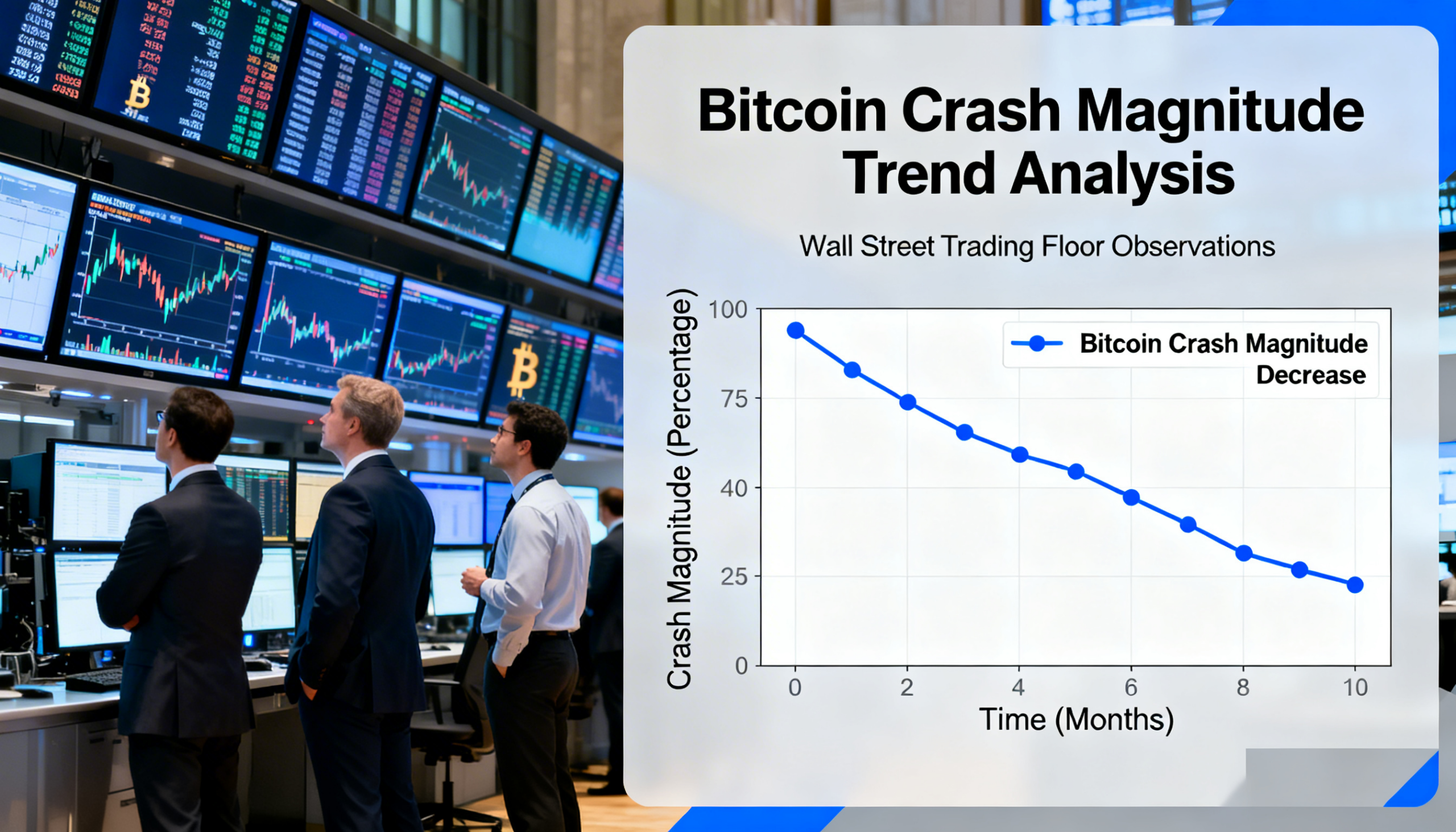
Bitcoin’s history has been defined by dramatic boom-and-bust cycles, with past bear markets wiping out as much as 80% to 90% of its value. This cycle, however, the decline has been closer to 50%—a shift that many analysts say reflects a maturing asset.
“Drawdowns compressing to around 50% point to a more developed market structure,” said AdLunam co-founder Jason Fernandes. As liquidity deepens and institutional participation grows, volatility tends to moderate on both the upside and downside, he noted. At that stage, the conversation shifts from whether bitcoin is viable to how it should be allocated.
That view echoes recent commentary from Fidelity Digital Assets analyst Zack Wainwright, who observed that bitcoin’s growth is becoming less impulsive, with a lower likelihood of extreme downside moves. He highlighted that the current pullback from the October high above $126,000 is far less severe than declines seen in earlier cycles.
Historically, those downturns were much sharper. After peaking near $1,163 in 2013, bitcoin plunged roughly 87% to about $152 by early 2015. A similar pattern followed the 2017 bull run, when prices fell from $20,000 to just over $3,100—an 84% drop.
Still, not everyone is convinced that such deep corrections are a thing of the past. Bloomberg Intelligence analyst Mike McGlone argues that bitcoin could undergo a “normal reversion” toward $10,000, maintaining that the broader crypto bubble has already burst. In his view, any further decline could align with weakness across equities, commodities, and other risk assets.
Fernandes, who disagrees with that outlook, said bitcoin’s growing size makes extreme collapses less likely. As the asset class expands, significantly larger capital flows are required to drive sharp declines. This dynamic is reinforced by institutional adoption, including ETFs and pension exposure, which makes large-scale unwinds more difficult.
Institutional portfolio dynamics are also shifting the narrative. Fernandes pointed out that even a small allocation—around 1% to 3%—can enhance returns and improve risk-adjusted performance without materially increasing downside risk. In that context, bitcoin is increasingly viewed not as a speculative bet, but as a portfolio optimization tool.
“That changes the risk equation,” he said. “The question is no longer whether to own bitcoin, but what it costs not to.”
Fidelity’s long-term data supports that evolution. Over the past decade, bitcoin has delivered returns of roughly 20,000%, outperforming equities, gold, and bonds, while also leading on a risk-adjusted basis despite its volatility. The firm noted that bitcoin has been the top-performing asset in 11 of the last 15 years.
At the same time, the tradeoff is becoming clearer. As volatility declines, so too does the potential for outsized gains. The explosive upside of earlier cycles came alongside severe drawdowns, but as those drawdowns shrink, bitcoin is beginning to behave more like a macro asset than a high-risk, venture-style investment.
If extreme losses are becoming less common and modest allocations can enhance portfolio performance without significantly increasing risk, bitcoin’s role is evolving. For institutional investors, that shift may mark a key turning point in how the asset is viewed and used.
Share this content: