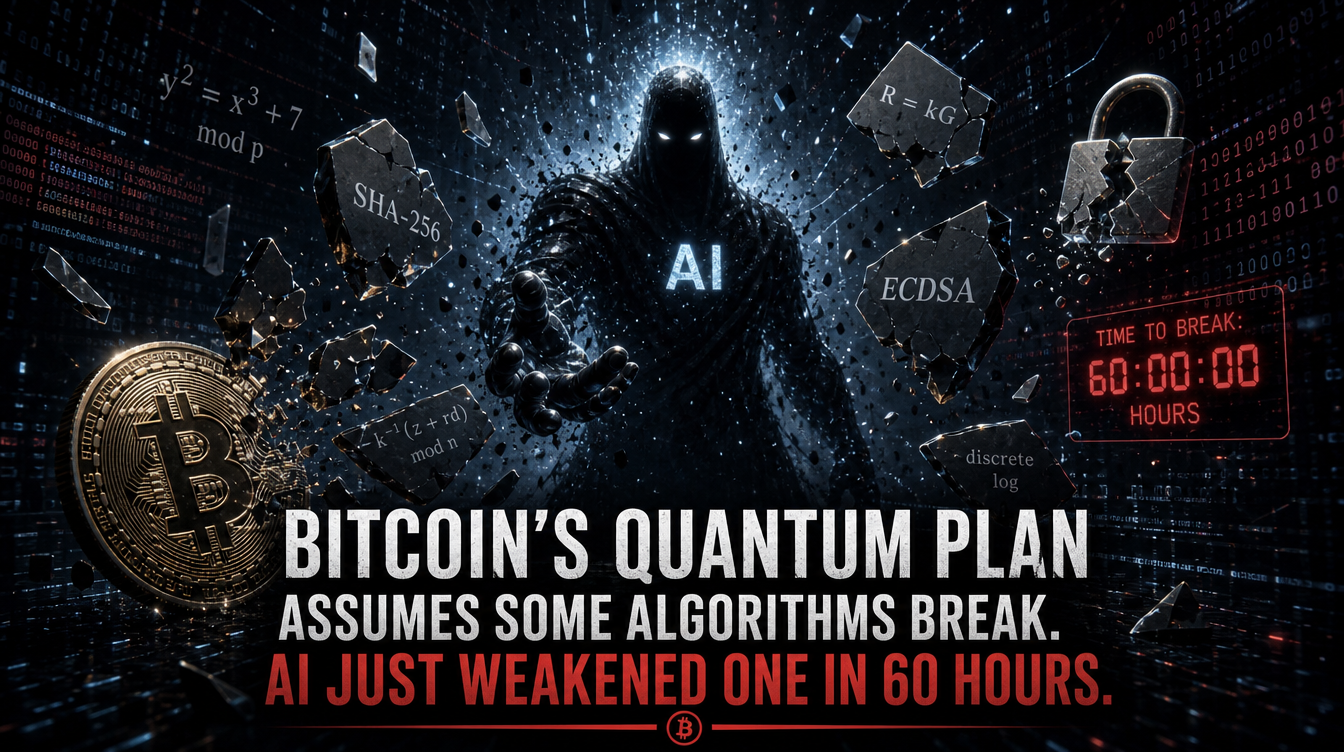
AI Advances Shake Bitcoin’s Quantum Roadmap With Rapid Algorithm Weakening
HAWK has not been deployed and is not used by Bitcoin, but it is part of the broader effort to build quantum-resistant cryptography—an area Bitcoin developers are actively preparing for.
This week, AI company Anthropic reported that its Claude Mythos Preview model uncovered a flaw that cuts HAWK’s effective key strength in half. HAWK is a proposed replacement for today’s digital signature systems, which secure online banking and web transactions.
The finding required around 60 hours of computation and about $100,000 in resources, targeting an algorithm that had already gone through two years of development and multiple rounds of expert review.
Digital signature schemes like HAWK verify that data originates from the holder of a specific private key. Bitcoin relies on such signatures for every transaction, and they also support secure web connections, indicated by the browser padlock icon.
Current signature methods are expected to break under sufficiently advanced quantum computers, and HAWK is one of several candidates under consideration. However, it has not yet been deployed in practice.
The research does not affect Bitcoin or Ethereum today, as both use elliptic curve cryptography, which was not targeted. HAWK is also not among the schemes Bitcoin plans to adopt.
Bitcoin’s BIP-360 proposal outlines a transition to quantum-resistant addresses using three algorithms already standardized by NIST, with built-in redundancy to provide fallback options if any are compromised.
What has changed is the pace of classical cryptographic attacks. A related proposal, BIP-361, warns that the window for migration is shrinking, citing improvements in attack efficiency of up to 20 times. Anthropic’s results support this trend, showing how AI can accelerate progress.
For HAWK’s smallest parameter set, the cost of recovering a key dropped from roughly 2^64 operations to 2^38. While larger keys remain difficult to attack, increasing key sizes would erode most of HAWK’s performance benefits.
Anthropic disclosed the issue to HAWK’s developers in June and coordinated its release through NIST.
In a separate result, the team improved attacks on a weakened version of AES—the standard encryption used to protect wallet files—by factors of 200 to 800.
Encouragingly, the model achieved only limited gains—under tenfold—against Poseidon, a hash function widely used in zero-knowledge proof systems that support rollups and privacy protocols.
Initially, Claude declined to attempt the AES challenge, calling it genuinely difficult. After a few prompts, however, it generated billions of tokens over three days and identified the improvement. Verifying the result took two researchers nearly a month.
The timing is notable. This week, the privacy-focused network Zcash rolled out an upgrade introducing a new shielded pool designed to remain secure in a future with quantum computers.
The cryptographic systems meant to guide this transition are now being stress-tested by AI tools that can move faster than the humans who designed them.
Share this content: