Vitalik Highlights $30M Annual Cost to Maintain Ethereum Core — Funding Debate Intensifies
Trent Van Epps has warned that Ethereum is staring at an estimated $20 million annual funding gap for core development, with the Client Incentive Program (CIP) set to expire in April 2026 and no clear replacement in place.
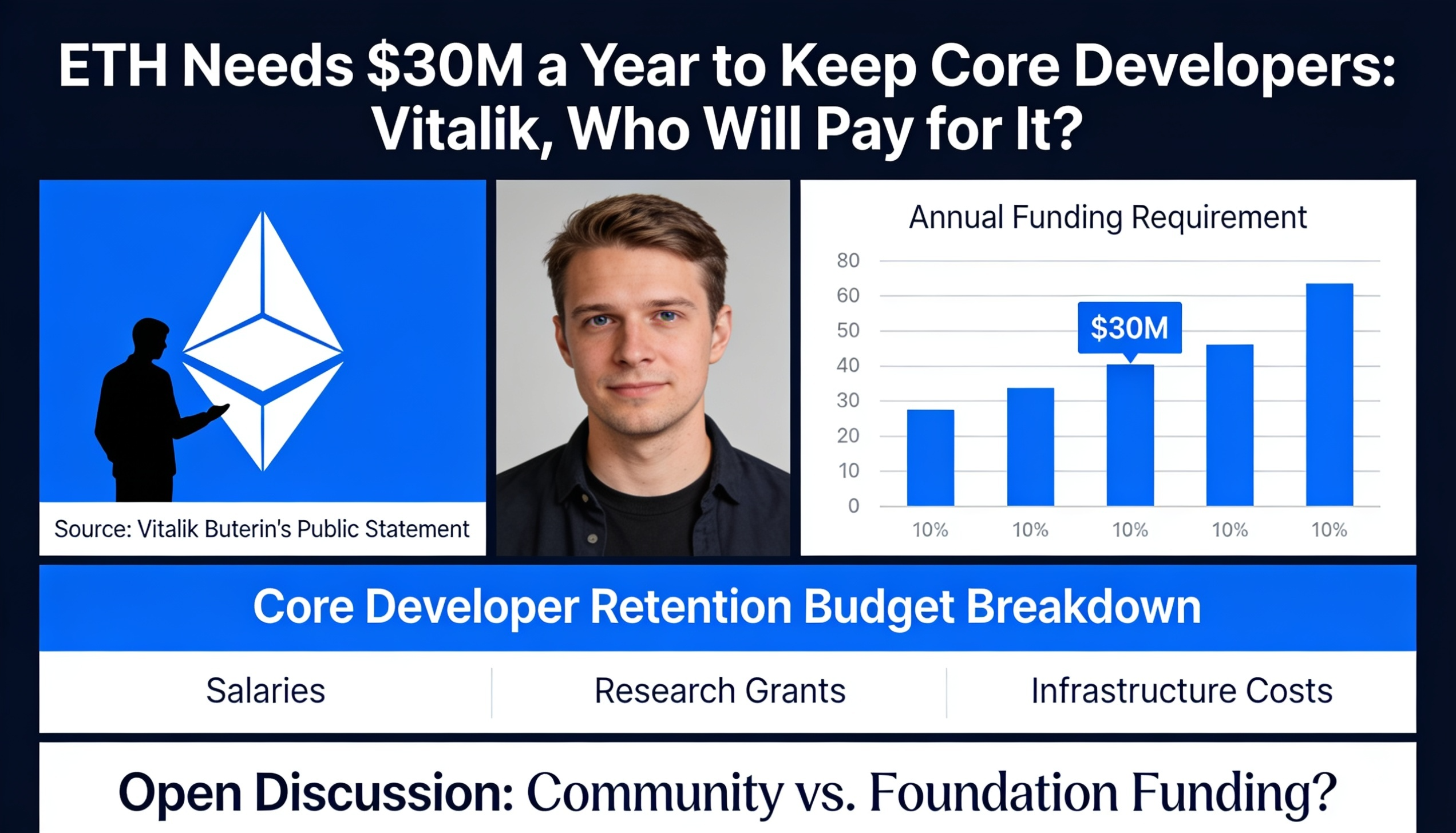
In a June 26 CoinDesk Markets Outlook interview with Jennifer Sanasie, the former Ethereum Foundation ecosystem development lead and Protocol Guild co-founder said the network needs roughly $30 million per year to sustain core protocol work. Existing funding channels fall well short, leaving a structural deficit with no scalable solution yet visible.
Van Epps framed the issue as more than a funding problem, calling it a critical test of Ethereum’s decentralized governance model as the Ethereum Foundation (EF) continues to reduce its role.
EF Retreat Leaves a Funding Void
The Ethereum Foundation is pushing forward with its “subtraction strategy,” aimed at shrinking its central influence and shifting responsibility to the broader ecosystem.
That shift includes plans to reduce annual treasury spending from about 15% of reserves to roughly 5% by 2030. The EF has also cut around 20% of its workforce and seen a wave of senior departures, including two co-directors in a short span, raising questions about coordination and long-term governance.
The most immediate pressure point is the end of the CIP, a four-year program that provided ETH-denominated incentives to client teams such as Geth, Erigon, and Lighthouse. Designed as a temporary bridge, it is now ending without a sufficiently scaled successor.
Protocol Guild Highlights the Gap
Van Epps co-founded Protocol Guild to help fund core contributors through token donations distributed via long-term vesting, without giving donors influence over protocol decisions.
Backed by projects like Lido, Uniswap, and ENS, the Guild has distributed nearly $40 million over four years—about $10 million annually—far below the $30 million needed, leaving a persistent $20 million shortfall.
He pointed to a “free rider” dynamic at the core of the issue, where DeFi protocols, stablecoin issuers, and Layer 2 networks benefit from Ethereum’s infrastructure without being required to fund its upkeep.
A Narrow Window to Act
Van Epps warned the next three to nine months will be decisive. Without sustainable funding mechanisms, Ethereum risks a gradual erosion of its developer base.
The consequences could include the loss of key maintainers, reduced client diversity, slower bug fixes, and delays to critical upgrades, including quantum-resistance efforts.
Despite these risks, Van Epps remains confident in Ethereum’s long-term position, citing its dominance in DeFi, stablecoin settlement, and EVM adoption as durable network effects. In that context, the $30 million annual requirement appears modest relative to Ethereum’s roughly $200 billion market cap and trillions in annual stablecoin volume.
Looking ahead, he envisions a more decentralized model where the Ethereum Foundation focuses on research and coordination, while independent entities take on funding, infrastructure, and ecosystem growth—an approach aligned with Vitalik Buterin’s view that the EF is not meant to be a permanent steward.
Van Epps also stressed the need to better articulate ETH’s value capture to attract institutional support capable of replacing CIP-style funding.
Ultimately, the clearest signal of success may be developer retention—whether the teams maintaining Ethereum’s core infrastructure remain intact over the next year.
Share this content: