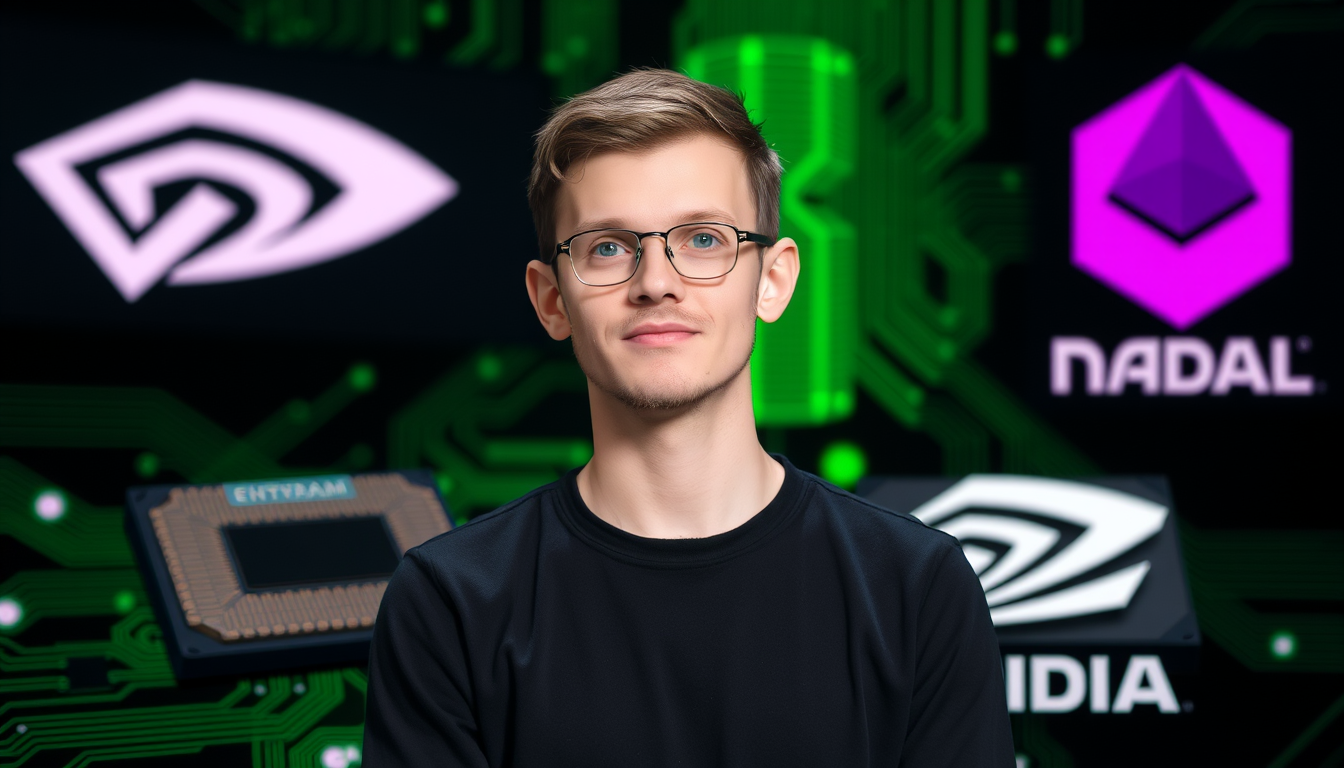
Vitalik Buterin Eyes Hardware Innovation as Ethereum’s Ambitions Expand Beyond Blockchain
Vitalik Buterin is looking to extend Ethereum’s decentralization principles into the semiconductor industry through open-source hardware development. The Ethereum co-founder has shared an in-depth analysis of chip design, covering transistor architecture, manufacturing methods, and hardware security. His argument is that the technology powering modern computing should be open to inspection and modification rather than remain a proprietary system controlled by a small group of manufacturers.
Could Ethereum eventually expand beyond blockchain infrastructure and develop its own hardware ecosystem? Vitalik’s latest exploration raises this possibility as Nvidia continues to strengthen its position in the global computing industry.
Vitalik Buterin Wants to Decentralize Hardware Design
Vitalik’s proposal addresses a familiar issue in cryptocurrency: trust. Open-source software allows developers to review code, identify vulnerabilities, and verify how applications work. Blockchain transactions can also be independently checked through public records. Hardware is more difficult to scrutinize because users generally have limited access to the internal design of computing components.
Processors can contain undisclosed vulnerabilities or malicious alterations that are difficult for users to identify. Consequently, even a secure wallet application may be exposed if the hardware supporting it has been compromised. Security concerns involving Ledger, Trezor, and other hardware wallet providers have demonstrated why protecting the physical layer matters.
This extends the concept of self-custody beyond private key ownership. Users may control their cryptocurrency keys, but they still need confidence in the devices responsible for protecting them.
Vitalik argues that “the hardware layer must be open for participation and tinkering too.” He wants chip architectures and technical specifications to become accessible to developers, researchers, and independent auditors, allowing them to examine and improve hardware without depending entirely on manufacturers.
Making hardware designs publicly available could also create opportunities for Ethereum-related technologies. Validators, hardware wallets, cryptographic applications, and zero-knowledge proof systems all depend on computing infrastructure that requires reliable security.
Can Ethereum Become a Competitor to Nvidia?
Nvidia built its position in the semiconductor market by making GPUs a critical part of artificial intelligence infrastructure. Its combination of advanced processors, CUDA software, and a large developer ecosystem has established a significant advantage over competing chipmakers.
Vitalik is proposing a different direction. Instead of prioritizing processing speed and competing directly with Nvidia’s most powerful GPUs, Ethereum-related hardware could focus on transparency, security, and verifiable designs.
The approach still faces substantial barriers. Advanced semiconductor production requires expensive machinery, specialized manufacturing facilities, and significant financial resources. Open-source chip projects therefore face difficulties matching the performance of leading commercial processors.
Vitalik recognizes that open hardware may involve performance compromises. He suggests that “Secure hardware may be 10x less efficient or more” while remaining capable of meeting the requirements of many computing applications.
This presents a different perspective from the semiconductor industry’s continued pursuit of faster and more powerful processors, regardless of the additional manufacturing costs.
Specialized chips designed for cryptographic calculations, privacy-preserving applications, secure data processing, and decentralized networks could benefit from open-source development. Developers could adapt chip architectures, researchers could examine their circuitry, and manufacturers could produce competing hardware using publicly accessible specifications.
Ethereum already has an established community working on cryptography, distributed systems, and blockchain technology. Applying that collaborative development approach to semiconductor design could help the ecosystem enter the hardware market without immediately challenging Nvidia’s dominance in AI computing.
The ambition may not be to create another Nvidia-sized GPU business. Instead, Ethereum could help establish a hardware ecosystem where transparency and security matter more than achieving the highest possible processing speeds.
Ethereum’s Vision Could Extend Beyond the Crypto Industry
Vitalik’s hardware proposal has implications beyond blockchain networks. He sees open-source chip development as part of a broader computing movement that would allow users to inspect, verify, and modify the technology they rely on.
Potential applications include personal computers, enterprise servers, Internet of Things (IoT) devices, and secure computing infrastructure. As artificial intelligence, financial services, and personal information increasingly depend on sophisticated computing systems, hardware transparency could become an important consideration.
Nvidia’s market leadership is unlikely to disappear anytime soon. However, Ethereum has developed around a philosophy of open participation and decentralized infrastructure rather than centralized control.
If Vitalik’s approach eventually brings these principles into semiconductor development, Ethereum could expand into a technology sector far removed from its traditional blockchain focus.
The bigger question is whether decentralization can move beyond software and financial infrastructure to reshape the physical chips powering the digital economy.
Share this content: