Market Jitters Over STRC Prompt Terra Echoes, But Experts Say It’s Not the Same Case
Benchmark analyst Mark Palmer says comparisons between STRC and Terra’s UST are based on a misunderstanding of Strategy’s structure, arguing the asset is a dividend-paying preferred equity instrument indirectly backed by bitcoin, not a fixed peg that can fail.
Strategy’s STRC shares have recently fallen to record lows, prompting renewed comparisons with Terra’s UST stablecoin, whose 2022 collapse wiped out roughly $40 billion in value.
While the analogy has spread across social media, Benchmark Research argues it overlooks fundamental differences.
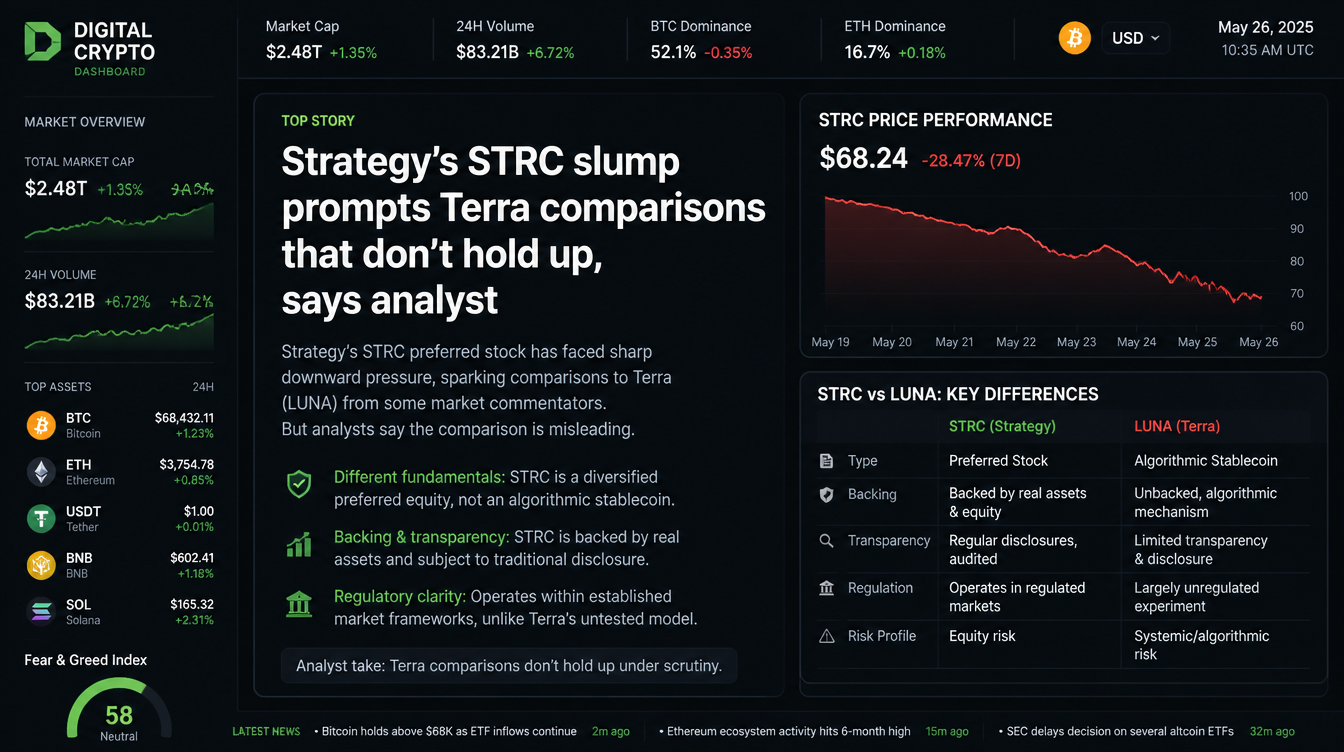
The comparison largely stems from two surface similarities. STRC is designed to trade near $100 but dropped to an intraday low of about $82.53 last week before recovering to around $88.65 on Monday, roughly 11% below its target level.
Some market participants have described the move as a “depeg,” borrowing terminology used for stablecoins that lose parity with $1. STRC also offers an 11.5% dividend yield, drawing comparisons with Terra’s Anchor protocol, which once promised high returns before its collapse.
However, Benchmark-StoneX analyst Mark Palmer rejected that interpretation, emphasizing that STRC is not a stablecoin.
Unlike stablecoins, which are structured to maintain a fixed $1 value, STRC is a preferred equity instrument intended to trade near $100 without a guaranteed peg, meaning it cannot technically “depeg.”
Palmer said Strategy’s goal is to support trading around $100 rather than guarantee it, describing the recent move as a “market-driven reset in required yield” rather than a structural breakdown.
He contrasted this with Terra’s UST, which relied on an algorithmic mint-and-burn mechanism tied to LUNA and lacked real asset backing. Once confidence broke, the system unraveled and both tokens collapsed.
STRC, by contrast, has no reflexive stabilization mechanism and is instead backed indirectly by Strategy’s bitcoin holdings, which the company says total 847,363 BTC worth about $54.5 billion.
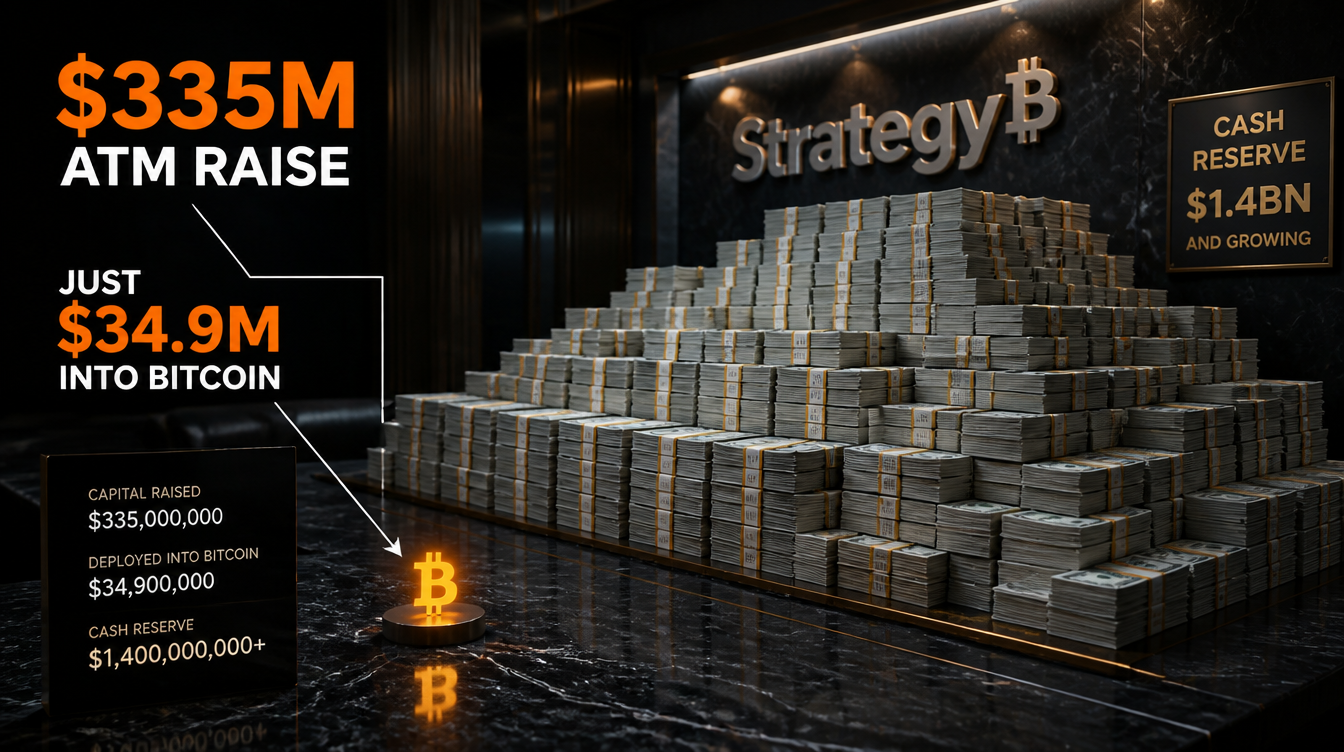
The decline has nonetheless affected Strategy’s capital-raising mechanism. When STRC trades above $100, the company issues shares to fund additional bitcoin purchases; below that level, issuance slows or stops, leading to a temporary pause.
Palmer noted that while funding efficiency has weakened, this does not imply structural damage to the company’s model.
Benchmark also reiterated its $570 price target on Strategy’s common stock (MSTR), well above its recent high of about $457 in October, even as shares fell 2.8% to $109 on Monday for a fifth consecutive decline.
Share this content: