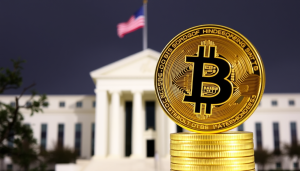
Bitcoin Strengthens Regulatory Position While CLARITY Act Remains Unresolved
BlackRock’s Robert Mitchnick said Bitcoin’s growing regulatory acceptance has reduced the importance of the CLARITY Act for the leading cryptocurrency, even as DeFi and other digital-asset sectors continue to operate under unclear rules.
Robert Mitchnick, BlackRock’s head of digital assets, told CNBC on Wednesday that Bitcoin has established a regulatory position that sets it apart from most other cryptocurrencies. Because of that progress, he said the CLARITY Act could have a greater impact on the rest of the crypto market than on Bitcoin.
The comments came as demand for U.S. spot Bitcoin ETFs remained strong. The products attracted $232.1 million in net inflows Wednesday, extending their positive streak to eight sessions and bringing cumulative inflows over the period to $2.8 billion, CoinGlass data showed.
Mitchnick said Bitcoin’s regulatory position should not be viewed in the same way as that of decentralized finance (DeFi) and other complex crypto sectors. While Bitcoin has gained broader regulatory recognition, questions surrounding the legal treatment of DeFi and similar activities remain unanswered.
CLARITY Act News: Senate Has Yet to Pass the Bill
The Digital Asset Market Clarity Act of 2025, or H.R. 3633, cleared the House of Representatives in a 294-134 vote on July 17, 2025, according to congressional records.
The Senate Banking, Housing, and Urban Affairs Committee advanced the measure with a substitute amendment on June 1, 2026. The Senate subsequently received motions for cloture and to proceed with consideration on Aug. 8.
The legislation remains pending in the Senate. If enacted, the amended bill would establish a regulatory framework for the offer and sale of digital commodities, involving oversight from both the SEC and CFTC.
For Bitcoin, Mitchnick said institutional investors are not treating additional legislation as a requirement for continued adoption. Instead, he characterized future regulatory progress as a potential benefit that could strengthen Bitcoin’s position further.
He said the situation is different for DeFi and other complex segments of the industry, where regulatory ambiguity remains a significant obstacle. The contrast highlights Bitcoin’s more established status within the U.S. digital-asset landscape.
BlackRock Adds to Its Digital-Asset Portfolio
Mitchnick said BlackRock’s IBIT continues to attract interest from institutions, financial advisers and individual investors. The firm has also expanded beyond Bitcoin with Ethereum products that provide both staking and non-staking exposure.
BlackRock added a Bitcoin premium-income product to its lineup during the summer, giving investors another way to gain exposure to the asset.
The company is also evaluating stablecoins for uses outside conventional crypto trading. Mitchnick pointed to opportunities in international payments and capital markets as implementation of the Genesis Act nears.
Bitcoin Rally Fueled by Crypto-Specific Factors
Mitchnick said Bitcoin’s ability to rise while equities struggled last week reflects its own market dynamics rather than simply behaving like a high-beta stock.
He highlighted Bitcoin ETF inflows and the broader debasement trade, while also citing investor worries over mounting global debt and government deficits. He added that younger generations are showing growing interest in Bitcoin as an alternative store of value to gold.
According to SoSoValue, U.S. spot Bitcoin ETFs have generated $54.6 billion in cumulative net inflows, while their combined net assets have reached $98.6 billion.
The continued capital inflow reinforces Bitcoin’s institutional position, making additional legislation less essential to its current investment case. For DeFi and other parts of the crypto market that still lack clear regulatory treatment, however, the CLARITY Act could prove considerably more important.
Share this content: