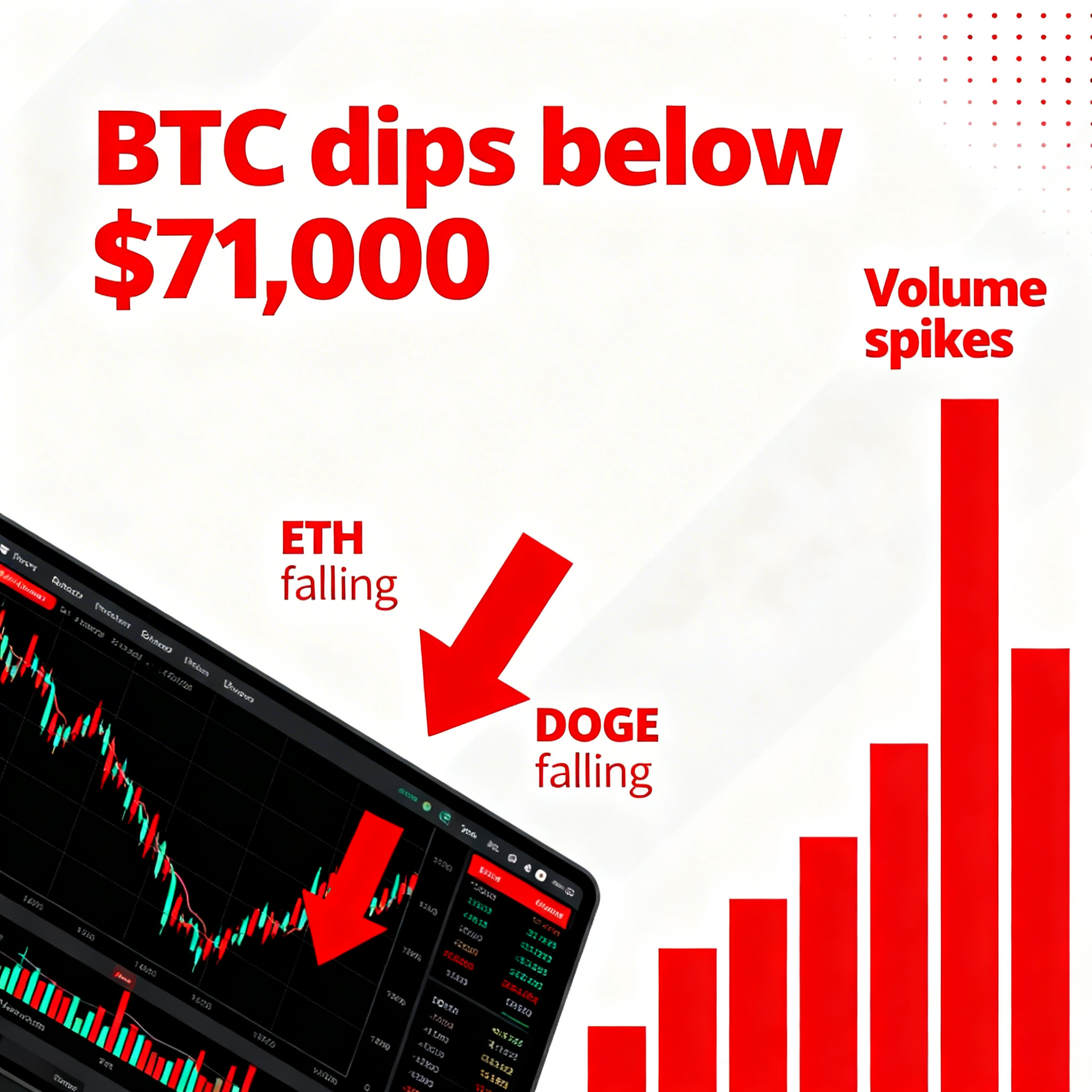
Bitcoin slid to the low $63,000 area on Tuesday as a firmer U.S. dollar and softer equities fueled broader risk aversion across global markets. A decisive break below the $60,000 threshold could open the door to cascading liquidations and a deeper correction toward $52,500 — a key historical support level from 2021.
BTC touched roughly $63,100, marking its fourth consecutive daily decline and its weakest level since the Feb. 6 dip to around $60,200, according to CoinDesk data. The move comes as U.S. stocks retreat and the dollar index (DXY) gains 0.5% since the start of Asian trading on Monday.
Bitcoin is down 2.1% since midnight UTC and off 4.7% over the past 24 hours. Market participants warn that a sustained move under $60,000 would likely trigger another wave of forced liquidations, potentially accelerating losses toward the mid-$50,000s.
Altcoins Under Pressure
The broader altcoin complex is also under strain. Bitcoin Cash fell 11.5% over the past 24 hours, while tokens such as Sui, Jupiter, and World Liberty Financial posted declines exceeding 2%.
Analysts describe the current environment as a “slow bleed,” reminiscent of prior bear market phases. Still, the average crypto relative strength index (RSI) is flashing oversold signals, suggesting the potential for a short-term bounce if buyers defend the low $60,000 region.
Derivatives Signal Ongoing De-Risking
Positioning in crypto derivatives markets reflects mounting caution:
- Total notional open interest across crypto futures dropped more than 4% to $92.5 billion, its lowest level since April 2025, indicating capital continues to exit leveraged trades.
- Roughly $360 million in positions were liquidated over the past 24 hours, with long positions accounting for more than 90% of forced closures on exchanges including BitMEX and Bitfinex.
- Despite the broader flush, global open interest in bitcoin futures rose to 690,890 BTC, the highest since Feb. 6, hinting that some traders are initiating fresh short positions.
- Funding rates for perpetual futures tied to major tokens remain negative, underscoring a bearish tilt. Perpetuals linked to TRON show funding rates as low as -35%, signaling crowded short positioning.
- Thirty-day implied volatility gauges for bitcoin and ether have climbed to two-week highs, reflecting renewed uncertainty.
- On Deribit, put options for bitcoin and ether are trading at a volatility premium of more than 10 points over calls through end-March expiries, highlighting downside hedging demand. Block trades featured BTC put spreads and straddles — strategies that either position for further downside or heightened volatility.
Token Talk: Few Bright Spots
Outside isolated outperformers, bullish catalysts remain scarce. AI-themed token Pippin has bucked the trend, rising 7.7% in the past 24 hours and doubling since the start of the year.
Meanwhile, decentralized finance metrics paint a cautious picture. Although total value locked (TVL) has not fallen as sharply as token prices, the divergence suggests investors are rotating into stablecoins rather than exiting protocols entirely.
The result has been weak performance across DeFi-related assets, with CoinDesk’s DeFi Select Index (DFX) down 34.8% year-to-date, making it the worst-performing major crypto benchmark so far in 2026.
As macro headwinds intensify and leverage unwinds, the market’s near-term trajectory hinges on whether $60,000 can hold — or whether another liquidation cascade pushes bitcoin toward its next major support zone.
Share this content: