Bitcoin at $62,870 as Middle East Tensions and Stablecoin Flight Rattle Crypto Markets
Here’s a cleaner and more concise rewrite:
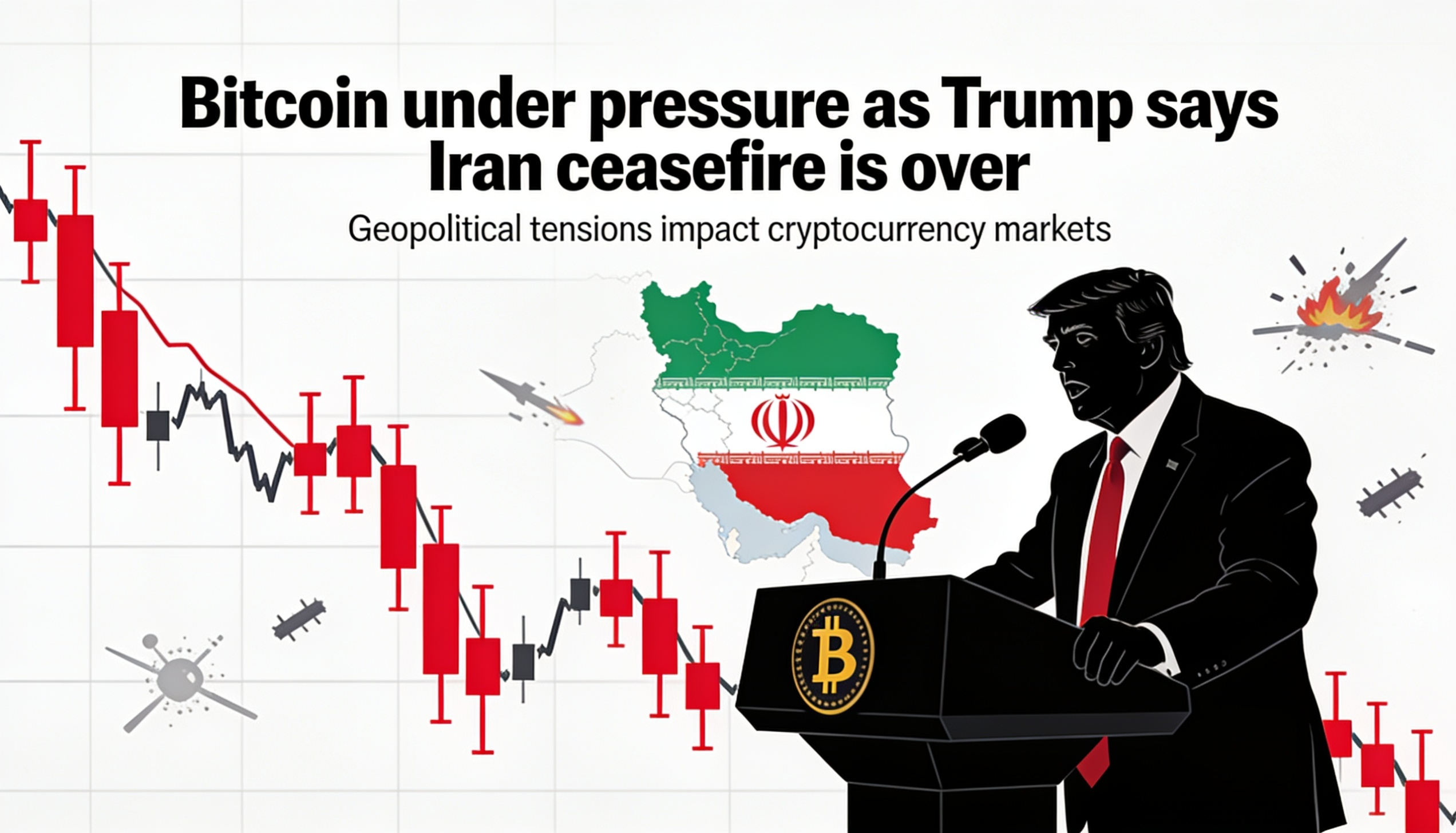
Bitcoin dropped to $62,870 on Wednesday after failing to break above the $64,000 resistance level, with fresh U.S. strikes on Iran delivering a sharp blow to already fragile risk sentiment.
A mix of geopolitical escalation, a $7.7 billion contraction in stablecoin supply, and weak ETF inflows has left the crypto market vulnerable heading into the second half of the week.
Geopolitical Tensions Trigger Sell-Off
Rising tensions between the U.S. and Iran acted as the immediate catalyst for Bitcoin’s decline. Iran’s Islamic Revolutionary Guard Corps claimed it targeted 85 U.S. military sites in Bahrain and Kuwait and reported downing a U.S. MQ-9 drone. Meanwhile, the U.S. revoked a waiver allowing Iran to export oil, pushing crude prices higher and accelerating the shift away from risk assets.
As a highly liquid, 24/7 market, Bitcoin quickly absorbed the sell pressure.
This reaction aligns with historical patterns: major geopolitical shocks tend to increase energy costs, tighten financial conditions, and push institutional investors toward safer positions.
Bitcoin had already hit a 21-month low of $57,742 on July 1 amid rate-hike concerns, leaving limited room to absorb another macro shock.
Stablecoin Drop Signals Capital Outflows
The geopolitical shock comes amid weakening liquidity conditions. Data cited by Walter Bloomberg shows the stablecoin market shrank by 2.4% in June—around $7.7 billion—bringing total supply to $312 billion. This marks the steepest monthly decline since the TerraUSD collapse in 2022.
That comparison is notable. The last time stablecoin supply fell this sharply, the market was dealing with a systemic crisis.
While the current drop reflects reduced demand rather than a collapse, the implication is similar: less capital available to support buying.
A shrinking stablecoin supply suggests funds are leaving the crypto ecosystem rather than rotating within it. The June decline coincided with a roughly 20% drop in Bitcoin, and if the trend continues, it could sustain selling pressure.
ETF Inflows Too Weak to Offset Pressure
Spot Bitcoin ETFs recorded a modest positive, with three consecutive days of inflows totaling $21.44 million. However, this is minimal compared to the heavy outflows seen in prior weeks.
Earlier, ETFs saw hundreds of millions in net withdrawals, making recent inflows insufficient to counterbalance the broader trend.
ETFs were expected to provide downside support, but their muted response amid geopolitical stress and tightening liquidity suggests institutional demand remains cautious.
If flows turn negative again, confidence in ETFs as a stabilizing force could weaken further.
Technical Outlook Remains Under Pressure
Technically, Bitcoin remains in a weak position, trading below key exponential moving averages—the 50-day at $65,577, the 100-day at $69,225, and the 200-day at $75,269.
This structure suggests any rally is likely to face resistance quickly.
The RSI sits near neutral at 48, while the MACD is still positive but fading, indicating that downward pressure has not fully cleared.
On the downside, there is little support between current levels and the July 1 low near $57,800.
A break below $62,000 could remove the final cushion and open the door for further declines. Retail sentiment has also weakened, reflecting growing caution as Bitcoin pulls back from recent highs.
Share this content: