Aviva Investors Introduces Tokenized Fund Class Through XRPL
Aviva Investors Brings Tokenized Fund Class to XRP Ledger
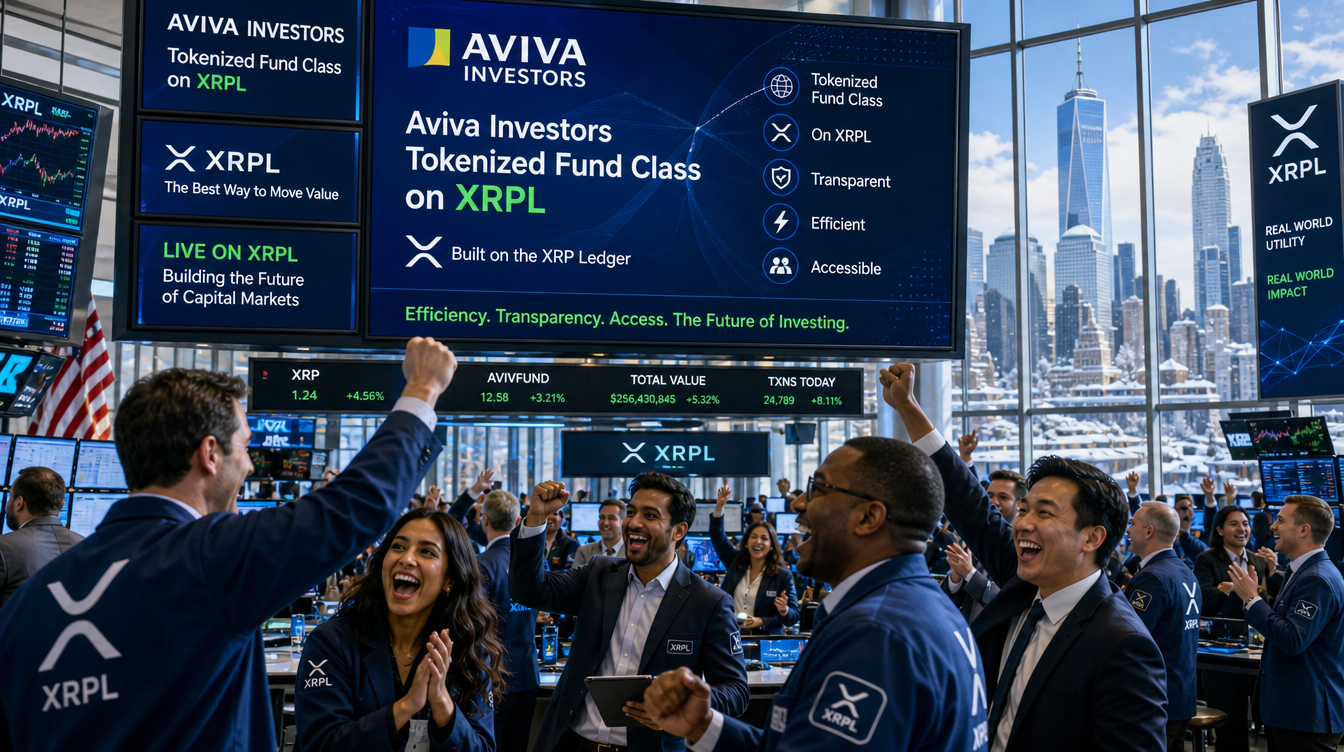
Aviva Investors has launched its first tokenized fund share class on the XRP Ledger (XRPL) in collaboration with Ripple, using regulated digital-asset custody and daily reconciliation between blockchain and traditional records.
The asset management arm of Aviva plc has issued a tokenized share class of its US Dollar Liquidity Fund on XRPL. Ripple is supporting the initiative, which has received approval from the Central Bank of Ireland, according to Ledger Insights and Structured Retail Products.
The launch follows a partnership announced by Aviva Investors and Ripple on February 11, 2026. It marks Aviva Investors’ first move into fund tokenization and represents another step in Ripple’s efforts to work with European investment managers on blockchain-based financial products.
The development comes as XRP has climbed 1.3% over the last 24 hours. Despite the modest gain, XRP remains just above its 18-month support around $1. The token is currently trading at $1.02, with daily trading volume of approximately $1.26 billion.
How the Tokenized Fund Share Class Works
According to Ledger Insights, the new share class operates within Aviva Investors’ existing US Dollar Liquidity Fund, a European UCITS money market fund. Its other share classes currently account for around $1.23 billion in assets under management.
The tokenized class has a minimum investment requirement and acts as a blockchain-based representation of the conventional fund register. The digital records correspond with entries in the traditional book-entry system, with both sets of records reconciled every day.
The tokens are not designed for unrestricted trading. Structured Retail Products reported that only eligible investors with digital wallets can participate.
Komainu is providing regulated institutional custody for the tokenized component. Bank of New York Mellon continues to safeguard the underlying fund assets, while Licuido is responsible for the tokenization infrastructure.
The fund itself continues to invest in high-quality, short-term US dollar debt. XRP is not part of the underlying portfolio, so the tokenized fund does not give investors direct exposure to XRP. XRPL is instead being used as the issuance and recordkeeping network.
Aviva Investors and Ripple’s February Agreement
The companies announced their partnership on February 11, 2026, describing the initiative as a long-term effort to introduce tokenized funds on XRPL during 2026 and in the years ahead.
Jill Barber, Chief Distribution Officer at Aviva Investors, said the collaboration could help improve fund efficiency, particularly through potential reductions in processing time and costs. She also pointed to the potential benefits tokenized funds could provide to investors.
Nigel Khakoo, Ripple’s Vice President of Trading and Markets, said tokenization was progressing from experimental applications toward production-scale use. He highlighted XRPL’s compliance features, fast settlement capabilities and native liquidity as important advantages for institutional assets.
At the time, Ripple said XRPL had processed more than 4 billion transactions since 2012. The network also had more than 7 million active wallets and was supported by 120 independent validators.
XRPL Expands Its Institutional Tokenization Role
Aviva’s launch adds to the growing use of XRPL as infrastructure for regulated token issuance and settlement rather than as a platform for direct XRP investment.
Ripple has supported infrastructure firms such as ZILO and Licuido in developing services for custody, transfer agency and trading around XRPL.
The expansion is taking place alongside increased activity in tokenized real-world assets on the network, with the value of XRPL-based tokenized RWAs reportedly surpassing $3 billion.
The decision to limit transfers and reconcile tokenized records with the traditional register each day suggests that Aviva is taking a cautious approach to fund tokenization. Broader transferability and 24/7 settlement could be introduced in later stages as regulators and financial institutions build greater experience with blockchain-based investment products.
Share this content: