BlackRock’s BITA Enters Market, Combining Bitcoin Growth Play With Income Generation at 0.65% Fee
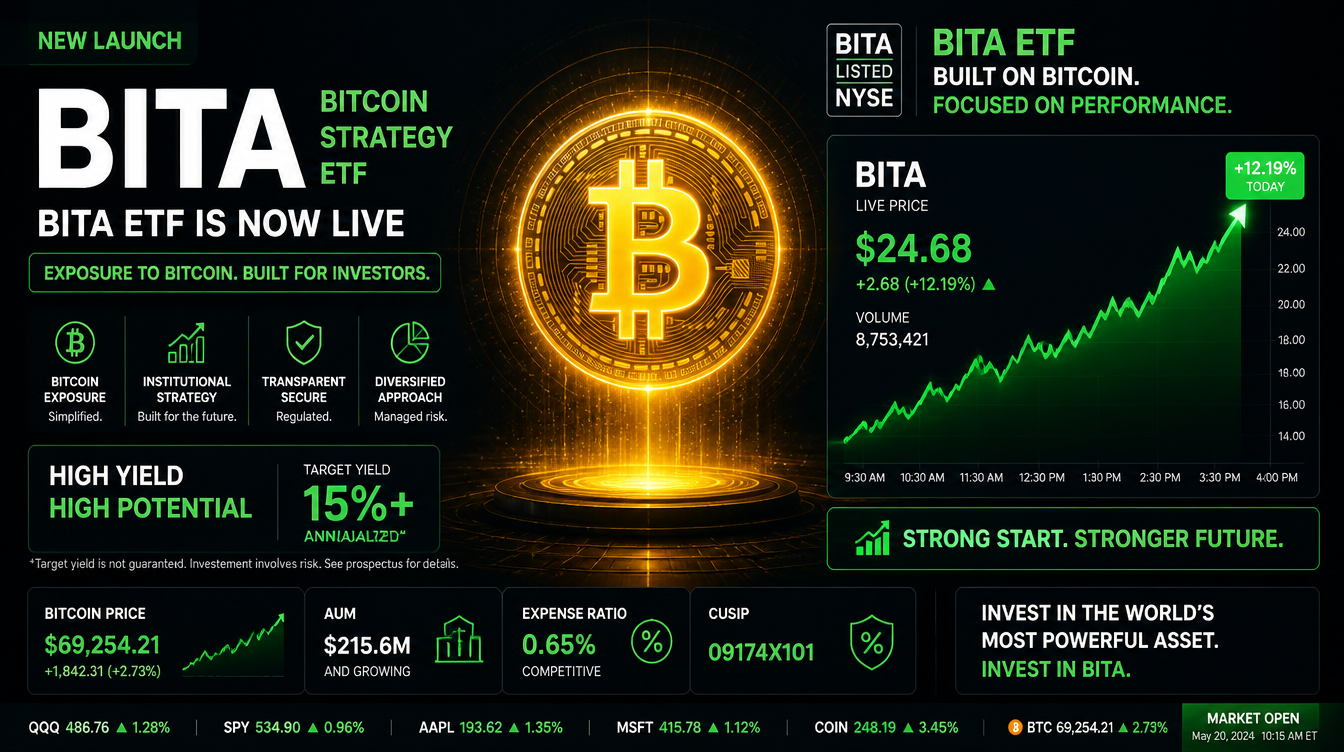
BlackRock’s iShares BITA ETF launched on Nasdaq on June 16, introducing an income-oriented Bitcoin strategy that targets 15–25% annual yield while maintaining roughly 70% participation in BTC’s upside through a partial covered-call overlay.
The iShares Bitcoin Premium Income ETF (BITA), listed on June 16, 2026, reflects a shift in crypto ETF design—from pure price-tracking vehicles to strategies engineered to generate income. By combining options writing with core Bitcoin exposure, the fund aims to balance yield with capital appreciation.
BlackRock filed its Form 8-A on June 11, bringing BITA to market nearly two weeks ahead of Goldman Sachs, which is expected to debut a similar income-focused Bitcoin ETF in early July under the SEC’s 75-day approval framework.
Rather than functioning as a standard spot Bitcoin wrapper, BITA represents a second-wave product—focused on shaping return profiles and monetizing volatility rather than simply offering access to BTC.
The ETF launched with Bitcoin trading around $62,400, down roughly 2.5% on the day, heading into the weekend—a period that often sees elevated volatility in crypto markets.
Strategy Breakdown: BITA’s Covered-Call Approach
BITA constructs its exposure using a combination of directly held Bitcoin, custodied at Coinbase, and shares of BlackRock’s iShares Bitcoin Trust (IBIT), which has grown to approximately $48–50 billion in assets since its January 2024 launch.
According to its SEC S-1 filing, the fund seeks to track Bitcoin’s price while enhancing returns by selling call options, primarily on its IBIT position.
The approach is partially covered, with options written on roughly 25–35% of total exposure. This structure allows BITA to retain significant upside potential, unlike fully covered-call strategies that cap gains more aggressively.
The income generated by the fund is largely driven by Bitcoin’s high implied volatility. BlackRock frames the strategy as a way to convert that volatility into a steady income stream, leveraging traditional options pricing dynamics where higher volatility leads to higher premiums.
The sustainability of this yield will depend on how Bitcoin’s volatility behaves across varying macro conditions, including changes in interest rates and broader market stress.
BITA’s 0.65% expense ratio is a key competitive differentiator. Competing products such as NEOS’s BTCI and Roundhill’s YBTC are priced closer to 0.99%, with Grayscale’s offering also in a similar range. By offering lower fees and utilizing IBIT’s liquidity for its options strategy, BlackRock gains an advantage over peers—especially those relying on futures-based exposure.
Goldman Sachs’ upcoming ETF will take a different route. It is expected to gain Bitcoin exposure indirectly through other ETFs and associated options, potentially via an offshore structure. Its strategy is more aggressive, with call options written on 40–100% of exposure.
While that model may generate higher income in range-bound markets, it would significantly limit upside participation during strong Bitcoin rallies compared to BITA’s more balanced approach. Goldman’s final fee structure will be a key indicator of its competitive stance.
The broader takeaway is clear: competition in Bitcoin income ETFs is intensifying. The real battleground is not just yield, but which issuer captures early adoption across institutional portfolios, advisory platforms, and model allocations as the space evolves.
Share this content: