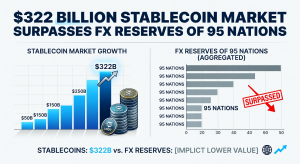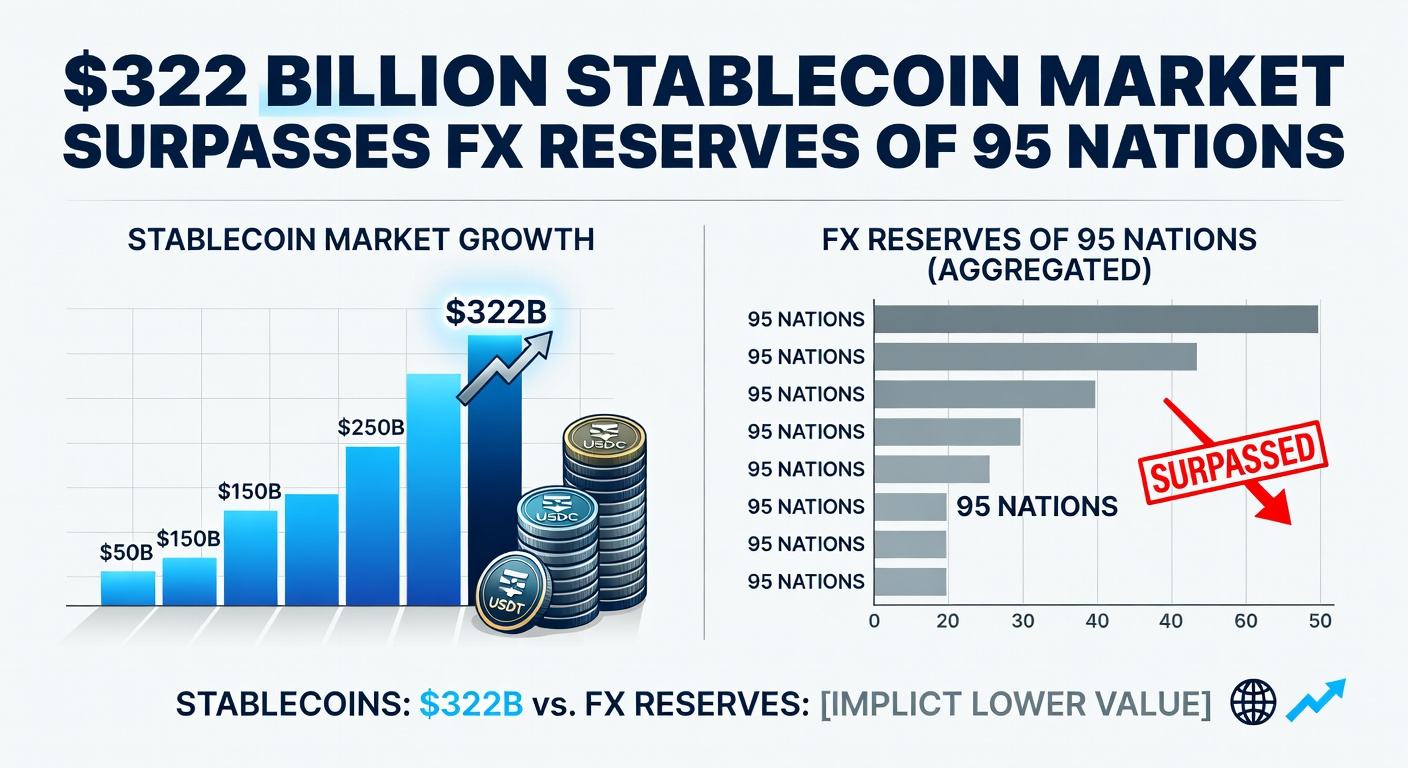
Stablecoins, now worth $322 billion, have outgrown the foreign reserves of 95 nations
Stablecoins have reached a new milestone, with their total market value now eclipsing the foreign exchange reserves of most countries.
The sector’s combined capitalization has surged to $322 billion, putting it ahead of the FX reserves held by 95 nations. This includes both emerging markets like Poland, Thailand, and Mexico, as well as developed economies such as the United Kingdom, Canada, and the United Arab Emirates.
The development reflects a broader shift in how fiat-linked liquidity is held and moved globally. Increasingly, dollar-denominated value is being stored outside traditional banking systems and instead circulating on blockchain networks in the form of tokenized assets.
Stablecoins are digital tokens pegged to fiat currencies, typically maintaining a 1:1 value with the U.S. dollar, though versions tied to other currencies also exist. Growth in the sector has been driven largely by dollar-backed tokens like Tether (USDT) and USD Coin (USDC), which dominate trading activity and liquidity across crypto markets.
In contrast, foreign exchange reserves—held by central banks in currencies and gold—serve as a key financial buffer, used to stabilize currencies, manage external liabilities, and fund imports. Despite the rapid rise of stablecoins, only a handful of countries, including China, Japan, Russia, India, Taiwan, and Germany, hold reserves exceeding the size of the entire stablecoin market.
Stablecoins are now deeply embedded in the digital asset ecosystem, widely used for trading, settlement in decentralized finance, and increasingly for cross-border payments due to their speed and cost efficiency compared to traditional banking systems.
According to the Bank for International Settlements, cross-border stablecoin usage has expanded rapidly, particularly in regions where conventional financial infrastructure is slow or expensive. The trend is most visible in economies dealing with high inflation or volatile exchange rates.
However, the rise of stablecoins also introduces new risks. Their ease of transfer can accelerate capital outflows, particularly in countries with weaker external balances.
The BIS notes that increased stablecoin activity is often associated with pressure on domestic currencies, disruptions in exchange rate dynamics, and widening gaps between official and market exchange rates. These patterns suggest stablecoins may enable users to bypass capital controls, facilitating the movement of funds into dollar-based assets with minimal friction.
As adoption continues to grow, stablecoins are playing an increasingly influential role in global finance—offering efficiency and accessibility while raising new challenges for policymakers and financial stability.
Share this content: