
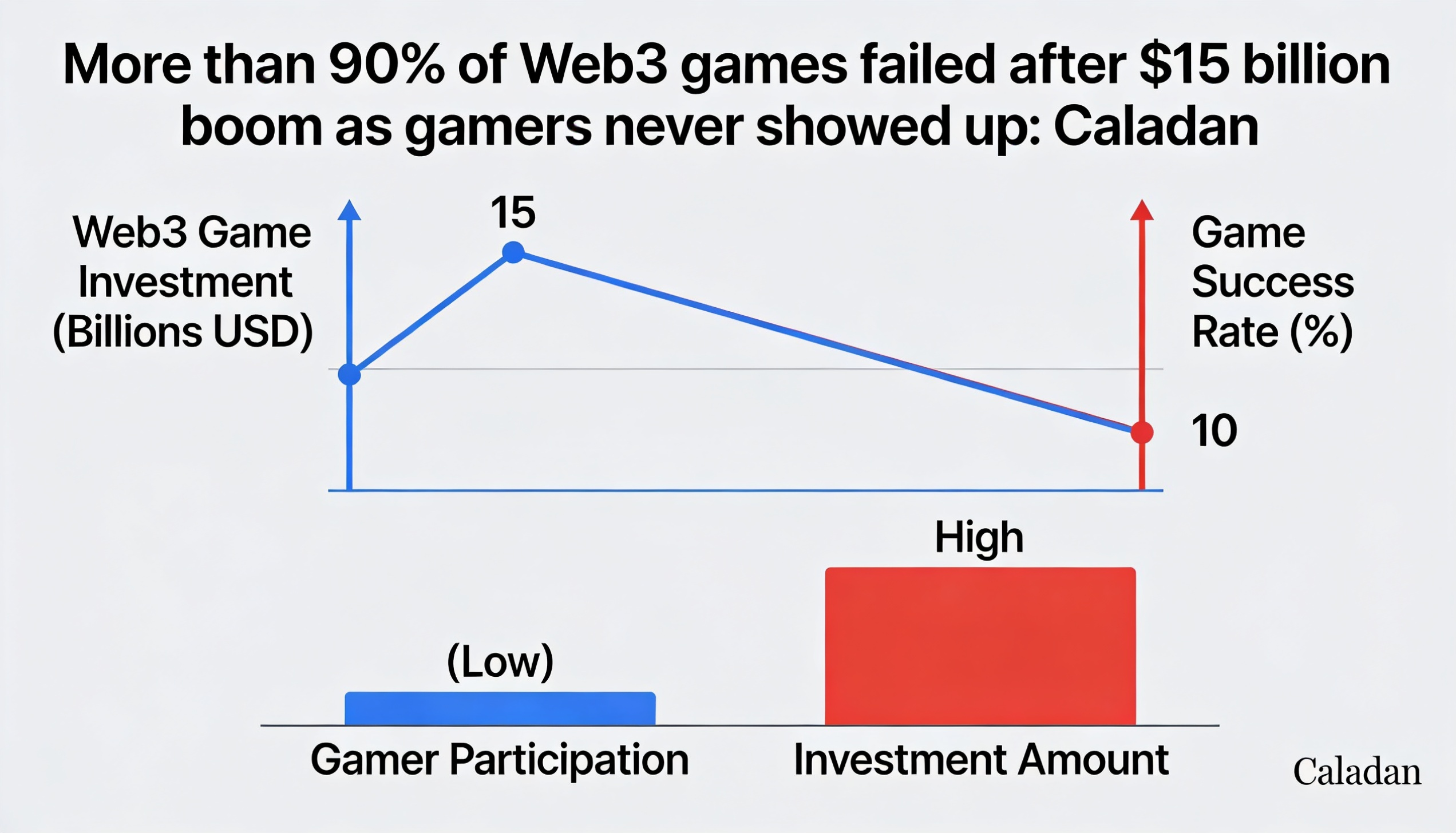
Web3 gaming, once the dominant narrative in crypto venture investing, has unraveled after a multibillion-dollar boom failed to translate into lasting player demand.
At its peak in 2022, gaming جذب roughly 63% of all Web3 venture funding. By 2025, that share had collapsed to single digits as capital rotated into artificial intelligence, real-world asset tokenization, and layer-2 infrastructure—areas seen as offering clearer paths to adoption and product-market fit.
According to data from Caladan, a market-making and trading firm, the sector burned through as much as $15 billion pursuing a token-driven vision that gamers largely rejected. Roughly 93% of GameFi projects are now effectively defunct, with token prices down about 95% from their 2022 highs and funding to studios plunging 93% by 2025.
The boom was fueled by heavy investment in tokens and NFTs before viable games were built. As capital shifted elsewhere, more than 300 blockchain-based titles shut down, leaving behind what many now view as a cautionary tale of speculation overtaking fundamentals.
“Capital was destroyed at every layer simultaneously,” the report noted, citing losses across venture firms, retail NFT buyers, gaming guilds, and even Telegram-based tap-to-earn ecosystems. Hamster Kombat, one of the most prominent examples, lost 96% of its users within six months, while YGG—the flagship gaming guild token—trades 99.6% below its 2021 peak.
Several high-profile projects underscore the scale of the collapse. Pixelmon raised $70 million through an NFT sale in 2022 but has yet to release a public game. Ember Sword spent $18 million over seven years in development before shutting down without refunds. Gala Games is facing legal challenges tied to allegations that a co-founder diverted $130 million in tokens, while Square Enix quietly wound down its Symbiogenesis initiative.
The data suggests the problem went beyond execution or market cycles. Instead, it reflects a deeper mismatch between a model built on financial incentives and an audience primarily seeking entertainment.
At the center of the trend was GameFi’s play-to-earn model, which turned gameplay into a financial loop. Players bought tokens or NFTs, earned rewards in those same assets, and profited as long as new users entered the system. Once inflows slowed, the model unraveled—token prices fell, rewards diminished, and users exited, collapsing in-game economies.
Axie Infinity, once the sector’s flagship, illustrates the decline. Daily active users have dropped from around 2.7 million at its peak to roughly 5,500 today, according to DappRadar.
Even during the height of the boom, adoption lagged. A Coda Labs survey cited by Caladan found that only 12% of gamers had ever tried a crypto-based game, highlighting a persistent gap between investor enthusiasm and user interest.
Capital allocation further compounded the issue. Many studios raised tens or hundreds of millions of dollars before delivering playable products, reducing the urgency to build engaging experiences that could retain users.
The shift in funding priorities is telling. While gaming dominated Web3 investment in 2022, by 2025 capital had flowed into AI, real-world assets, and infrastructure. Even Animoca Brands, one of the sector’s most active backers, has reduced its gaming exposure to about a quarter of its portfolio while pivoting toward stablecoins, RWAs, and AI.
Long development cycles also clashed with the fast-moving nature of crypto markets. Projects often took three to five years to build, while their associated tokens traded continuously, requiring sustained momentum. By launch, many tokens had already lost most of their value.
The result is a sector that expanded rapidly on speculative demand and contracted just as quickly once that demand faded. With hundreds of projects shuttered and investment shifting toward infrastructure, Web3 gaming now stands as a stark example of what happens when financial engineering outpaces product-market fit.
Share this content: