
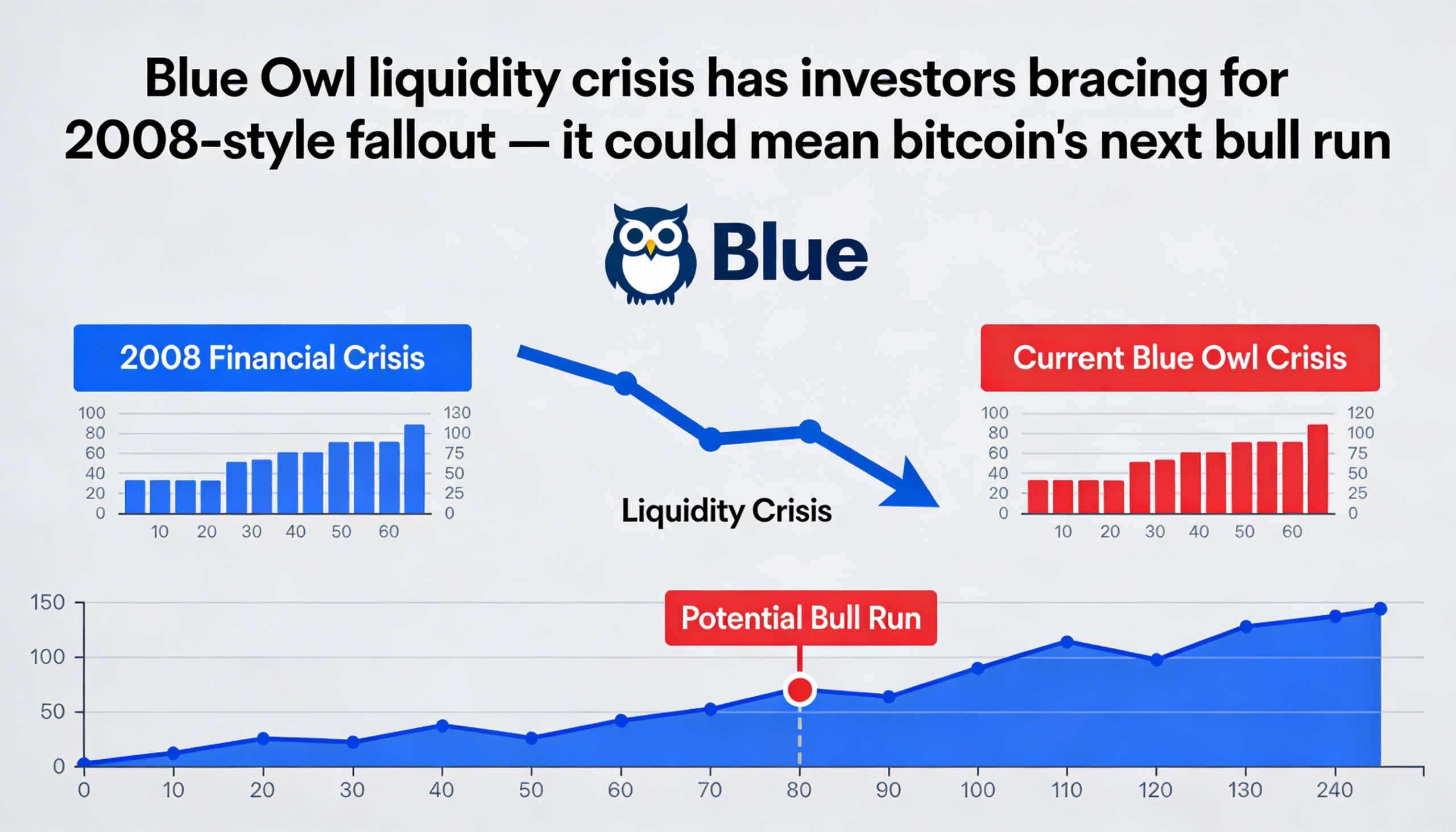
Shares of private-equity firm Blue Owl Capital (OWL) slumped nearly 15% this week after the company moved to liquidate $1.4 billion in loans to meet redemption requests from investors in one of its retail-focused private credit funds.
The decision has rattled markets, with some analysts drawing comparisons to the early tremors of the 2008 financial crisis. For holders of Bitcoin, the potential implications are significant.
Echoes of 2007?
Blue Owl said it would sell $1.4 billion in loans to raise liquidity for exiting investors — a step that revived memories of the summer of 2007, when two Bear Stearns hedge funds collapsed under the weight of subprime mortgage exposure. Around the same time, BNP Paribas froze withdrawals in several funds, citing difficulties valuing U.S. mortgage assets. What initially appeared contained soon spiraled into a global credit freeze and ultimately the 2008 financial crisis.
This week’s stress has so far been largely isolated. Major stock indices avoided significant damage, though Blue Owl shares are now down more than 50% year-over-year. Other alternative asset managers — including Blackstone, Apollo Global Management and Ares Management — also posted notable declines.
Former Pimco chief Mohamed El-Erian questioned whether the situation represents a “canary in the coal mine” moment reminiscent of August 2007, while cautioning that the scale of risk does not yet appear comparable to the global financial crisis. He also pointed to broader excesses in artificial intelligence-linked markets as an additional vulnerability.
What would it mean for bitcoin?
If strains in private credit deepen, the short-term impact may not favor bitcoin or other risk assets. Tighter credit conditions historically pressure speculative markets. While bitcoin did not exist during the 2008 meltdown, the early phase of the COVID-19 crisis offers a useful parallel: from mid-February to mid-March 2020, BTC plunged roughly 70% as liquidity evaporated across global markets.
However, central bank responses can alter the trajectory dramatically. In 2020, massive stimulus from the Federal Reserve helped propel bitcoin from below $4,000 to above $65,000 within a year.
The 2007–2008 sequence followed a similar arc — credit stress, equity market complacency, contagion in financial institutions, then sweeping central bank intervention. If Blue Owl’s challenges prove to be the first domino, as some market veterans have suggested, private credit could replace subprime mortgages as the trigger for broader instability.
Bitcoin’s origins in crisis
The global financial crisis also gave birth to bitcoin itself. Created by the pseudonymous Satoshi Nakamoto, the cryptocurrency emerged amid frustration with government bailouts and central bank money creation.
Bitcoin’s Genesis Block, mined on Jan. 3, 2009, famously embedded a headline from The Times of London: “Chancellor on brink of second bailout for banks,” referencing the U.K. government’s rescue efforts during the crisis.
Initially obscure and virtually worthless, bitcoin has since grown into a trillion-dollar asset class embraced by major institutions. What began as an anti-establishment alternative to traditional finance has increasingly become integrated into it — with exchange-traded funds offering exposure to mainstream investors and corporations adding BTC to their balance sheets.
A new chapter?
Whether Blue Owl’s liquidity move proves to be an isolated event or the start of a broader credit unwind remains uncertain. If the episode evolves into a systemic shock prompting aggressive monetary intervention, bitcoin could once again benefit from the liquidity wave — though likely not before enduring volatility along the way.
If El-Erian’s “canary” metaphor proves prescient, markets may be at the early stages of a larger repricing. And in that scenario, bitcoin — in its modern, institutionalized form — could once again find itself at the center of the conversation.
Share this content: