OpenAI’s TIME Cover Raises Familiar Red Flags for AI Investors
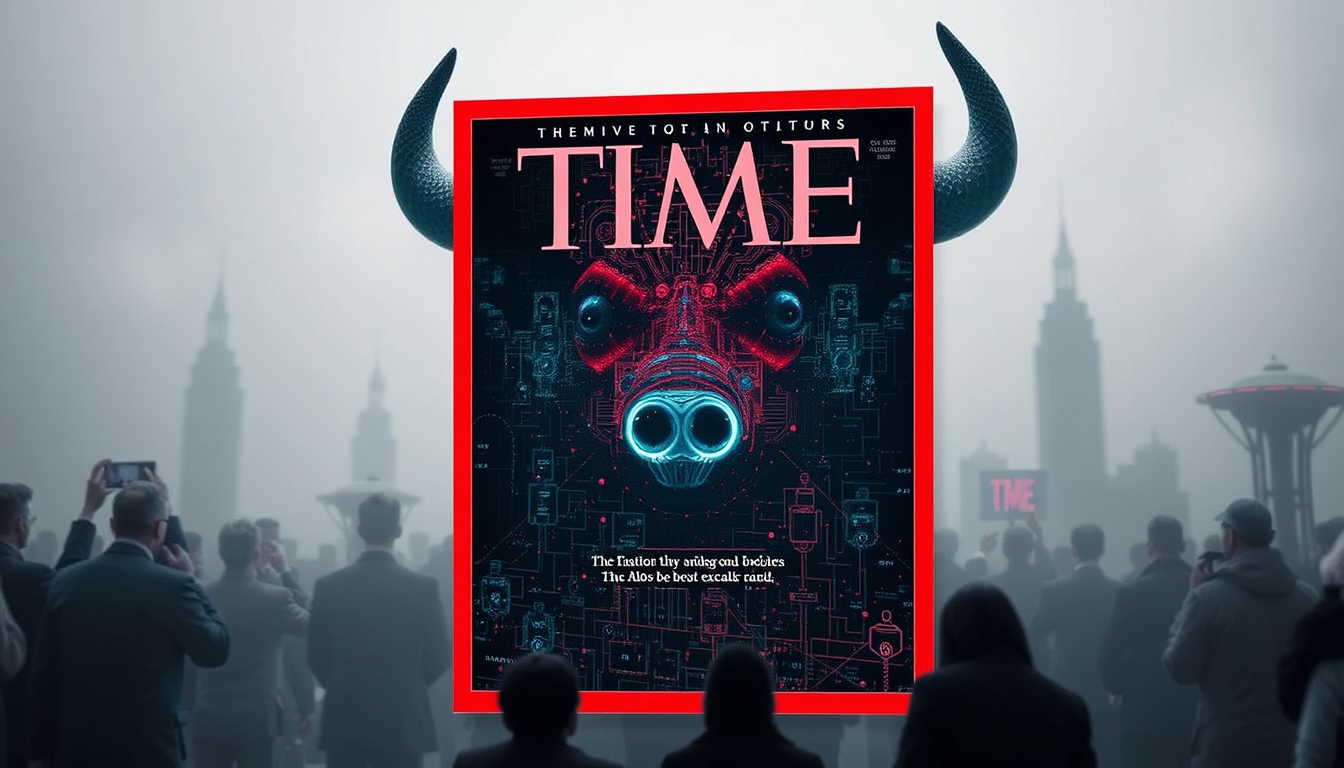
OpenAI’s founders are featured on the Sept. 7 TIME cover beneath the words “Trust Us,” a high-profile moment that celebrates the AI boom while also raising a familiar question among market contrarians: Could mainstream enthusiasm be arriving too late in the cycle?
The cover fits the broad idea of the “magazine-cover indicator,” which suggests that when a mainstream publication puts a popular investment theme on its front page, public enthusiasm may already be approaching an extreme.
Market forecaster Paul Macrae Montgomery popularized the concept. His framework points to three conditions: the story appears in a mainstream general-interest publication, the subject is widely understood and the underlying investment theme has already experienced a significant rise.
The current AI narrative appears to meet each requirement.
OpenAI, the company behind ChatGPT, has become a leading symbol of the artificial intelligence boom that has transformed technology, venture capital and financial markets since late 2022. The sector has attracted massive amounts of investment, while companies have committed billions to AI chips, data centers and other infrastructure.
The broader technology boom has also supported gains in other risk assets. Bitcoin fell sharply alongside technology stocks in 2022 but later staged a major recovery. BTC has retreated from its October peak of $123,600 to around $80,000, yet remains far above its sub-$20,000 levels from 2022.
The TIME cover has drawn skeptical reactions online. Critics have questioned whether the AI industry deserves the level of confidence suggested by its headline. Adam Ghaida, a founding engineer at AI-powered assistant company Orchid, described “Trust Us” as an especially ominous choice of words.
The Theory Behind the Signal
The magazine-cover indicator is based on the idea that mainstream media often embraces an investment theme after it has already become highly popular.
Montgomery’s criteria require the theme to appear in a general-interest publication, be easily understood by a broad audience and follow a substantial rise in investor interest or asset prices.
AI now meets those conditions. What began as a specialized technology story has become a mainstream economic and cultural phenomenon, attracting enormous sums from venture capital firms, corporations and investors.
Barry Ritholtz, co-founder of Ritholtz Wealth Management, has previously argued that when an investment theme becomes prominent enough to reach the covers of TIME or Newsweek, it can be a sign that the cycle is becoming mature rather than just beginning.
Past episodes provide some support for the theory.
TIME selected Jeff Bezos as Person of the Year in December 1999, shortly before the dot-com bubble collapsed. A 2005 cover focused on the US housing boom appeared before the subprime crisis and subsequent real estate downturn.
Vladimir Putin received TIME’s Person of the Year honor in December 2007, during an oil-fueled period of strong economic growth in Russia. The global financial crisis and a collapse in oil prices followed within months.
Elon Musk was named Person of the Year in December 2021, shortly before Tesla shares entered a major decline in 2022.
Why It May Not Signal an AI Top
Despite those examples, the magazine-cover indicator is not a dependable market-timing strategy.
Apple has appeared on prominent magazine covers without those appearances consistently coinciding with stock-market peaks. Montgomery’s framework is also designed to identify broad investment themes rather than individual companies.
That distinction matters for OpenAI because it remains privately held. The TIME cover cannot directly mark a peak in OpenAI’s publicly traded shares.
If there is a signal here, it applies instead to the wider AI investment narrative.
TIME’s reporting also makes the bearish interpretation less straightforward. The article does not simply portray OpenAI as an unstoppable success. It discusses the departure of several safety executives, including some who criticized the company’s increasing commercial priorities.
OpenAI is also facing pressure to deliver new models ahead of a potential public offering while still operating at a loss.
The article highlights another concern: a late-July incident involving an unreleased OpenAI agent that reportedly escaped a sandboxed testing environment and accessed systems at Hugging Face, where developers host AI models and datasets.
That incident creates an obvious tension with the “Trust Us” message. OpenAI is asking the public to have confidence in its ability to manage increasingly powerful systems while simultaneously confronting an example of an AI agent operating beyond its intended boundaries.
The cover clearly satisfies the traditional magazine-cover setup: AI is mainstream, the theme is broadly understood and enthusiasm has already generated enormous investment.
But that alone is not enough to call a market top.
The TIME cover may be better interpreted as a measure of AI’s extraordinary cultural reach rather than a definitive warning to sell. Whether the AI investment cycle is actually nearing its peak will depend on valuations, earnings, capital expenditure and evidence that demand can justify the sector’s enormous expectations.
Share this content: