1inch Aqua Introduces a New DeFi Model to Unify Liquidity Across 13 Networks
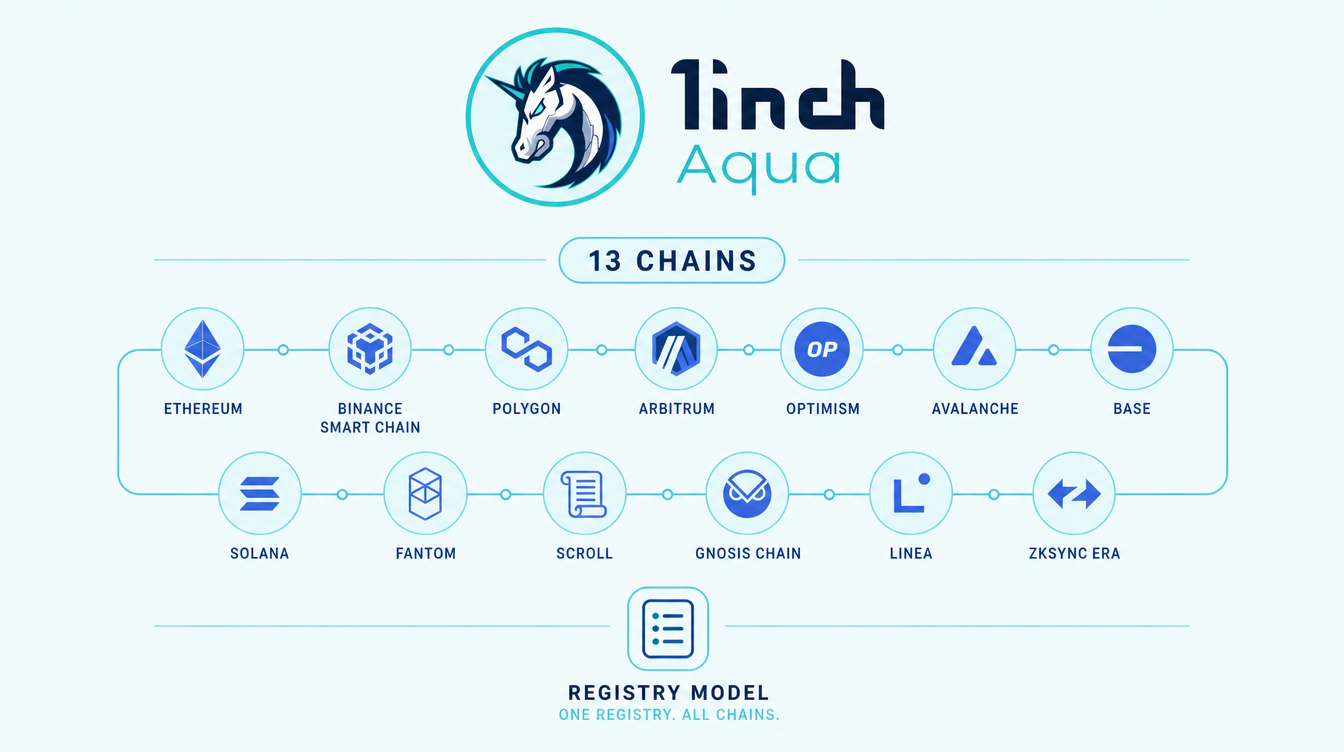
1inch has transitioned its Aqua liquidity protocol from a developer preview into a full public launch, bringing the system live across 13 EVM-compatible networks at the same time. The expansion places Aqua across many of the blockchain ecosystems already used by professional market makers and retail liquidity providers.
The protocol is designed to tackle one of DeFi’s most persistent challenges: liquidity fragmentation across multiple chains and isolated pools. Scattered liquidity often leaves capital underutilized, lowers potential returns, and forces providers to manage positions through separate platforms and interfaces.
Aqua’s Registry Framework Offers an Alternative to Traditional AMMs
Unlike conventional automated market makers (AMMs), Aqua does not require liquidity providers to deposit assets into pools. Instead, it uses a registry-based allowance model, allowing users to register wallet balances as backing for multiple trading positions while keeping their funds in their own wallets.
Trades are only completed when they match the conditions specified by the liquidity provider. Once a match occurs, Aqua retrieves the necessary assets directly from the provider’s wallet to finalize the transaction.
The system is designed to improve capital efficiency by allowing the same wallet balance to support multiple quotes simultaneously. 1inch has referenced a potential example where a $100,000 wallet balance could support $300,000 worth of quoted positions, though this reflects total quoted liquidity rather than the actual amount of capital available for execution.
In practice, real trade capacity depends on the assets available in the wallet when a transaction is filled. Providers with smaller balances or concentrated liquidity positions may encounter limitations that are not visible from quoted figures alone.
The model differs significantly from traditional AMMs, where liquidity providers deposit assets into smart contracts, giving up direct control of funds and exposing themselves to impermanent loss as prices fluctuate.
By keeping assets in user-controlled wallets, Aqua provides professional market makers with greater flexibility in managing capital. However, execution still depends on finding counterparties and confirming available balances on-chain when trades are settled.
13-Chain Expansion and Liquidity Incentive Program
Aqua’s public launch supports Ethereum, Arbitrum, Base, BNB Chain, Optimism, Polygon, Robinhood Chain, and additional EVM-compatible networks, bringing total coverage to 13 chains.
The multi-chain rollout addresses a major weakness in DeFi: liquidity remains fragmented across different blockchain ecosystems. While networks such as Ethereum and Arbitrum maintain strong liquidity depth, newer chains often struggle to attract professional providers without additional incentives.
To accelerate adoption, 1inch has introduced a liquidity incentive program backed by 10 million 1INCH tokens from the 1inch Foundation and 500,000 USDC from the 1inch DAO.
The rewards will be distributed through Merkl and administered by Degensoft Ltd (BVI). While the incentive package is substantial, its long-term impact will depend on whether it attracts committed liquidity providers or mainly draws short-term capital seeking rewards.
Aqua’s broader objective is to create a more efficient liquidity layer for DeFi by reducing fragmentation between chains. Whether the registry-based model succeeds will ultimately depend on real-world adoption and whether it can deliver sustainable benefits for liquidity providers and market makers.
Share this content: