Ripple Share Sale Moves Ahead After Court Approval, Galaxy Digital Leads Investment
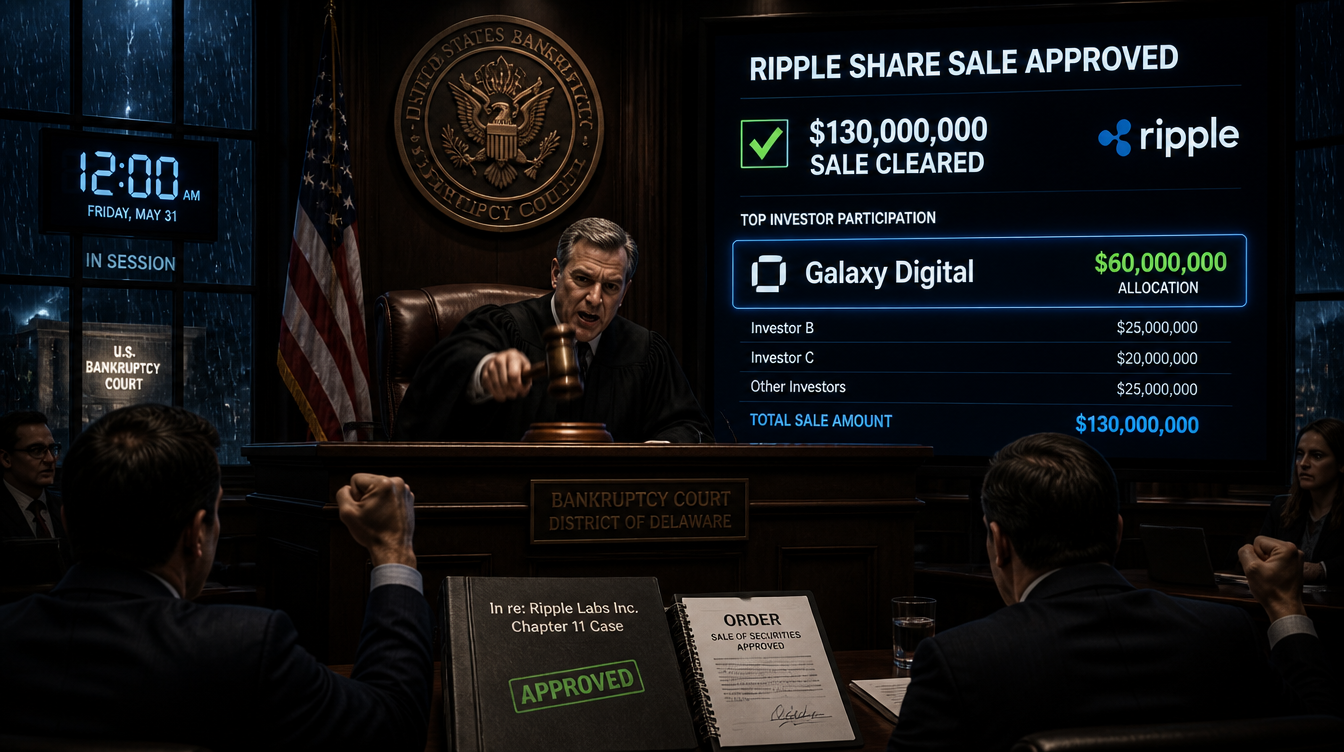
A U.S. Bankruptcy Court has approved Linqto’s $130 million sale of Ripple equity, with Galaxy Digital anchoring the deal through a $60 million purchase, as proceeds are set to fund customer recoveries.
The transaction covers the sale of approximately $130 million in Ripple Labs common shares to four institutional investors. Galaxy Digital leads with $60 million, followed by Arrington Capital at $50 million, the Private Shares Fund at $16 million, and GAM Alternatives Lux at $4 million. The funds will be directed into a Chapter 11 wind-down trust established to compensate customers.
Rather than a routine distressed sale, the deal highlights continued institutional demand for Ripple’s private-market equity across a range of valuations, even as Linqto’s bankruptcy estate winds down a platform that once provided retail investors access to pre-IPO shares.
The development coincided with XRP rising nearly 4% overnight to $1.13, breaking above the $1.10 resistance level. Daily trading volume also increased, reaching around $1.29 billion.
Ripple Equity Sale: Allocation, Pricing, and ROFR
The four transactions were executed at different per-share prices. Galaxy Digital secured the largest allocation at $60 million, while Arrington Capital committed $50 million. The Private Shares Fund and GAM Alternatives Lux acquired smaller stakes valued at $16 million and $4 million, respectively.
Galaxy’s block represents the largest portion in both share count and total proceeds, according to summaries of the asset purchase agreements. Ripple waived its right of first refusal (ROFR) on Galaxy’s portion, allowing the deal to proceed without co-sale requirements.
Galaxy appears to have entered at a discount compared to the other buyers, reflecting the size of its allocation and the nature of distressed secondary-market transactions. This approach aligns with its history of accumulating Ripple exposure during periods of market dislocation.
This is strictly a secondary equity sale. It does not signal an IPO and has no direct impact on XRP holders or the token’s economics. Ripple’s investor materials from November 2025 also indicated that such transactions do not affect XRP.
Linqto Bankruptcy: Background and Forge Dispute
Linqto ceased operations in March 2025 and filed for Chapter 11 bankruptcy in July 2025 after new management identified potential securities law violations dating back to 2020. These issues were tied to the use of special-purpose vehicles that pooled customer investments.
The bankruptcy estate includes stakes in roughly 111 private companies with a combined valuation exceeding $500 million. On February 6, 2026, the court approved Linqto’s restructuring plan, which received about 95% customer support. The plan offers recovery through a liquidating trust, a publicly listed closed-end fund holding private shares, or a combination of both.
However, the recovery process now faces a fresh complication. According to Bloomberg Law, Linqto and its Official Committee of Unsecured Creditors have sued Forge Global Holdings after the firm attempted to withdraw as trustee just five days before the planned July 20 launch.
Forge cited directives from its parent company, Charles Schwab, as the reason for stepping back. It had been expected to safeguard customer assets, manage share transfers, and oversee the recovery process.
The court is being asked to compel Forge to honor its agreement. While the dispute could delay asset transfers and increase legal costs, it does not affect the validity of the Ripple share sale or XRP’s value. For Linqto users, the main concern is timing rather than asset integrity.
Institutional Takeaways: What the Pricing Spread Shows
The structure of the sale—across four institutional buyers—underscores Galaxy Digital’s leading role with its $60 million commitment. The discount on its purchase likely reflects the size of the block and the dynamics of a distressed secondary transaction, rather than a weaker view on Ripple’s valuation.
Sustained institutional demand at these price levels, alongside Ripple’s goal of reaching a $1 billion revenue run rate by 2026, suggests that its private-market valuation floor remains intact even under bankruptcy-driven selling pressure.
This transaction is likely the first of several. As the wind-down trust continues to monetize its broader portfolio of 111 companies, more large institutional sales are expected to follow.
Share this content: